Hubbry Logo
GrommetGrommetMain
Open search
Grommet
Community hub
Grommet
logo
8 pages, 0 posts
0 subscribers
Be the first to start a discussion here.
Grommet
Grommet
from Wikipedia
Curtain grommets, used among others in shower curtains

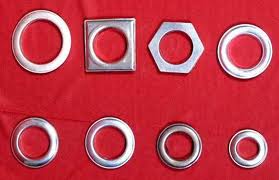
A grommet is a ring or edge strip inserted into a hole through thin material, typically a sheet of textile fabric, sheet metal or composite of carbon fiber, wood or honeycomb. Grommets are generally flared or collared on each side to keep them in place, and are often made of metal, plastic, or rubber. They may be used to prevent tearing or abrasion of the pierced material or protection from abrasion of the insulation on the wire, cable, line being routed through the penetration, and to cover sharp edges of the piercing, or all of the above.

A small grommet may also be called an eyelet, used for example on shoes, tarps and sails for lacing purposes.[1]

Grommets in electrical applications are referred to as "insulating bushings". Most common are molded rubber bushings that are inserted into hole diameters up to 2″ (51 mm). There are many hole configurations from standard round to assorted U-shapes. Larger penetrations that are irregular in shape as well as long straight edges are often fitted with extruded or stamped strips of continuous length, referred to as "grommet edging". This type of protective bushing is quite common in applications that range from telecom switches and data center cabinets to complex and dense wire/cable and even hydraulic tubing in aircraft, transportation vehicles and medical equipment.

As reinforcement or crafting

[edit]
Metal eyelets and an eyelet setting tool
Seaman's chest with grommets fashioned for use as handles

Grommets are typically used to reinforce holes in leather, cloth, shoes, canvas and other fabrics.[2] They can be made of metal, rubber, or plastic, and are easily used in common projects, requiring only the grommet itself and a means of setting it. A simple punch, a metal rod with a convex tip, is often sold with the grommets. It can be struck with a hammer to set the grommet.[2] It can alternatively be set with an electronic, pneumatic, or gas-powered machine. There are also dedicated grommet presses with punch and anvil, as shown in the picture, ranging from inexpensive to better-quality tools, which are somewhat faster to use.

Typical applications are footwear for boot and shoe laces, in laced clothing such as corsets, in flags for hoisting,[3] and in curtains and other household items that require hanging from hooks, as when they are used in conjunction with tensioner rods for shower curtains.[4] The grommet prevents the cord from tearing through the hole, thereby providing structural integrity. Small grommets are also called eyelets, especially when used in clothing or crafting. Eyelets may be used purely decoratively for crafting. When used in sailing and various other applications, they are called cringles. Sometimes field workers refer to them as grunyons[citation needed].

Maritime use

[edit]

Traditionally, rope grommets have been widely used on sailing ships in a variety of ways. They have been utilized as chest handles or on row boats as a soft oar lock. They are a rope ring that is made by first disassembling the rope then re-weaving the strands to the desired size.[5]

Use in electrical equipment

[edit]

For cable protection

[edit]
Cable grommets

Holes in metal or another hard material will often have sharp edges.[6] Electrical wires, cord, rope, lacings, or other soft vulnerable material passing through the hole can become abraded or cut, or electrical insulation may break due to repeated flexing at the exit point of the casing of a junction box for example.[6] Rubber, plastic or plastic coated metal grommets are used to avoid this. Tight fitting rubber grommets can also prevent the entry of dirt, air, water, etc.[6] The smooth and sometimes soft inner surface of the grommet shields the wire from damage.[6]

Grommets are generally used whenever wires pass through punched or drilled sheet metal or plastic casings for this reason.[6] Molded and continuous strip grommets, also known as edge grommets, are manufactured in a wide variety of sizes and lengths expressly for this purpose; they are usually a single piece which can be inserted by hand. Two-piece hard plastic devices are available which also grip the wire that passes through. These are called strain relief bushings and are often used to insulate, anchor, and protect power cords where they enter panels. Preventing a tug or twist on the wire from stressing the electrical connections inside the connected equipment. Sleeved grommets have a flexible extension (sleeve), usually tapered or moulded to flex increasingly towards the free end in order to reduce fracturing of electrical insulation.

To minimize vibration

[edit]

Grommets made of rubber or other elastic material are also used to minimize the transmission of vibration. They were widely used for mounting shock-sensitive computer disk drives, particularly in equipment subject to vibration or jarring, but are not usually used with more robust modern drives. The screws that hold the drive in place pass through grommets that decouple it acoustically from the chassis. Grommets are used in a similar way to acoustically isolate electronic circuit components that are susceptible to microphonism caused by mechanical vibration or jarring.

Surgical grommets

[edit]
Tympanostomy tube

In chronic cases of otitis media with effusions present for months, surgery is sometimes performed to insert a grommet, called a "tympanostomy tube" into the eardrum to allow air to pass through into the middle ear, and thus release any pressure buildup and help clear excess fluid within.

This is also a correcting measure for a patulous Eustachian tube (when air moves to and from the middle ear with each breath making the eardrum flap).

[edit]

See also

[edit]

References

[edit]
[edit]
Revisions and contributorsEdit on WikipediaRead on Wikipedia
from Grokipedia
A grommet is a ring-shaped , typically made of metal, , or rubber, that is inserted into a in thin materials such as fabric, , or composites to reinforce the edge, prevent fraying, and provide a smooth passage for elements like wires, ropes, or laces. Grommets are available in various types to suit different applications, including solid grommets for permanent reinforcement, split or open-barrel designs that allow easy insertion without tools, and flanged variants that distribute pressure evenly across the material. Materials are selected based on environmental needs: metals like or offer durability and corrosion resistance for outdoor or heavy-duty uses, while s and rubbers provide insulation, flexibility, and cost-effectiveness for electrical or protective applications. Common uses of grommets span multiple industries, from reinforcing holes in and for laces, to securing banners and signage against wind stress, protecting cables in and automotive assemblies, and sealing edges in marine sails or tarpaulins. In , the term also refers to small tubes (tympanostomy tubes) inserted into the to treat conditions like recurrent infections. In , they insulate wires passing through metal panels to prevent short circuits, while in construction, they safeguard conduits in walls or floors. The use of reinforced eyelets dates back centuries, with the modern grommet originating in the as nautical rope rings. Metal grommets were introduced in the , evolving from handcrafted reinforcements to machine-pressed designs during the for in textiles and hardware. Modern advancements, including composites and automated installation tools, have expanded their role in high-tech sectors like and .

Overview

Definition and Purpose

A grommet is a ring-shaped or edge strip component inserted into a hole through thin materials, such as fabric, , or composites, to reinforce the edges against tearing or abrasion. It serves to protect contents passing through the hole, like cables or wires, from sharp edges while providing insulation or strain relief. This design ensures durability and safe passage in various assemblies. The primary purposes of grommets include edge reinforcement to resist and mechanical stress, safeguarding wires from damage due to jagged surfaces, and dampening in . They also facilitate aesthetic finishing for exposed holes and, in some cases, offer basic sealing against dust or moisture ingress. These functions make grommets essential for maintaining structural integrity without compromising functionality. Grommets typically feature a tubular body with flanges or flared washers on one or both ends to secure them firmly within the host material. Available in a range of sizes, they span from small eyelets under 1 cm in for delicate applications to larger bushings up to 51 mm for industrial uses. The term "grommet" derives from a nautical origin, referring to a ring formed from a single strand of used in handling lines on sailing ships.

History and Etymology

The term "grommet" entered English in the 1620s, derived from the obsolete French word gromette, meaning "curb of a " or originally a "ring or of " used in nautical contexts. In its earliest recorded nautical application, it referred to a circle of employed as a fastening or eyelet on vessels, such as for securing lines or oars. By , the term had evolved to encompass metal eyelets, reflecting a shift from organic forms to more durable reinforcements. The term and concept of grommets originated in nautical contexts in the 1620s, referring to a ring or of used on ships for fastenings. Hand-sewn or -reinforced grommets became common in sailmaking by the 18th and 19th centuries to enhance durability in sails and . Their transition to broader applications occurred in the 19th century amid the , as mechanized enabled of reinforced fabrics for , sails, and goods; plain metal grommets were introduced around 1830 to replace labor-intensive sewn eyelets, enhancing strength in holes. A pivotal advancement came in 1883 with the invention of the spur grommet by William Wilcox, a self-piercing that cut and set its own hole in one step, standardizing installation for sails and textiles. The saw grommets adopted in electrical applications as insulating bushings to protect wires from chafing during the widespread electrification of homes and industry. World Wars I and II accelerated standardization, particularly of metal grommets for military gear like ponchos, hammocks, and components, where they secured fabrics and wiring under harsh conditions; rubber variants emerged to meet demands for flexible, oil-resistant protections in wartime equipment. Post-WWII, the surge in synthetic materials led to plastic and rubber grommets for consumer goods, offering corrosion resistance and ease of in . From manual hand-pressing in the , installation evolved to automated machines by the mid-, driven by industrial needs and military specifications like MS35489 for types. In the , advancements in materials like composites and automated installation have expanded grommet applications to high-tech fields such as and (as of 2025).

Types and Materials

Common Types of Grommets

Grommets are classified by their design into several primary variants, each tailored to specific functional needs such as , passage facilitation, or secure fitting. Solid ring grommets, also known as eyelet-style, consist of a simple annular structure that provides basic edge without internal passage, commonly used in lighter applications where minimal protrusion is required. Tubular grommets feature a hollow cylindrical body designed to allow the passage of cables, wires, or hoses while protecting them from abrasion. Flanged grommets incorporate an integrated or paired washer-like to enhance stability and distribute load, ensuring a more secure attachment in panels or fabrics. Bushing grommets, typically cylindrical and rigid, serve primarily for electrical insulation and friction reduction in mounting applications. Specialized grommet types address advanced installation or environmental demands. Snap-in grommets enable quick, tool-free installation by snapping into place around cords or into holes, ideal for rapid assembly in dynamic settings. Self-piercing grommets integrate a to punch through materials without pre-drilling, streamlining the setting process in a single motion and accommodating thicknesses up to approximately 6 mm depending on the model and manufacturer. Airtight or sealing grommets provide a watertight barrier, often rated to IP67 standards, to maintain pressure differentials and protect against ingress in high-stakes environments like enclosures. Oval and rectangular grommets adapt to non-circular apertures, offering flexibility for elongated or irregular openings in custom assemblies. Size and shape variations further distinguish grommet types, with standard diameters ranging from 3 mm to 50 mm to suit diverse hole sizes and load requirements. Open grommets feature a continuous internal channel to permit the passage of elements like wires, whereas closed grommets form a solid seal to block contaminants or maintain integrity. These dimensions ensure compatibility across applications, with groove widths typically matching panel thicknesses for optimal fit. Grommet designs adhere to established standards for consistency in dimensions and performance. The ASTM D2000 classification system specifies material properties for rubber grommets, including hardness, tensile strength, and aging resistance, which indirectly influence load-bearing capabilities. Military specifications like MS35489 define precise dimensions, such as diameters from 0.407 to 0.469 inches for certain nonmetallic types, ensuring in standardized assemblies. Load-bearing standards, often evaluated through deflection graphs under specified forces, confirm suitability for vibrational or pressurized conditions per ASTM guidelines. A historical shift from predominantly metal to compositions has expanded these design options for lighter, corrosion-resistant variants.

Materials and Manufacturing

Grommets are primarily manufactured from metals such as , , and aluminum, valued for their durability and electrical conductivity in demanding environments. provides high tensile strength, often reaching up to 500 MPa, making it suitable for applications requiring robust reinforcement. Stainless steel and aluminum offer similar strength while enhancing corrosion resistance in harsh conditions. Plastic materials such as , , and PVC are commonly used for their lightweight nature and inherent resistance, particularly in grommets for textiles and crafting applications where they reinforce holes in fabrics such as curtains, banners, tarps, and awnings. Unlike metal versions, these plastic grommets resist rust and corrosion, enhancing suitability for outdoor and fabric-based uses. They allow grommets to be produced at lower weights without sacrificing basic functionality. Rubber compounds, including EPDM and , provide essential flexibility and sealing properties, with EPDM particularly noted for its ability to conform to irregular surfaces and prevent leaks. Recent enhancements in EPDM formulations from 2023 to 2025 have improved its UV and resistance through advanced compounding, extending lifespan in outdoor exposures. Key material properties include tensile strength for metals, as exemplified by brass's capacity up to 500 MPa, which ensures structural integrity under load. For rubbers, elasticity is measured by durometer ratings typically ranging from 40 to 90 Shore A, balancing firmness for insertion with compliance for sealing. Synthetic materials in grommets generally tolerate temperatures from -50°C to 150°C, enabling use in varied thermal environments without degradation. Manufacturing processes for metal grommets involve stamping and forming techniques to cut and shape sheets into precise eyelet structures. Plastics and rubbers are produced via injection molding, where molten material is injected into molds for high-volume, consistent output. Emerging since 2024, has enabled custom prototypes of grommets, particularly for complex or low-volume designs using flexible filaments. Recent developments include the adoption of sustainable bio-based plastics post-2023, derived from renewable sources to reduce environmental impact in grommet production. Synthetic composites have driven cost reductions by optimizing material efficiency, contributing to projected market growth from USD 1.21 billion in 2023 to USD 2.15 billion by 2033.

Applications in Everyday and Industrial Use

Reinforcement in Textiles and Crafting

Grommets serve as essential reinforcements in textiles by encasing holes to prevent fraying, tearing, and wear from repeated use or tension. In fabric-based items, they distribute stress evenly around the opening, allowing secure passage for cords, drawstrings, hooks, or laces while maintaining structural integrity. This function is particularly vital in everyday textiles like curtains, where grommets enable smooth sliding on rods, and in banners, tarps, awnings, clothing, or backpacks, where they facilitate attachments without compromising the material's durability. Historical examples highlight grommets' longstanding role in apparel and accessories. Metal eyelets, a precursor to modern grommets, appeared in corsets around , revolutionizing lacing by permitting tighter closures without fabric degradation, a development tied to 19th-century industrial advances in . Similarly, eyelets in shoes gained prominence during the same , enhancing boot and construction for better fit and longevity under daily wear. In contemporary uses, metal or plastic grommets in flags and tarps bolster wind resistance, securing edges to poles or ties to avoid pull-out during exposure to gusts up to 50 mph or more. Plastic eyelets (also called plastic grommets) are commonly used to reinforce holes in fabric for lacing, hanging, or decorative purposes, such as in curtains, banners, tarps, awnings, and clothing. They are made from durable plastic (often nylon or polypropylene) to resist rust and corrosion, unlike metal versions. They come in various sizes, commonly 1/4" to 1" inner diameter. They are typically installed with a punch and setting tool. Installation of grommets in textiles typically involves manual or mechanical methods to ensure a firm hold. For manual insertion, a hole is first punched in the fabric using a specialized tool, followed by placing the grommet barrel through the opening and securing it with a washer on the reverse side; compression is then applied via a hammer and anvil or a handheld press to flare the edges and lock the assembly. Machine-inserted variants, using hydraulic or pneumatic grommet presses, are common for high-volume textile production, achieving consistent results across materials like canvas or vinyl. Heavy-duty grommets in these applications provide strong holding power, exceeding tested loads of approximately 30 kg in materials like banners. In crafting and DIY sewing projects, grommets provide versatile reinforcement with greater flexibility than rigid alternatives like rivets, permitting adjustable lacing or cord routing in custom bags, apparel embellishments, and home decor. Artisans often incorporate them into handmade items such as tote bags or wall hangings, where they add both functionality— like loop attachments—and aesthetic appeal through visible metallic finishes. This adaptability makes grommets a staple in hobbyist , enhancing project durability without requiring advanced machinery.

Maritime and Nautical Applications

In maritime and nautical contexts, grommets have historically served as essential reinforcements and guides for ropes and lines in sailing and boating. Early versions, such as hand-sewn rope loops (precursors to modern metal grommets), were commonly embedded in sails dating back to at least the 19th century to create secure attachment points for rigging, distributing loads across high-stress areas such as the head, tack, and clew to prevent tearing under tension. By the late 19th century, metal grommets began replacing traditional rope versions for greater durability. These reinforcements also functioned as fairleads to guide ropes smoothly through sails and rigging, reducing friction and entanglement during maneuvers. Additionally, reinforcements worked with thole pins in rowboats to provide stable fulcrums for oars while minimizing wear on wooden gunwales. In life preservers, grommets have been integral since the mid-20th century, securing straps and lines for buoyancy and retrieval, as seen in designs for military and aviation escape systems that meet rigorous durability standards. Modern nautical grommets have evolved to prioritize durability in harsh marine environments, commonly crafted from for superior resistance in saltwater exposure. UV-resistant plastics are also used in non-load-bearing applications, such as covers, to prevent degradation from prolonged sun exposure. Available in standard sizes with inner ranging from 0.264 inches (#0) to 0.669 inches (#5), suitable for ropes up to approximately 0.5 inches in , or larger custom variants for heavy , ensuring compatibility with various line thicknesses in sails and deck hardware. Stainless steel variants, in particular, offer non-porous construction that resists pitting, , and scratches, making them ideal for long-term use on vessels exposed to constant moisture and salt. From a safety perspective, play a critical role in preventing chafe on lines and sails, where repeated from and motion could otherwise lead to failures during voyages. By reinforcing attachment points, they distribute forces evenly, maintaining under high and waves to avoid premature wear or rupture. In life preservers and devices, grommets must comply with U.S. specifications for and materials, ensuring secure fastening of pendants and lines with breaking strengths exceeding 5,400 N (1,215 lb) to support emergency use. Representative examples include deck fittings on yachts, where stainless steel grommets act as fairleads for halyards and sheets, guiding lines through reinforced eyelets to handle dynamic loads. Sail edge grommets, often clustered along clews and reefs, bolster fabric against winds exceeding 50 knots, as in gale conditions where sails experience peak strains without distorting or failing. These applications underscore grommets' foundational role in nautical reliability, from traditional rowboats to contemporary offshore racing vessels.

Applications in Technical Fields

Electrical and Cable Management

Grommets play a crucial role in electrical and by insulating electrical wires and cables from sharp or abrasive panel edges, thereby preventing chafing, abrasion, and potential short circuits during installation and operation. This protective function is essential in enclosures where cables pass through metal or panels, reducing wear over time and extending the lifespan of wiring systems. Additionally, grommets provide strain relief by securing cables against excessive pulling, pushing, or twisting forces, which could otherwise lead to conductor breakage or connector in dynamic environments. In metal grommet variants, such as those designed for (EMC), they also facilitate EMI shielding by creating a conductive path that grounds interference and protects sensitive from external electromagnetic fields. Common examples include or bushings installed in computer cases to safeguard power and cables exiting the , ensuring safe routing without damage from edges. In household appliances like washing machines or industrial control panels, similar grommets protect wiring harnesses from mechanical stress. Rubber grommets are particularly valued in IP-rated , where variants achieving IP67 seal cable entries against dust and water ingress, maintaining enclosure integrity in harsh outdoor or wet conditions. These rubber types often feature flexible membranes that conform to cable shapes, providing both protection and environmental sealing without compromising electrical performance. Adherence to standards like for flammability ensures that plastic and rubber grommets resist ignition and flame propagation, critical for in electrical assemblies where hazards are a concern; many are rated V-0 for self-extinguishing properties within seconds. Post-2023 innovations include airtight sealed grommets for data centers, such as brush-style or dual-layer designs that minimize airflow leakage through openings, enhancing cooling efficiency and energy savings in high-density server environments. Installation of these grommets typically involves mechanisms for rapid assembly into pre-drilled holes, requiring no tools and allowing quick retrofitting in field applications. Adhesive-backed options provide secure mounting on irregular surfaces, while capacities accommodate cable bundles up to 10 mm in diameter, supporting efficient organization of multiple wires in compact spaces. As a secondary benefit, they can help minimize transmission to cables, though this is not their primary electrical function.

Automotive and Vibration Control

In automotive applications, grommets primarily function as vibration isolators to mitigate , harshness, and mechanical stress in dynamic components such as engines, suspensions, and emerging (EV) battery systems. These flexible rubber components absorb and dampen vibrational energy, preventing its transmission to the vehicle's or surrounding structures, which enhances ride comfort and reduces component . For instance, they act as mounting bushings for hoses, wiring harnesses, and other fluid or electrical lines, securing them against friction and oscillatory forces during vehicle operation. Common examples include rubber grommets integrated into dashboard mounts, where they cushion vibrations from the and road inputs to minimize interior noise and panel rattle. In suspension systems, rubber bushings serve a similar role, isolating and steering linkages to maintain handling precision while suppressing road-induced harshness. For EV battery packs, EPDM grommets have gained prominence since 2023, providing alongside heat and pressure sealing to protect sensitive cells from mechanical stress in high-power applications. As of 2025, the demand for heat-resistant grommets in EV applications continues to grow with increased production. Performance characteristics of automotive grommets emphasize effective , with materials like or providing isolation for disturbing frequencies above 30 Hz, thereby significantly reducing transmission in typical and suspension setups. EPDM variants offer resistance up to 150°C, ensuring reliability in compartments or underhood environments exposed to . These metrics contribute to overall noise-vibration-harshness (NVH) reduction, extending the lifespan of connected components. Recent advancements include self-piercing grommets designed for efficient integration, allowing automated installation without pre-drilled holes to streamline production of vibration mounts. Additionally, emerging smart grommets incorporate embedded sensors to monitor real-time levels and material degradation, supporting in connected . These innovations align with the shift toward EVs, where precise vibration control is critical for battery integrity and .

Medical Applications

Tympanostomy Tubes

Tympanostomy tubes, also known as grommets or tubes, are small cylindrical devices surgically inserted into the tympanic membrane to ventilate the and facilitate drainage of fluid buildup, primarily in cases of chronic with (OME). These tubes create a pathway for air to enter the space, equalizing pressure and preventing recurrent infections or hearing impairment caused by persistent . They are most commonly used in children aged 6 months to 12 years who experience recurrent acute or OME lasting more than three months, though they may also benefit adults with similar conditions. The insertion procedure, known as placement, is typically an lasting 10 to 15 minutes per ear. In pediatric patients, general anesthesia is standard to ensure safety and comfort, while suffices for adolescents and adults. An otolaryngologist makes a small incision () in the using a or , aspirates any fluid present, and inserts the tube, which remains in place without sutures. Tube materials commonly include fluoroplastic for short-term use or for greater flexibility and longevity; these designs promote natural extrusion after 6 to 18 months as the heals around and eventually pushes out the device. Emerging options include bioabsorbable tubes made from materials like , which dissolve over 9-12 months to avoid removal surgery. Tympanostomy tubes provide significant benefits by alleviating , reducing the incidence of ear infections, and minimizing the need for systemic antibiotics, thereby improving speech development and overall in affected children. However, risks include postoperative otorrhea (ear discharge), reported in 16% of cases within four weeks and up to 26% over the tube's lifespan, often managed with topical antibiotics. Other complications, such as tube blockage or early , occur less frequently, while permanent tympanic membrane is rare, affecting 1% to 4% of cases with spontaneous tube extrusion. The use of tympanostomy tubes originated in the mid-20th century, with the first modern plastic versions developed by otolaryngologist Beverly Armstrong in 1954 to address limitations of earlier metal or ivory designs from the 19th century. Prior to this, myringotomy alone was performed since the 1800s, but tubes offered sustained ventilation. Current standards for patient selection, surgical indications, and postoperative care are outlined in the Clinical Practice Guideline: Tympanostomy Tubes in Children, updated by the American Academy of Otolaryngology–Head and Neck Surgery Foundation in 2022 to incorporate recent evidence on efficacy and complications.

Other Surgical and Therapeutic Uses

In , grommets have been employed as protective components in , particularly for and repairs in the hand. Titanium grommets, designed as press-fit circumferential rings, are inserted to shield the midsection of silicone hinge implants from sharp bony edges and shearing forces during procedures such as metacarpophalangeal or proximal interphalangeal reconstructions. This application is analogous to stabilization, as seen in repairs for conditions like , where the grommets prevent implant wear and fracture, thereby supporting long-term function. Clinical considerations for surgical grommets emphasize rigorous sterilization and protocols to ensure . Gamma radiation sterilization, utilizing sources, is a preferred method due to its penetrating efficacy and low-temperature process, which preserves material integrity without residues. testing adheres to standards, evaluating , , and implantation effects to confirm non-toxic integration with human tissues. In hand surgery for radiocarpal joint in patients, use of grommets has shown a 95% success rate in long-term outcomes.

References

Add your contribution
Related Hubs
User Avatar
No comments yet.