Hubbry Logo
TikkanaTikkanaMain
Open search
Tikkana
Community hub
Tikkana
logo
8 pages, 0 posts
0 subscribers
Be the first to start a discussion here.
Tikkana
Tikkana
from Wikipedia

Tikkana (1205–1288), also known as Tikkana Somayaji, was a 13th century Telugu poet. Born into a Telugu-speaking Niyogi Brahmin family . He was the second poet of the "Trinity of Poets (Kavi Trayam)" that translated Mahabharata into Telugu. Nannaya Bhattaraka, the first, translated two and a half chapters of Mahabharata. Tikkana translated the final 15 chapters, but did not undertake translating the half-finished Aranya Parvamu. The Telugu people remained without this last translation for more than a century, until it was translated by Errana.

Key Information

Tikkana is also called Tikkana Somayaji, as he completed the Somayaga. Tikkana's titles were Kavibrahma and Ubhaya Kavi Mitrudu.

Religious conflict

[edit]

Tikkana was born in 1205 in Patur village, Kovur, Nellore district during the Golden Age of the Kakatiya dynasty. During this time conflict occurred between the two sects of Sanātana Dharma, Shaivism and Vaishnavism. Tikkana attempted to bring peace to the warring Shivaites and Vaishnavites.[citation needed]

Political situation

[edit]

Tikkana was a minister of the Nellore Choda ruler Manuma-siddhi II.[1] In 1248, Manuma-siddhi II faced multiple rebellions, and lost control of his capital. He faced Tikkana as an emissary to the court of his overlord, the Kakatiya king Ganapati-deva. Ganapati received Tikkana warmly, and sent an army that re-established Manuma-siddhi II on the throne of Nellore.[2]

Writing style

[edit]

His writing style was mostly Telugu, unlike Nannayya whose work was mostly sanskritized. Tikkana used Telugu words even to express very difficult ideas. He used Telugu words and parables extensively.[citation needed]

In the colophons of his work, Tikkana calls himself "a friend to both [kinds of] poets" (Ubhaya-kavi-mitra). The meaning of this phrase is not clear: it may refer to Sanskrit and Telugu poets; or Shaivite and non-Shaivite poets; or Brahmin and non-Brahmin poets; or folk poets and scholarly poets.[3]

[edit]

The 15th or 16th century poet Nutana-kavi Suranna claimed descent from Tikkana.[4]

There is a library named after him in Guntur. It is maintained by a committee headed by Machiraju Sitapati and Kurakula Guraviah, an ex-corporator. In 2013 they celebrated 100 years of the library's functioning.[5] There was a television series made on the life of Tikkana.

See also

[edit]

References

[edit]
Revisions and contributorsEdit on WikipediaRead on Wikipedia
from Grokipedia

Tikkana Somayaji (c. 1205–1288), also known as Errapragada or simply Tikkana, was a 13th-century Telugu , , and born into a family during the Kakatiya dynasty's era. Regarded as the second of the Kavi Trayam—the trinity of great Telugu poets alongside Nannaya Bhatta and —he played a pivotal role in rendering the Mahabharata into accessible Telugu verse, translating fifteen of its eighteen parvas (books) from the fourth to the eighteenth, thereby completing the bulk of the epic left unfinished by Nannaya's initial efforts on the first two and a half parvas. His work, composed in style blending prose and poetry, not only preserved and popularized the epic's narratives but also infused them with devotional themes promoting harmony between and , reflecting his advocacy for the Hari-Hara cult.
As a minister to the Nellore Chola ruler Manumasiddhi II, Tikkana exemplified the integration of literary patronage and governance in medieval , leveraging his position to foster cultural and religious synthesis amid diverse sectarian influences. His translations emphasized ethical and philosophical depth, drawing from first-hand interpretations of Vyasa's original to adapt complex concepts into idiomatic Telugu, which elevated the language's literary stature and influenced subsequent generations of poets. Tikkana's enduring legacy lies in democratizing sacred texts for vernacular audiences, bridging classical traditions with regional expression, and establishing benchmarks for poetic eloquence and moral discourse in .

Early Life and Background

Birth and Family

Tikkana Somayaji was born circa 1205 CE into a family in the region of present-day , during the prosperous era of the . Niyogi Brahmins, distinct from priestly Vaidiki subgroups, traditionally engaged in secular professions such as administration, scholarship, and literature, which aligned with the intellectual environment fostering Tikkana's early development. His family adhered to , emphasizing devotion to alongside rigorous study of Vedic texts and , a common practice among litterateurs of the period that provided the foundational religious and scholarly milieu for his upbringing. The title "Somayaji," appended to his name, denoted his expertise in performing the Somayaga, a complex Vedic fire ritual involving the extraction and offering of soma, signifying advanced ritual proficiency and status within the Smarta tradition. Little is documented about specific immediate relatives, though the familial focus on literary and religious pursuits likely influenced his immersion in classical learning from an early age, setting the stage for his later scholarly achievements without direct involvement in governance at this juncture.

Education and Influences

Tikkana, born into a family of Shaivite Brahmin scholars during the Kakatiya dynasty's golden age (circa 1205–1288 CE), received traditional training in Sanskrit literature as was customary for Brahmin litterateurs of the era. This education emphasized mastery of classical texts, including epics like the Mahabharata, through oral recitation, memorization, and interpretive study under familial or community gurus. His profound command of Sanskrit, evident in his poetic adaptations, underscores this rigorous scholarly preparation, which prioritized linguistic precision and philosophical depth over formalized institutions. A pivotal influence was the unfinished Telugu translation of the Mahabharata by Nannaya Bhattaraka (11th century), who rendered the Adi Parva and approximately half of the Aranya Parva into verse, establishing Telugu as a vehicle for epic narrative. Tikkana's exposure to this partial work, disseminated through regional literary circles, inspired his decision to resume and expand the project, adapting the remaining portions while preserving Nannaya's stylistic foundations. This continuity reflects Tikkana's commitment to vernacularizing masterpieces for broader access amid a cultural shift from classical dominance. Tikkana's intellectual formation also occurred against the backdrop of escalating sectarian dynamics in 13th-century Andhra, where Shaivite traditions—rooted in his familial heritage—clashed with resurgent Vaishnavite currents, fostering debates over scriptural interpretation and devotional practices. These tensions permeated literary patronage and discourse, exposing young scholars like Tikkana to competing theological frameworks that emphasized Shiva's supremacy versus Vishnu's, without yet resolving into syncretic philosophies. Such regional rivalries honed his analytical engagement with epic themes of and conflict.

Political Involvement

Patronage by Manumasiddhi

Tikkana Somayaji served as a minister and court poet, bearing the title Kavibrahma, to Manumasiddhi II, the ruler of the Choda kingdom from 1248 to 1263 CE. This role positioned him at the heart of the royal court, where he composed dedicatory verses extolling the king's virtues and administrative prowess, as evident in his early work Nirvachanottara Ramayanamu, a Telugu rendition of the latter portions of the narrative. The manifested in material support, including access to scribal assistance and textual resources, which were essential for Tikkana's ambitious translation of the , covering approximately 70% of the epic from the onward. Under Manumasiddhi II's reign, enjoyed relative stability as a provincial domain under broader , fostering an environment conducive to sustained literary production despite intermittent regional threats from neighboring powers like the Pandyas. Tikkana's brother, Rana Tikka, held a concurrent high or administrative post in the same , further embedding the poet's family within the network and ensuring logistical backing for scholarly pursuits. Historical accounts in Telugu literary traditions record that this royal endorsement not only elevated Tikkana's status but directly correlated with the pace of his compositional output, as the court's resources mitigated the disruptions common to itinerant or unsupported poets of the era. Inscriptions from the region, such as those referencing Choda royal grants during this period, indirectly attest to the cultural investments under Manumasiddhi II, including support for scholars like Tikkana, whose works reinforced the legitimacy of local rule through poetic encomia. This patronage exemplifies the 13th-century Telugu court's role in commissioning epics, prioritizing accessibility over exclusivity, and thereby amplifying Tikkana's productivity in translating and adapting ancient narratives for regional audiences.

Relations with Kakatiya Rulers

Tikkana served as the to Manumasiddhi II, the Telugu Chola ruler of (Vikramasimhapuri), who functioned as a feudatory under the Kakatiya paramountcy. In the mid-13th century, around 1248 CE, Manumasiddhi faced internal rebellions led by his brothers Akkanna and Bayyanna, resulting in his temporary loss of the throne and control over the capital. To restore his patron's position, Tikkana was dispatched as an emissary to the Kakatiya court of King Ganapatideva (r. 1199–1262 CE) at (Orugallu). At the Kakatiya court, Tikkana reportedly demonstrated his scholarly prowess by engaging in debates with Jaina scholars and reciting select verses, which impressed Ganapatideva and prompted the monarch to intervene decisively. Ganapatideva dispatched an army under to , which suppressed the usurpers, reinstated Manumasiddhi, and stabilized the regional order under Kakatiya . This episode illustrates Tikkana's instrumental role in leveraging intellectual and diplomatic skills to achieve political rehabilitation, highlighting the intersection of literary patronage and in 13th-century Deccan governance. Following the restoration, Tikkana was elevated to prime minister of , solidifying his influence within the feudatory administration while maintaining allegiance to the Kakatiya overlords. Traditional accounts attribute the success of Tikkana's mission to his persuasive eloquence, which aligned cultural demonstration with strategic advocacy for Manumasiddhi's legitimacy.

Literary Works

Andhra Mahabharatam Translation

Tikkana's Andhra Mahabharatam constitutes a Telugu verse rendition of fifteen parvas—spanning the Virāṭaparvam (4th book) to the Svargārohaṇaparvam (18th book)—from Vyāsa's Sanskrit Mahābhārata. This effort directly extended the unfinished translation initiated by Nannaya Bhattaraka in the 11th century, who had covered the initial three parvas (Ādiparva, Sabhāparva, and partial Araṇyaparva). By rendering these sections into metrical , Tikkana preserved the epic's sequential narrative from the Pāṇḍavas' incognito year in Virāṭa to their ascent to heaven, drawing on the critical junctures of the war and its aftermath. The composition occurred in the mid-13th century CE, aligning with Tikkana's active period (c. 1220–1300), during which he served under patrons like Manumasiddhi II of . Historical cross-references in subsequent Telugu works, such as those by Errapragada who completed the remaining portions, along with surviving palm-leaf manuscripts preserved in regional archives, substantiate this timeline and the work's continuity with Nannaya's style. Tikkana maintained fidelity to the source's core events and philosophical undertones, selectively incorporating idiomatic Telugu expressions to enhance accessibility without introducing extraneous interpolations. This translation, estimated at over 100,000 verses across the covered parvas, marked a pivotal of the epic in Telugu, bridging classical tradition with vernacular literary norms. Its methodological approach emphasized verbatim equivalence where possible, as evidenced by alignments with Vyāsa's Bhārata in key episodes like the Bhīṣmaparva and Droṇaparva.

Scope and Omissions

Tikkana's translation project for the Andhra Mahabharatam covered 15 parvas, commencing with the Virāṭa Parva (fourth book) and extending through to the Svargārohaṇa Parva (eighteenth book), thereby rendering the majority of the epic's narrative arc into Telugu verse. This scope prioritized seamless progression of the core storyline, incorporating selective expansions for poetic elaboration while adhering closely to the original's sequential events from the Pāṇḍavas' exile in disguise onward. He intentionally bypassed the incomplete segment of the Araṇya Parva (third book), which Nannaya Bhattaraka had partially translated two centuries earlier, to prevent overlap and maintain distinct contributions within the collaborative endeavor. This omission left a narrative gap that persisted until the 14th century, when completed the remaining portion of the Araṇya Parva, integrating it with the prior works to form a cohesive whole. The resulting corpus emphasized interpretive fidelity and rhythmic adaptation over exhaustive inclusion of every sub-episode or digressive episode found in the Sanskrit Mahabharata, reflecting constraints of time and amid the regional political fragmentation of 13th-century Andhra, including conflicts involving Kakatiya overlords and subordinate Nelōre chiefs. Early literary analysts observed this selective approach as a practical response to incomplete precedents and unstable conditions, favoring polished execution of principal episodes rather than total replication, which could have diluted focus during periods of feudal unrest. Such decisions ensured the translation's viability as a standalone literary achievement without preempting future completions.

Religious and Philosophical Stance

Sectarian Rivalries in Contemporary Andhra

In 13th-century Andhra, under the influence of the and its feudatories, emerged as the predominant sect, with rulers constructing numerous temples such as the by Recherla Rudra Senani and the Trikutesvara by Nami Reddi, reflecting royal patronage that prioritized Shaivite institutions. This favoritism contributed to cultural fragmentation, as resources and inscriptions disproportionately supported Shaiva centers like those at and Kalesvaram, sidelining alternative traditions and fostering sectarian distinctiveness in art, literature, and ritual practices. Vaishnavism, while gaining ground through endowments by feudatories like the Gona and Cheruku chiefs—who commissioned Vishnu temples and texts such as Gona Buddha's Ranganatha Ramayana—remained secondary to Shaivism's dominance, with no recorded royal opposition but evident competition for influence in temple and scholarly patronage. Jainism and , already waning from earlier declines, faced exacerbated pressures; the last documented grant occurred in 1182 CE via Kota Ketaraja's Abhur inscription, after which Virasaiva campaigns and shifting patronage delivered decisive blows, limiting these sects to isolated pockets like . Under Ganapatideva (r. 1199–1262 CE), Saivite persecution targeted , as evidenced by the Pudur inscription in , which highlights suppression that accelerated Jainism's retreat amid the era's temple-building fervor and doctrinal assertions. Such preferences by patron kings not only fragmented religious cohesion but also spurred theological debates challenging rival orthodoxies, as sects vied for legitimacy in a of yet hierarchical coexistence, where Shaiva dominance overshadowed heterodox and Vaishnava expressions without erupting into widespread akin to other regions.

Promotion of Harihara Advaita

Tikkana Somayaji articulated the doctrine of Harihara Advaita, positing the non-dual unity of () and (Hara) as manifestations of a single supreme reality, in direct response to the Shaiva-Vaishnava sectarian conflicts prevalent in 13th-century Andhra. In the preface to his Telugu translation of the , known as Andhra Mahabharatam, he explicitly invoked this unity, stating obeisance to the "Paratatva" (absolute reality) of Hari-Hara, described as Shiva in the form of Hari and in the form of Hara. This stance countered exclusive devotional practices by emphasizing that apparent differences in nomenclature and iconography did not alter the underlying oneness of the divine, thereby promoting integrated worship over rivalry. Tikkana's formulation of Advaita drew from scriptural synthesis rather than abstract akin to Shankara's , grounding the unity in empirical textual precedents from puranic and epic sources that depict collaborative divine acts between and . He dedicated his Mahabharatam to Harihara Swami, a composite deity symbolizing this non-duality, and interspersed verses throughout the work reinforcing that devotional exclusivity stemmed from misinterpretation rather than core . This approach privileged causal coherence in devotion, arguing that sectarian divisions disrupted the holistic pursuit of spiritual truth evidenced in shared mythological narratives. By embedding Advaita within his translation—spanning fifteen parvas completed around 1260 CE—Tikkana influenced subsequent Telugu literary and expressions, encouraging a tolerance rooted in scriptural over dogmatic adherence. His efforts synthesized evidence from epics like the , where instances of Hari-Hara equivalence appear, to advocate a unified religious praxis that mitigated social discord without diluting devotional specificity. This philosophical contribution persisted in regional traditions, fostering empirical amid diverse forms.

Writing Style and Poetic Techniques

Linguistic Innovations

Tikkana distinguished his poetic style by emphasizing native Telugu lexicon and syntax over the Sanskrit-dominated archaisms of Nannaya, thereby democratizing access to epic narrative for non-elite speakers. He incorporated indigenous proverbs, parables, and even colloquial slang, adapting informal expressions to elevate vernacular authenticity while rendering philosophical and ethical concepts from the . This approach, evident in his of 15 parvas completed around 1260–1280 CE, marked a causal shift from pedantic fidelity to idiomatic Telugu fluency, as seen in his self-designation ubhaya-kavi-mitra (ally to both poetic traditions), bridging elite and popular linguistic realms. In the genre—mixing prose (gadya) and verse (padya)—Tikkana innovated narrative cohesion by calibrating syllable counts in slokas to align with Telugu phonetic rhythms, diverging from rigid to favor regional cadence and readability. Manuscripts of his Andhra Mahabharatam, such as those preserved in 14th-century copies, demonstrate this through consistent metrical patterns that later poets like emulated, standardizing Telugu poetic amid dialectal variations in contemporary Andhra. These innovations empirically influenced Telugu's evolution as a literary medium, with post-Tikkana works showing reduced loanwords (from Nannaya's ~40% to under 20% in select passages) and heightened use of Dravidian roots, verifiable via comparative philological analyses of Kakatiya-era inscriptions and texts.

Narrative and Rhetorical Approaches

Tikkana's approach in the Andhra Mahabharatam emphasized a dramatic style, contrasting with Nannaya's more straightforward rendering of the epic. This involved infusing scenes with performative tension and character-driven dynamism, allowing figures like Krishna and to engage in dialogues marked by enigmas and concise verses that heightened emotional stakes. Unlike Nannaya's -heavy, literal fidelity to Vyasa's text, Tikkana adapted episodes to evoke Telugu social realities, fostering a nuanced portrayal of motivations and psychological depth in characters who err, repent, and evolve. Rhetorically, Tikkana employed upamana (similes) and parables rooted in accessible Telugu idiom to convey complex epic events, prioritizing native vocabulary over compounds even for abstract concepts. His descriptions of battles and moral dilemmas often drew from regional lifeways, rendering cosmic conflicts relatable through everyday analogies that amplified persuasive impact without diluting the source material's . This technique achieved emotional resonance, as seen in the 's dramatic buildup, where heightened rhetoric transformed static retellings into vivid, audience-engaging spectacles. Traditional commentaries praise this balance of brevity and intensity, though some note occasional elaboration in rhetorical flourishes that extended key passages for emphasis.

Legacy and Cultural Impact

Influence on Telugu Literature

Tikkana Somayaji, as the second poet of the Kavitrayam, resumed Nannaya's partial translation of the Mahabharata after a hiatus of over two centuries, rendering the Virata Parva through the Svargarohana Parva into Telugu verse during the Kakatiya era (circa 13th century). This effort, completed before Errana's contributions in the early 14th century, unified the Andhra Mahabharatam as a cohesive epic, positioning it as the cornerstone of Telugu literary tradition and elevating the vernacular as a vehicle for grand narrative poetry. His prosodic mastery and narrative expansions influenced immediate successors, with 14th-15th century poets like Srinatha (c. 1370–1420) and Nachana Somanatha citing Tikkana's techniques in their compositions, such as Srinatha's Bhavishyottara Ramayanam, where imitations of Tikkana's rhythmic elaboration and ethical interpolations appear. These citations demonstrate causal emulation, as later works adopted Tikkana's model of kampu-style verse—blending indigenous Telugu with Sanskrit—to craft regional epics and puranic retellings, thereby standardizing epic translation as a Telugu genre. Over centuries, Tikkana's Andhra Mahabharatam provided a template for bhakti-infused , evident in 15th-century adaptations like Bammera Potana's Bhagavatam, which echoed its dharma-focused while adapting epic scale to devotional themes. This foundational role affirmed Telugu's classical pedigree, fostering a lineage of poets who prioritized vernacular innovation over pure emulation, as seen in the Prabandha movement's reliance on his precedent for sustained poetic campaigns.

Modern Recognition and Depictions

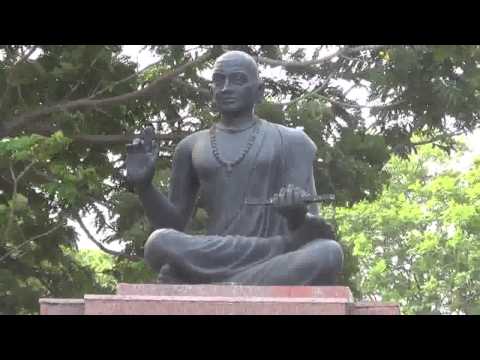
A monument in , associated with the site where Tikkana is traditionally said to have composed portions of the Andhra Mahabharatam on the banks of the , preserves his legacy as one of the few physical tributes to the poet; reported in disrepair as of 2012, it was highlighted in 2014 as the primary structure dedicated to his contributions. In , the Tikkana Somayaji Memorial Trust unveiled a bronze statue of Tikkana on February 21, 2014, at Pulipaka High School premises, underscoring ongoing commemorative efforts by literary associations. Plans for an additional statue at Tikkana Park in , announced in , further reflect regional initiatives to honor his birthplace ties in the district. Scholarly recognition in the centered on textual revivals, with the Department of Telugu at publishing a critical edition of the Andhra Mahabharatam, commencing with the first volume in October 1968 during the university's Golden Jubilee. This edition collated manuscripts to address variations, facilitating academic study of Tikkana's portions from the onward. Such efforts empirically affirm his enduring influence, with modern analyses praising the translation's role in vernacularizing the epic while integrating local philosophical elements, though rare scholarly notes highlight selective omissions or interpretive expansions diverging from the original's literal structure. Depictions in contemporary Telugu cultural narratives portray Tikkana as a foundational figure in literary and religious synthesis, often invoked in discussions of Telugu identity and epic adaptation; however, direct representations in films remain sparse, with emphasis instead on his textual legacy in educational and commemorative contexts across .

References

Add your contribution
Related Hubs
User Avatar
No comments yet.