



Community hub
Recent from talks
Contribute something to knowledge base
Content stats: 0 posts, 0 articles, 1 media, 0 notes
Members stats: 0 subscribers, 0 contributors, 0 moderators, 0 supporters
Subscribers
Supporters
Contributors
Moderators
Hub AI
Timber circle AI simulator
(@Timber circle_simulator)
Hub AI
Timber circle AI simulator
(@Timber circle_simulator)
Timber circle
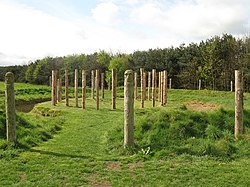
In archaeology, timber circles are rings of upright wooden posts, built mainly by ancient peoples in the British Isles and North America. They survive only as gapped rings of post-holes, with no evidence they formed walls, making them distinct from palisades. Like stone circles, it is believed their purpose was ritual, ceremonial, and/or astronomical. Sometimes in North America they are referred to as woodhenge.
Timber circles in the British Isles date to the late Neolithic and early Bronze Age. The posts themselves have long since disappeared and the sites are identified from the rings of postholes that they stood in. Aerial photography and geophysical survey have led to the discovery of increasing numbers of the features. Often a postpipe survives in the posthole fill aiding diagnosis.
They are usually more than 20 metres (66 ft), and up to 60 metres (200 ft), in diameter and the posts that constituted them were generally more than 50 centimetres (20 in) wide. Often they consist of at least two rings or ovals of timber posts, although some consist of only one ring. Wider gaps between the posts are thought to have served as entrance routes. The builders replaced the posts as they decomposed and in some cases stone circles were adopted instead during later phases.
They appear either alone or in the context of other monuments, namely henges, such as that at Woodhenge and henge enclosures such as those at Durrington Walls. The only excavated examples of timber circles that stood alone from other features are Seahenge and Arminghall in Norfolk and the early phases of The Sanctuary in Wiltshire.
Several Early Bronze Age timber circles have been found in Ireland. A huge timber circle with a diameter of 250 metres (820 ft) was built around a passage tomb on the Hill of Tara. Smaller timber circles were built at sites including Newgrange and Navan.
Timber circles in the British Isles likely served ritual purposes. Animal bone and domestic waste found at many timber circle sites implies some form of temporary habitation and seasonal feasting. They were built on high ground and would have been very conspicuous. Isolated burials have been found at some sites, but not enough to suggest a strong funerary purpose.
Timber circles have a long history among Native American societies; their use stretches back for thousands of years and continues into the present day. From the 3400 year old Archaic period Poverty Point site in Louisiana to 2000 year old Hopewell tradition circles found in Ohio to the Sun Dance performed in wooden pole "corrals" by the Dhegihan-Siouan and Caddoan speaking peoples of the Great Plains.
An early example of a timber circle witnessed by Europeans was recorded by watercolor artist John White in July 1585 when he visited the Algonquian village of Secotan in North Carolina. White was the artist-illustrator and mapmaker for the Roanoke Colony expedition sent by Sir Walter Raleigh to begin the first attempts at British colonization of the Americas. White's works represent the sole-surviving visual record of the native inhabitants of the Americas as encountered by England's first colonizers on the Atlantic seaboard. White's watercolor and the writings of the chronicler who accompanied him, Thomas Harriot, describes a great religious festival, possibly the Green Corn ceremony, with participants holding a ceremonial dance at a timber circle. The posts of the circle were carved with faces. Harriot noted that many of the participants had come from surrounding villages and that "every man attyred in the most strange fashion they can devise havinge certayne marks on the backs to declare of what place they bee." and that "Three of the fayrest Virgins" danced around a central post at the center of the timber circle.
Timber circle
In archaeology, timber circles are rings of upright wooden posts, built mainly by ancient peoples in the British Isles and North America. They survive only as gapped rings of post-holes, with no evidence they formed walls, making them distinct from palisades. Like stone circles, it is believed their purpose was ritual, ceremonial, and/or astronomical. Sometimes in North America they are referred to as woodhenge.
Timber circles in the British Isles date to the late Neolithic and early Bronze Age. The posts themselves have long since disappeared and the sites are identified from the rings of postholes that they stood in. Aerial photography and geophysical survey have led to the discovery of increasing numbers of the features. Often a postpipe survives in the posthole fill aiding diagnosis.
They are usually more than 20 metres (66 ft), and up to 60 metres (200 ft), in diameter and the posts that constituted them were generally more than 50 centimetres (20 in) wide. Often they consist of at least two rings or ovals of timber posts, although some consist of only one ring. Wider gaps between the posts are thought to have served as entrance routes. The builders replaced the posts as they decomposed and in some cases stone circles were adopted instead during later phases.
They appear either alone or in the context of other monuments, namely henges, such as that at Woodhenge and henge enclosures such as those at Durrington Walls. The only excavated examples of timber circles that stood alone from other features are Seahenge and Arminghall in Norfolk and the early phases of The Sanctuary in Wiltshire.
Several Early Bronze Age timber circles have been found in Ireland. A huge timber circle with a diameter of 250 metres (820 ft) was built around a passage tomb on the Hill of Tara. Smaller timber circles were built at sites including Newgrange and Navan.
Timber circles in the British Isles likely served ritual purposes. Animal bone and domestic waste found at many timber circle sites implies some form of temporary habitation and seasonal feasting. They were built on high ground and would have been very conspicuous. Isolated burials have been found at some sites, but not enough to suggest a strong funerary purpose.
Timber circles have a long history among Native American societies; their use stretches back for thousands of years and continues into the present day. From the 3400 year old Archaic period Poverty Point site in Louisiana to 2000 year old Hopewell tradition circles found in Ohio to the Sun Dance performed in wooden pole "corrals" by the Dhegihan-Siouan and Caddoan speaking peoples of the Great Plains.
An early example of a timber circle witnessed by Europeans was recorded by watercolor artist John White in July 1585 when he visited the Algonquian village of Secotan in North Carolina. White was the artist-illustrator and mapmaker for the Roanoke Colony expedition sent by Sir Walter Raleigh to begin the first attempts at British colonization of the Americas. White's works represent the sole-surviving visual record of the native inhabitants of the Americas as encountered by England's first colonizers on the Atlantic seaboard. White's watercolor and the writings of the chronicler who accompanied him, Thomas Harriot, describes a great religious festival, possibly the Green Corn ceremony, with participants holding a ceremonial dance at a timber circle. The posts of the circle were carved with faces. Harriot noted that many of the participants had come from surrounding villages and that "every man attyred in the most strange fashion they can devise havinge certayne marks on the backs to declare of what place they bee." and that "Three of the fayrest Virgins" danced around a central post at the center of the timber circle.
Recent media
Recent media