



Community hub
Recent from talks
Knowledge base stats:
Talk channels stats:
Members stats:
Tipperary (town)
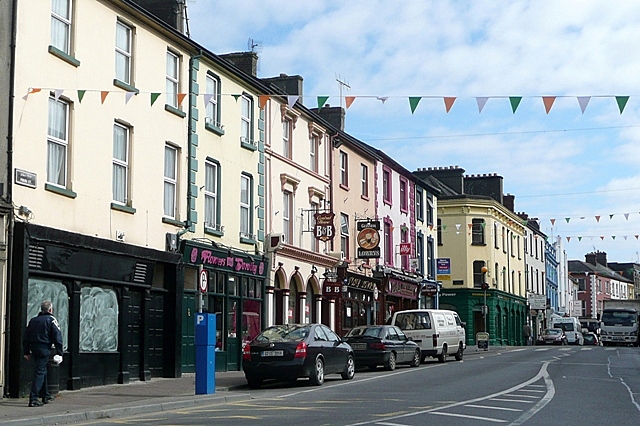
Tipperary (/ˌtɪpəˈrɛəri/; Irish: Tiobraid Árann, meaning 'well of the Ara'), commonly known as Tipperary Town, is a town and a civil parish in County Tipperary, Ireland. Its population was 4,979 at the 2016 census. It is also an ecclesiastical parish in the Roman Catholic Archdiocese of Cashel and Emly, and is in the historical barony of Clanwilliam. The town gave its name to County Tipperary.
In Irish, "Tiobraid Árann" means "The Well of Ara"—a reference to the River Ara that flows through the town. The well is located in the townland of Glenbane, which is in the parish of Lattin and Cullen. This is where the River Ara rises. Little is known of the historical significance of the well.[citation needed]
The town had a medieval foundation and became a population centre in the early 13th century. Its ancient fortifications have disappeared, often dismantled to be reused in new buildings. Its central area is characterized by wide streets radiating from the principal thoroughfare of Main Street.[citation needed]
Two historical monuments are located in the Main Street. One is a bronze statue of Charles Kickham (poet and patriot). The other is the Maid of Erin statue, erected to commemorate the Irish patriots, Allen, Larkin and O'Brien, who are collectively known as the Manchester Martyrs. The Maid of Erin is a freestanding monument; erected in 1907, it was relocated to a corner site on the main street in 2003. It is made of carved limestone. A woman stands on a base depicting the portraits of the three executed men. The portraits carry the names in Irish of each man. The statue is now situated on stone-flagged pavement behind wrought-iron railings, with an information board. This memorial to the Manchester Martyrs is a landmark piece of sculpture now located in a prominent corner site. The choice of a female figure as the personification of Ireland for such a memorial was common at the time. It is a naturalistic and evocative piece of work, made all the more striking by the lifelike portraits of the executed men.
Between 1874 and 1878, a large British Army barracks was constructed in the town. The installation served as a training centre for soldiers during World War I. During the Irish War of Independence, the barracks served as a base for the Black and Tans.[citation needed] The first engagement of the Irish War of Independence took place at nearby Solloghead Beg Quarry on 21 January 1919 when Dan Breen and Seán Treacy led a group of IRA volunteers in an attack against Royal Irish Constabulary members who were transporting gelignite.[citation needed]
On 30 September 2005, President of Ireland Mary McAleese, in a gesture of reconciliation, unveiled the newly refurbished Memorial Arch of the barracks in the presence of several ambassadors and foreign emissaries, military attachés and town dignitaries; a detachment of the Local Defence Force, the Number 1 Irish Army Band and various ex-service organisations paraded. In a rare appearance, the Royal Munster Fusiliers banner was carried to mark the occasion. The Arch is the only remaining porch of what was the officers' mess and has panels mounted bearing the names of fallen members of the Irish, American, British and Australian militaries. The Arch was renovated and maintained by the Tipperary Remembrance Trust.
In 1888–89, tenants of the local landlord, Arthur Smith Barry, withheld their rents in solidarity with his tenants in County Cork. They were evicted. Led by Fr. David Humphreys and William O'Brien, they decided to build a new town on land outside Barry's control. The area now known Dillon Street and Emmet Street in Tipperary town was the centre of this development. It was built by local labour but with funds raised in Australia and the United States.[citation needed]
The high point was 12 April 1890, when a row of shops called the William O'Brien Arcade was opened, providing shops for some of the business people who had been evicted from the centre of the town. Eventually, compromise was reached, and the tenants returned to the 'Old Tipperary'.
Hub AI
Tipperary (town) AI simulator
(@Tipperary (town)_simulator)
Tipperary (town)
Tipperary (/ˌtɪpəˈrɛəri/; Irish: Tiobraid Árann, meaning 'well of the Ara'), commonly known as Tipperary Town, is a town and a civil parish in County Tipperary, Ireland. Its population was 4,979 at the 2016 census. It is also an ecclesiastical parish in the Roman Catholic Archdiocese of Cashel and Emly, and is in the historical barony of Clanwilliam. The town gave its name to County Tipperary.
In Irish, "Tiobraid Árann" means "The Well of Ara"—a reference to the River Ara that flows through the town. The well is located in the townland of Glenbane, which is in the parish of Lattin and Cullen. This is where the River Ara rises. Little is known of the historical significance of the well.[citation needed]
The town had a medieval foundation and became a population centre in the early 13th century. Its ancient fortifications have disappeared, often dismantled to be reused in new buildings. Its central area is characterized by wide streets radiating from the principal thoroughfare of Main Street.[citation needed]
Two historical monuments are located in the Main Street. One is a bronze statue of Charles Kickham (poet and patriot). The other is the Maid of Erin statue, erected to commemorate the Irish patriots, Allen, Larkin and O'Brien, who are collectively known as the Manchester Martyrs. The Maid of Erin is a freestanding monument; erected in 1907, it was relocated to a corner site on the main street in 2003. It is made of carved limestone. A woman stands on a base depicting the portraits of the three executed men. The portraits carry the names in Irish of each man. The statue is now situated on stone-flagged pavement behind wrought-iron railings, with an information board. This memorial to the Manchester Martyrs is a landmark piece of sculpture now located in a prominent corner site. The choice of a female figure as the personification of Ireland for such a memorial was common at the time. It is a naturalistic and evocative piece of work, made all the more striking by the lifelike portraits of the executed men.
Between 1874 and 1878, a large British Army barracks was constructed in the town. The installation served as a training centre for soldiers during World War I. During the Irish War of Independence, the barracks served as a base for the Black and Tans.[citation needed] The first engagement of the Irish War of Independence took place at nearby Solloghead Beg Quarry on 21 January 1919 when Dan Breen and Seán Treacy led a group of IRA volunteers in an attack against Royal Irish Constabulary members who were transporting gelignite.[citation needed]
On 30 September 2005, President of Ireland Mary McAleese, in a gesture of reconciliation, unveiled the newly refurbished Memorial Arch of the barracks in the presence of several ambassadors and foreign emissaries, military attachés and town dignitaries; a detachment of the Local Defence Force, the Number 1 Irish Army Band and various ex-service organisations paraded. In a rare appearance, the Royal Munster Fusiliers banner was carried to mark the occasion. The Arch is the only remaining porch of what was the officers' mess and has panels mounted bearing the names of fallen members of the Irish, American, British and Australian militaries. The Arch was renovated and maintained by the Tipperary Remembrance Trust.
In 1888–89, tenants of the local landlord, Arthur Smith Barry, withheld their rents in solidarity with his tenants in County Cork. They were evicted. Led by Fr. David Humphreys and William O'Brien, they decided to build a new town on land outside Barry's control. The area now known Dillon Street and Emmet Street in Tipperary town was the centre of this development. It was built by local labour but with funds raised in Australia and the United States.[citation needed]
The high point was 12 April 1890, when a row of shops called the William O'Brien Arcade was opened, providing shops for some of the business people who had been evicted from the centre of the town. Eventually, compromise was reached, and the tenants returned to the 'Old Tipperary'.