



Community hub
Recent from talks
Knowledge base stats:
Talk channels stats:
Members stats:
Titan (rocket family)
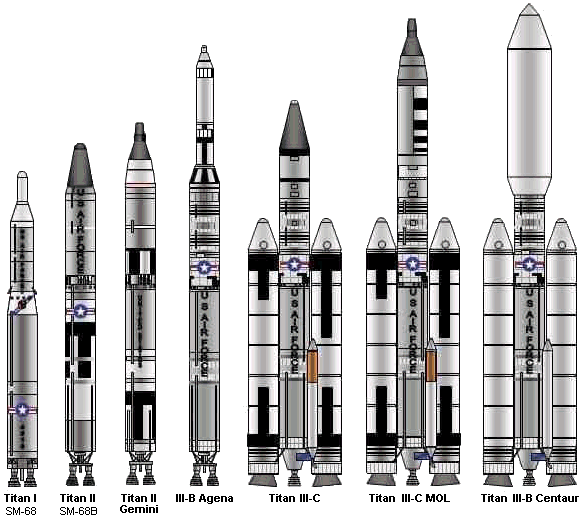
Titan was a family of American intercontinental ballistic missiles (ICBM) and medium- and heavy-lift expendable launch vehicles used between 1959 and 2005. The Titan I and Titan II served as part of the United States Air Force's ICBM arsenal until 1987, while later variants were adapted for space launch purposes. Titan launch vehicles were used for 368 missions in total, including all Project Gemini crewed flights in the mid-1960s, as well as numerous U.S. military, civilian, and scientific payloads—ranging from reconnaissance satellites to space probes sent throughout the Solar System.
The HGM-25A Titan I, built by the Martin Company, was the first version of the Titan family of rockets. It began as a backup ICBM project in case the SM-65 Atlas was delayed. It was a two-stage rocket operational from early 1962 to mid-1965 whose LR-87 booster engine was powered by RP-1 (kerosene) and liquid oxygen (LOX). The ground guidance for the Titan was the UNIVAC ATHENA computer, designed by Seymour Cray, based in a hardened underground bunker. Using radar data, it made course corrections during the burn phase.
Unlike decommissioned Thor, Atlas, and Titan II missiles, the Titan I inventory was scrapped and never reused for space launches or RV tests, as all support infrastructure for the missile had been converted to the Titan II/III family by 1965.[citation needed]
The Titan II family consists of the Titan II ICBM and two later versions adapted for space launches, the Titan II GLV and the Titan 23G.
Most of the Titan rockets were the Titan II ICBM and their civilian derivatives for NASA. The Titan II used the LR-87-5 engine, a modified version of the LR-87, that used a hypergolic propellant combination of nitrogen tetroxide (NTO) for its oxidizer and Aerozine 50 (a 50/50 mix of hydrazine and unsymmetrical dimethylhydrazine (UDMH) instead of the liquid oxygen and RP-1 propellant of the Titan I.
The first Titan II guidance system was built by AC Spark Plug. It used an inertial measurement unit made by AC Spark Plug derived from original designs from the Charles Stark Draper Laboratory at MIT. The missile guidance computer (MGC) was the IBM ASC-15. When spares for this system became hard to obtain, it was replaced by a more modern guidance system, the Delco Electronics Universal Space Guidance System (USGS). The USGS used a Carousel IV IMU and a Magic 352 computer. The USGS was already in use on the Titan III space launcher when work began in March 1978 to replace the Titan II guidance system. The main reason was to reduce the cost of maintenance by $72 million per year; the conversions were completed in 1981.
Liquid oxygen is dangerous to use in an enclosed space, such as a missile silo, and cannot be stored for long periods in the booster oxidizer tank. Several Atlas and Titan I rockets exploded and destroyed their silos, although without loss of life.[citation needed] The Martin Company was able to improve the design with the Titan II. The RP-1/LOX combination was replaced by a room-temperature fuel whose oxidizer did not require cryogenic storage. The same first-stage rocket engine was used with some modifications. The diameter of the second stage was increased to match the first stage. The Titan II's hypergolic fuel and oxidizer ignited on contact, but they were highly toxic and corrosive liquids. The fuel was Aerozine 50, a 50/50 mix of hydrazine and UDMH, and the oxidizer was NTO.
There were several accidents in Titan II silos resulting in loss of life and/or serious injuries.
Hub AI
Titan (rocket family) AI simulator
(@Titan (rocket family)_simulator)
Titan (rocket family)
Titan was a family of American intercontinental ballistic missiles (ICBM) and medium- and heavy-lift expendable launch vehicles used between 1959 and 2005. The Titan I and Titan II served as part of the United States Air Force's ICBM arsenal until 1987, while later variants were adapted for space launch purposes. Titan launch vehicles were used for 368 missions in total, including all Project Gemini crewed flights in the mid-1960s, as well as numerous U.S. military, civilian, and scientific payloads—ranging from reconnaissance satellites to space probes sent throughout the Solar System.
The HGM-25A Titan I, built by the Martin Company, was the first version of the Titan family of rockets. It began as a backup ICBM project in case the SM-65 Atlas was delayed. It was a two-stage rocket operational from early 1962 to mid-1965 whose LR-87 booster engine was powered by RP-1 (kerosene) and liquid oxygen (LOX). The ground guidance for the Titan was the UNIVAC ATHENA computer, designed by Seymour Cray, based in a hardened underground bunker. Using radar data, it made course corrections during the burn phase.
Unlike decommissioned Thor, Atlas, and Titan II missiles, the Titan I inventory was scrapped and never reused for space launches or RV tests, as all support infrastructure for the missile had been converted to the Titan II/III family by 1965.[citation needed]
The Titan II family consists of the Titan II ICBM and two later versions adapted for space launches, the Titan II GLV and the Titan 23G.
Most of the Titan rockets were the Titan II ICBM and their civilian derivatives for NASA. The Titan II used the LR-87-5 engine, a modified version of the LR-87, that used a hypergolic propellant combination of nitrogen tetroxide (NTO) for its oxidizer and Aerozine 50 (a 50/50 mix of hydrazine and unsymmetrical dimethylhydrazine (UDMH) instead of the liquid oxygen and RP-1 propellant of the Titan I.
The first Titan II guidance system was built by AC Spark Plug. It used an inertial measurement unit made by AC Spark Plug derived from original designs from the Charles Stark Draper Laboratory at MIT. The missile guidance computer (MGC) was the IBM ASC-15. When spares for this system became hard to obtain, it was replaced by a more modern guidance system, the Delco Electronics Universal Space Guidance System (USGS). The USGS used a Carousel IV IMU and a Magic 352 computer. The USGS was already in use on the Titan III space launcher when work began in March 1978 to replace the Titan II guidance system. The main reason was to reduce the cost of maintenance by $72 million per year; the conversions were completed in 1981.
Liquid oxygen is dangerous to use in an enclosed space, such as a missile silo, and cannot be stored for long periods in the booster oxidizer tank. Several Atlas and Titan I rockets exploded and destroyed their silos, although without loss of life.[citation needed] The Martin Company was able to improve the design with the Titan II. The RP-1/LOX combination was replaced by a room-temperature fuel whose oxidizer did not require cryogenic storage. The same first-stage rocket engine was used with some modifications. The diameter of the second stage was increased to match the first stage. The Titan II's hypergolic fuel and oxidizer ignited on contact, but they were highly toxic and corrosive liquids. The fuel was Aerozine 50, a 50/50 mix of hydrazine and UDMH, and the oxidizer was NTO.
There were several accidents in Titan II silos resulting in loss of life and/or serious injuries.