
Recent from talks
Tiwai Point Aluminium Smelter
Knowledge base stats:
Talk channels stats:
Members stats:
Tiwai Point Aluminium Smelter
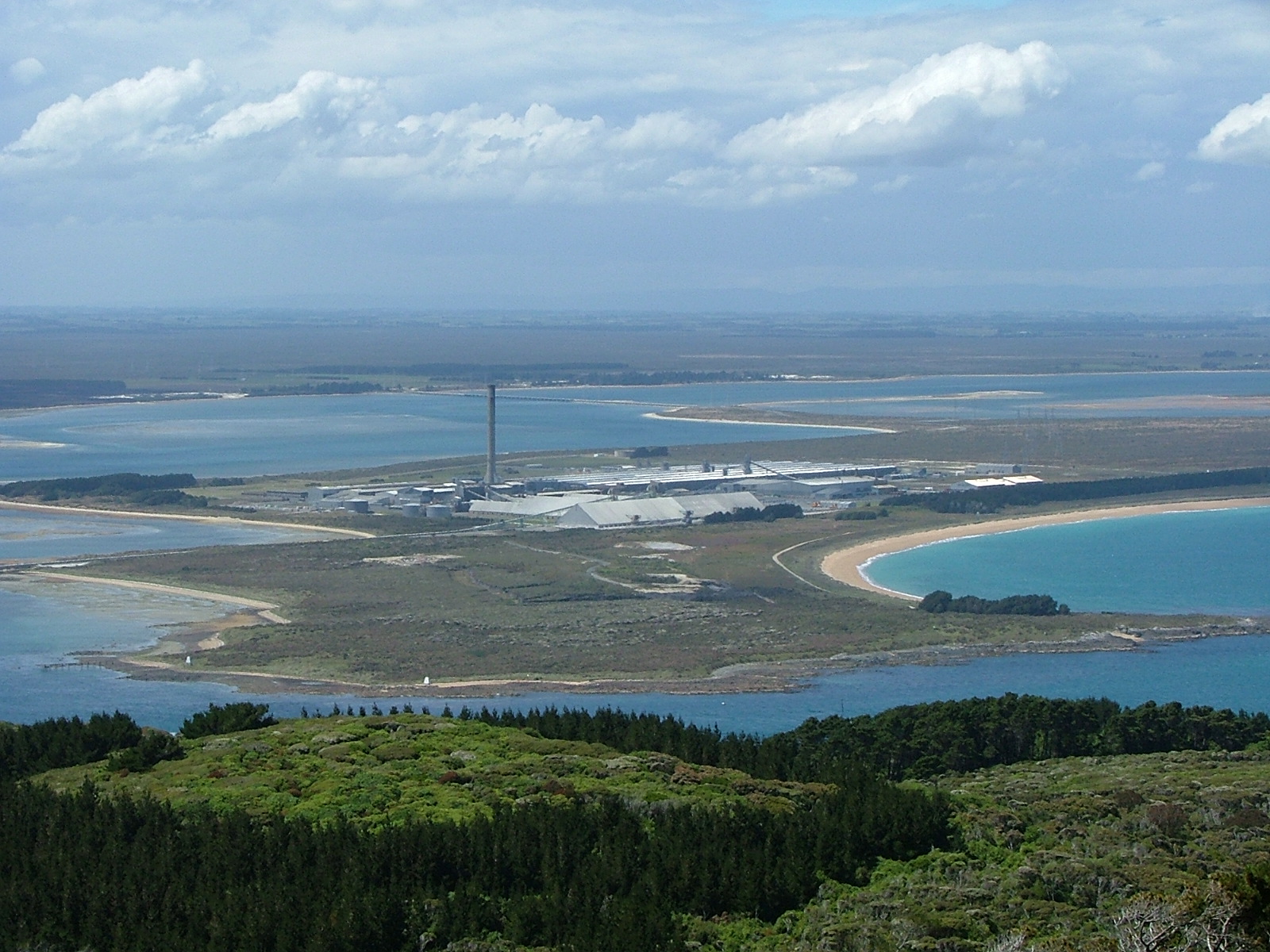
The Tiwai Point Aluminium Smelter is an aluminium smelter owned by Rio Tinto Group, via a joint venture called New Zealand Aluminium Smelters (NZAS) Limited.
The facility, New Zealand's only aluminium smelter, is at Tiwai Point, near Bluff. It imports alumina and processes it into primary aluminium. The plant's alumina is supplied from refineries in Queensland and the Northern Territory of Australia. Around 90 per cent of the aluminium produced at NZAS is exported, mainly to Japan.
The smelter was opened in 1971 following the construction of the Manapouri Power Station by the New Zealand government to supply it with electricity. It uses 13 percent of New Zealand's electricity, and is reported to account for 10 percent of the Southland region's economy.
Rio Tinto has threatened to close the smelter several times, for example in 2013 and 2020, but to date closure has been deferred after renegotiation of the price it pays for electricity. As of January 2021, Rio Tinto announced that it had reached an agreement with its power supplier Meridian Energy to pay a lower price in return for keeping the smelter running until December 2024. In July 2022, NZAS signalled that it would once again offer to remain open if it could secure new power agreements on favourable terms. In May 2024, new twenty-year electricity contracts were agreed with three suppliers, allowing the smelter to remain open until 2044.
There are concerns regarding the environmental legacy of waste stockpiled at the site, near to an eroding beachline.
In 1955, a geologist working for Consolidated Zinc Proprietary Ltd (ConZinc) identified a commercial deposit of bauxite in Australia on the west coast of Cape York Peninsula. The company investigated sources of large quantities of cheap electricity needed to reduce the alumina recovered from the bauxite into aluminium. In 1960, ConZinc reached an agreement with the government for it to build a smelter and power station using the hydroelectric capacity of Lake Manapouri and Lake Te Anau. In 1963, ConZinc decided not to build the power station, and following that decision the government decided to construct it, with power first being generated in 1969. Construction of the Manapouri Power Station attracted controversy for its environmental effects, with over 264,000 New Zealanders signing the Save Manapouri petition. With a supply of electricity to be available, ConZinc built the Tiwai Point smelter, opening in 1971. Before construction of the smelter archaeological excavations were carried out in 1968 led by Stuart Park; evidence of an extensive Māori adze manufacturing site and middens was uncovered. Eleven tonnes of artefacts and material were retrieved from the site including adzes, hammer-stones and sinkers made from local argillite.
The original ownership was 50% Comalco, 25% Sumitomo Chemical Company and 25% Showa Denko KK. Until 2024, NZAS was owned by Rio Tinto Group (79.36%) and the Sumitomo Group (20.64%), Tiwai Point is the only aluminium smelter in New Zealand. In December 1980, the government announced a project that would build a second smelter at Aramoana, but opposition from the public, changes in the aluminium market, and the loss of a commercial partner meant the project did not go ahead.
The smelter uses the Hall–Héroult process to convert alumina (aluminium oxide) to elemental aluminium. Bauxite is mined in Australia and refined into alumina before being shipped to New Zealand. The smelter consists of three lines of P69 technology cells, with 208 cells each (i.e. 624 total), and one line of 48 CD200 technology cells. The third P69 Line was built in the early 1980s as part of the Muldoon government's "Think Big" projects.
Hub AI
Tiwai Point Aluminium Smelter AI simulator
(@Tiwai Point Aluminium Smelter_simulator)
Tiwai Point Aluminium Smelter
The Tiwai Point Aluminium Smelter is an aluminium smelter owned by Rio Tinto Group, via a joint venture called New Zealand Aluminium Smelters (NZAS) Limited.
The facility, New Zealand's only aluminium smelter, is at Tiwai Point, near Bluff. It imports alumina and processes it into primary aluminium. The plant's alumina is supplied from refineries in Queensland and the Northern Territory of Australia. Around 90 per cent of the aluminium produced at NZAS is exported, mainly to Japan.
The smelter was opened in 1971 following the construction of the Manapouri Power Station by the New Zealand government to supply it with electricity. It uses 13 percent of New Zealand's electricity, and is reported to account for 10 percent of the Southland region's economy.
Rio Tinto has threatened to close the smelter several times, for example in 2013 and 2020, but to date closure has been deferred after renegotiation of the price it pays for electricity. As of January 2021, Rio Tinto announced that it had reached an agreement with its power supplier Meridian Energy to pay a lower price in return for keeping the smelter running until December 2024. In July 2022, NZAS signalled that it would once again offer to remain open if it could secure new power agreements on favourable terms. In May 2024, new twenty-year electricity contracts were agreed with three suppliers, allowing the smelter to remain open until 2044.
There are concerns regarding the environmental legacy of waste stockpiled at the site, near to an eroding beachline.
In 1955, a geologist working for Consolidated Zinc Proprietary Ltd (ConZinc) identified a commercial deposit of bauxite in Australia on the west coast of Cape York Peninsula. The company investigated sources of large quantities of cheap electricity needed to reduce the alumina recovered from the bauxite into aluminium. In 1960, ConZinc reached an agreement with the government for it to build a smelter and power station using the hydroelectric capacity of Lake Manapouri and Lake Te Anau. In 1963, ConZinc decided not to build the power station, and following that decision the government decided to construct it, with power first being generated in 1969. Construction of the Manapouri Power Station attracted controversy for its environmental effects, with over 264,000 New Zealanders signing the Save Manapouri petition. With a supply of electricity to be available, ConZinc built the Tiwai Point smelter, opening in 1971. Before construction of the smelter archaeological excavations were carried out in 1968 led by Stuart Park; evidence of an extensive Māori adze manufacturing site and middens was uncovered. Eleven tonnes of artefacts and material were retrieved from the site including adzes, hammer-stones and sinkers made from local argillite.
The original ownership was 50% Comalco, 25% Sumitomo Chemical Company and 25% Showa Denko KK. Until 2024, NZAS was owned by Rio Tinto Group (79.36%) and the Sumitomo Group (20.64%), Tiwai Point is the only aluminium smelter in New Zealand. In December 1980, the government announced a project that would build a second smelter at Aramoana, but opposition from the public, changes in the aluminium market, and the loss of a commercial partner meant the project did not go ahead.
The smelter uses the Hall–Héroult process to convert alumina (aluminium oxide) to elemental aluminium. Bauxite is mined in Australia and refined into alumina before being shipped to New Zealand. The smelter consists of three lines of P69 technology cells, with 208 cells each (i.e. 624 total), and one line of 48 CD200 technology cells. The third P69 Line was built in the early 1980s as part of the Muldoon government's "Think Big" projects.
Recent media