Hubbry Logo
ArgilliteArgilliteMain
Open search
Argillite
Community hub
Argillite
logo
8 pages, 0 posts
0 subscribers
Be the first to start a discussion here.
Argillite
Argillite
from Wikipedia
Argillite
Sedimentary rock
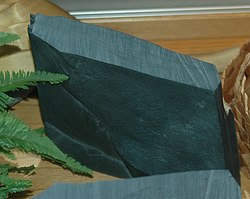
A piece of black argillite from Haida Gwaii, Canada
Composition
indurated clay particles
Grey chunks of graptolitic argillite on Pakri Peninsula, Estonia; yellowish and white chunks are limestone

Argillite ( /ˈɑːrɪlt/) is a fine-grained sedimentary rock composed predominantly of indurated clay particles. Argillaceous rocks are basically lithified muds and oozes. They contain variable amounts of silt-sized particles. The argillites grade into shale when the fissile layering typical of shale is developed. Another name for poorly lithified argillites is mudstone.[citation needed] These rocks, although variable in composition, are typically high in aluminium and silica with variable alkali and alkaline earth cations. The term pelitic or pelite is often applied to these sediments and rocks. Metamorphism of argillites produces slate, phyllite, and pelitic schist.

Belt Supergroup

[edit]

The Belt Supergroup, an assemblage of rocks of late Precambrian (Mesoproterozoic) age, includes thick sequences of argillite, as well as other metamorphosed or semi-metamorphosed mudstones.[1] It is exposed primarily in western Montana, including the Bitterroot Valley and Bitterroot Mountains, the Missoula area, Flathead Lake, and Glacier National Park, and in northern Idaho. There are also minor occurrences in northeastern Washington and western Wyoming.[2] Excellent outcrops of deep purple, wine red, red, blue, turquoise, and green argillites of the Belt Supergroup can be seen in Glacier National Park in northwestern Montana and in Wolf Creek Canyon along Interstate 15 in west-central Montana.[3]

"Black slate"

[edit]

The Haida carvings of Haida Gwaii along the coast of British Columbia are notable aboriginal art treasures created from a type of a hard, fine black silt argillite, sometimes called "black slate". The black slate occurs only at a quarry on a Slatechuck Mountain in the upper basin of Slatechuck Creek, near the town of Skidegate on Graham Island. At one time, around 1900, it was shipped to Victoria for manufacturing; today the Haida have a monopoly on use of the argillite. Argillite carvings are synonymous with Haida artwork and are one of the few art forms on the Northwest Coast that is the exclusive right of one cultural group. This artwork has been of high quality and prized around the world since the Haida first began carving it to trade and sell to sailors around 1800. Contemporary Haida carvers continue the tradition.

See also

[edit]
  • Mudrock – Type of sedimentary rock
  • Catlinite – Type of metamorphosed mudstone
  • Lutite – Old terminology for clayey sedimentary rock

References

[edit]
Revisions and contributorsEdit on WikipediaRead on Wikipedia
from Grokipedia
Argillite is a fine-grained composed predominantly of indurated clay particles or clay-sized materials, typically with a compact texture, low , and grain sizes less than 1/256 mm. It forms through the of or via increased compaction and induration, resulting in a hardened structure that lacks the clear and fissility of but shows incipient recrystallization. This rock type represents an intermediate stage between softer mudstones and more intensely metamorphosed slates, often exhibiting a massive or blocky appearance due to its uniform fine-grained matrix. Compositionally, argillite is chiefly clay minerals such as , , or , with minor , , or iron oxides that can impart colors ranging from gray and black to red, green, or purple depending on environmental conditions during deposition, such as oxidation states. It commonly occurs in ancient sedimentary sequences, including to formations, and is found in regions like the , Glacier National Park in , and the axial ranges of New Zealand's North and South Islands, often interbedded with sandstones or limestones. Argillite's durability and carvability make it suitable for various practical and artistic applications. In and , it serves as a stable host rock in deep disposal studies due to its low permeability and chemical inertness. Artisanal uses include crafting ornaments, statuary, and tools, particularly in prehistoric contexts where it was knapped for lithic artifacts like projectile points. A particularly notable cultural application is among the of (Queen Charlotte Islands, ), who have quarried a dense, black variety of argillite from Slatechuck Mountain since at least the early for intricate carvings. These works, often depicting traditional motifs such as totem poles, pipes, and platters, emerged prominently around the 1820s as trade items with European sailors and whalers, evolving into a sophisticated form that reflects Haida cosmology and social narratives. The practice continues today, preserving Indigenous artistic traditions while highlighting argillite's unique workability when properly seasoned.

Etymology and Terminology

Origin of the Name

The term "argillite" derives from the Latin word argilla, meaning "white clay" or simply "clay," which originates from the argillos (ἄργιλλος), referring to a fine, white clay used in . The suffix "-ite," borrowed from Greek via Latin, is a standard ending in and to denote rocks, minerals, or materials, as seen in terms like "" or "." This combination reflects the rock's primary composition of indurated, clay-rich sediments. The word entered geological nomenclature in the late , with its first documented English usage in 1794 by Irish chemist and mineralogist Richard Kirwan in his influential textbook Elements of . Kirwan applied "argillite" to describe a compact, argillaceous (clayey) rock cemented by silica, distinguishing it from softer clays and more fissile shales based on its degree of induration. This early adoption occurred amid the rapid development of systematic mineral classification in , influenced by Enlightenment-era efforts to catalog natural materials. Over the following decades in the 19th century, the term evolved in European geological literature to specifically denote fine-grained, lithified clay sediments lacking slaty cleavage, helping to refine distinctions within sedimentary rock classifications. Geologists such as those in the Neptunist school, emphasizing aqueous origins for such rocks, incorporated similar terminology into broader stratigraphic frameworks, though early usages often varied by language and region before standardization in English texts. This historical context underscores argillite's role in early efforts to categorize clay-based sedimentary rocks.

Common Names and Misnomers

Argillite is frequently referred to as "black slate" due to its dark coloration and fine-grained texture, a term that originated in the among Haida artisans and European traders observing carvings from . This nomenclature arose from the material's visual similarity to but is a , as argillite is a lacking the metamorphic cleavage and fissility characteristic of true . The term "black slate" gained prominence in historical trade descriptions during the early to mid-1800s, when Haida carvers produced argillite objects—such as and figurines—for exchange with maritime fur traders and collectors, often labeling the material simply as in transaction records and shipping manifests. This usage contributed to confusion in identification, as non-geologists mistook it for harder, more uniform metamorphic used in roofing or . Regional variants like "Haida slate" persist in artistic and cultural contexts, emphasizing its association with quarries, while "indurated mudstone" serves as a more precise geological descriptor but can lead to misclassification when applied broadly to less consolidated mudrocks without specifying the degree of hardening. These names imply a of that blurs boundaries with shales or phyllites, complicating accurate cataloging in collections. Misnomers have endured in non-geological settings, notably in 19th-century catalogs and inventories, perpetuating the slate association among curators and buyers. In indigenous , "black slate" holds cultural significance for Haida carvings depicting crests and narratives, though its geological inaccuracy highlights ongoing identification challenges.

Definition and Classification

Geological Definition

Argillite is defined as a fine-grained composed predominantly of indurated clay-sized particles and , with grain sizes typically less than 0.0625 mm, distinguishing it from coarser clastic sediments. This induration process hardens the rock without significant recrystallization, resulting in a compact structure that retains its original sedimentary characteristics. Within sedimentary geology, argillite is classified as an argillaceous rock, belonging to the broader family, which includes rocks formed from consolidated mud. Unlike , it lacks well-developed fissility due to the absence of parallel alignment in its clay particles, and it differs from by not exhibiting metamorphic . This places argillite in an intermediate position among indurated mud-based rocks, emphasizing its sedimentary origin over metamorphic alteration. Identification criteria for argillite, as outlined by the American Geological Institute, focus on the degree of induration: it must be more consolidated than or —often to the point of being hard and non-fissile—but without the cleavage planes that define . Geological societies recognize this through field and petrographic examination, where the rock's massive or weakly laminated texture and lack of slaty parting confirm its classification, ensuring distinction from related lithologies in stratigraphic mapping. Argillite is distinguished from primarily by its greater degree of induration and lack of fissility, meaning it does not split easily along planes as does. While is a finely laminated, clay-rich that exhibits well-developed fissility due to its softer, less compacted nature, argillite represents a more hardened equivalent, often derived from compacted or clay without the pronounced layering. This higher compaction in argillite results from increased and cementation, making it denser and more resistant to compared to the more friable . In comparison to mudstone, argillite typically exhibits higher hardness due to greater induration, though the boundary can be transitional. is an indurated, non-fissile composed of and clay, but it remains softer and less consolidated than argillite, which undergoes additional to achieve a blocky, massive structure. Argillite's enhanced durability arises from this advanced induration, distinguishing it from mudstone's more crumbly texture in hand specimens. Unlike slate, argillite lacks metamorphic or slaty cleavage, remaining a low-grade sedimentary or very weakly metamorphosed rock. Slate forms through regional of or , developing a pronounced planar cleavage that allows it to split into thin sheets, whereas argillite retains its original without such reorientation of minerals. This absence of in argillite prevents the sheet-like parting characteristic of slate, highlighting its position as an intermediate between unmetamorphosed mudrocks and true metamorphic varieties. Diagnostic tests for identification emphasize these structural differences: argillite typically displays a conchoidal or subconchoidal when broken, producing smooth, curved surfaces rather than the irregular, splintery breaks of or the even cleavage of . Field examination for the absence of fissile planes or slaty cleavage, combined with its waxy luster and blocky form, aids in differentiating argillite from these relatives. Historical misclassifications in early 20th-century geological surveys often arose from interchangeable use of terms like argillite, , and due to varying degrees of induration and regional nomenclature inconsistencies. For instance, surveys in the frequently mapped indurated clay-rich rocks as despite lacking fissility, leading to errors in resource assessments for ceramics and construction materials until refined classifications in the mid-20th century clarified distinctions based on induration levels.

Formation and Composition

Sedimentary Processes

Argillite primarily forms through the of fine-grained muds and oozes deposited in low-energy environments, where rates allow for the accumulation of clay-sized particles without significant disturbance. These settings include deep marine basins, floodplains, and lacustrine bottoms, where calm waters facilitate the settling of suspended clays derived from eroded continental sources. Over geological timescales spanning millions of years, these unconsolidated sediments undergo diagenetic transformation into a compact, indurated rock. The key processes driving argillite formation are compaction and cementation. Compaction begins as accumulating sediments apply pressure, expelling interstitial water and reducing from initial values around 70-80% to less than 10%. This mechanical occurs rapidly in the first 500 meters of and continues more gradually thereafter. Cementation follows, where dissolved minerals precipitate in pore spaces, binding clay particles together and enhancing rock hardness without the introduction of significant new material. These processes indurate the while preserving its primary sedimentary fabric. Burial depth plays a critical role in achieving induration, typically ranging from 2 to 5 kilometers, where lithostatic pressures of 50-150 MPa promote consolidation but remain below the thresholds for metamorphism (around 200-300°C and higher pressures). At these depths, the rock transitions from soft mudstone or shale to argillite, characterized by increased brittleness and reduced permeability. Pressure alone suffices for much of the induration in argillaceous materials, as thermal effects are minimal until greater depths. Argillites exhibit a broad age range from Precambrian to Cenozoic, reflecting diverse depositional histories across Earth's geological record. Notable examples include formations in anoxic basins, where oxygen-poor conditions inhibited bioturbation and preserved laminated structures. These environments, often tectonically stable subsiding basins, allowed for prolonged accumulation and subsequent burial without oxidative alteration.

Mineralogical Composition

Argillite's mineralogical composition is dominated by fine-grained clay minerals, which typically comprise 50-80% of the rock volume, including illite, kaolinite, and smectite as the primary constituents. Accessory minerals such as quartz, feldspar, and carbonates make up the remaining fraction, often as detrital grains. The fundamental chemical structure of the dominant clay minerals is based on layered silicates, with represented by the general \ceAl2Si2O5(OH)4\ce{Al2Si2O5(OH)4}. Variations in composition arise from ionic substitutions, including in and magnesium or iron in , while variable iron oxides (such as or ) impart the characteristic colors ranging from gray to red or green. Compositional differences in argillite reflect the nature of source sediments; for instance, those derived from volcanic materials exhibit elevated content due to the weathering of basaltic or andesitic precursors. In contrast, argillites from continental tend to be richer in and .

Physical and Chemical Properties

Texture and Structure

Argillite exhibits a clastic texture characterized by fine-grained, uniform particles typically smaller than 0.004 , rendering individual clasts invisible to the naked eye. This rock is often massive or thinly bedded, lacking the fissility that distinguishes it from , where it does not readily split along closely spaced planes. The high degree of induration contributes to its compact, non-laminated appearance in hand samples. Macroscopically, argillite commonly displays structures resulting from tectonic deformation, including fractures and veins filled with secondary minerals such as or . Occasional nodules or concretions may occur, particularly along planes or as disseminations within the matrix, as observed in formations like the Lockatong argillite. These features reflect post-depositional alteration and diagenetic processes without achieving the metamorphic seen in . Under microscopic examination in thin sections, argillite reveals a matrix dominated by clay minerals, with occasional aligned clay flakes indicating subtle preferred orientation from compaction, though lacking the pronounced cleavage of more metamorphosed rocks. The matrix includes minor , , and grains embedded within the fine clay fabric, underscoring its detrital origin from lithified .

Durability and Color Variations

Argillite possesses a Mohs hardness ranging from 2 to 3, providing a balance of that allows it to withstand moderate mechanical stress while remaining suitable for and shaping. Its uniaxial can range from less than 10 to over 150 MPa depending on and degree of induration, with values of 50-100 MPa and averages around 59 MPa reported for deposits in the Makran structural field, . This strength contributes to its use in structural applications, but lower values in samples highlight the need for site-specific testing. The color of argillite varies based on and organic content, most commonly appearing in to black due to elevated levels of organic carbon. Green hues arise from the presence of minerals, while red tones result from inclusions. In specific deposits, such as those near , argillite exhibits orange coloration with tan inclusions, reflecting localized iron oxidation and sedimentary variations. Chemically, argillite is generally inert with low reactivity due to its dominant composition (e.g., , , ), contributing to its low permeability and suitability for applications. Regarding , argillite demonstrates resistance to surface in dry environments owing to its indurated nature, but it is susceptible to swelling and degradation in wet conditions, primarily due to clay minerals that absorb water and expand. This behavior, evidenced by slake durability indices as low as 0.14% in some samples, can lead to reduced structural integrity over time in humid or cyclic wetting-drying climates.

Geological Occurrences

Major Formations

Argillite is prominently featured in the Belt Supergroup of , a vast sedimentary sequence spanning approximately 1.47 to 0.85 billion years old, with extensive deposits across , , and southeastern . These rocks formed in ancient rift basins associated with the passive rifting of the supercontinent , where fine-grained clastic sediments, including argillite, accumulated in a subsiding intracratonic basin up to 20 kilometers thick. The Purcell Supergroup, often considered correlative or basal to the Belt Supergroup, also dates to the (around 1.47 to 1.4 billion years old) and contains significant argillite layers interspersed with carbonates, quartzites, and intrusions, primarily in southeastern . Similarly, the Supergroup (approximately 0.78 to 0.54 billion years old) includes argillite-dominated units, such as olive-green argillites and siltstones in its Hyland Group, exposed in the Purcell Mountains and western of . Globally, argillite occurs commonly within mudrock sequences but reaches its peak abundance and preservation in sedimentary basins, reflecting widespread fine-grained deposition during that era's tectonic stability and continental configurations. It is also found in sequences in regions such as and .

Notable Deposits

One of the most distinctive argillite deposits occurs at Slatechuck Mountain on in , , where a unique black, carbonaceous variety associated with the Kunga Formation is quarried. This deposit consists primarily of clay minerals including , , , and minor , resulting from the of fine-grained muds in a sedimentary environment. The quarry site, located near Slatechuck Creek on the east flank of , represents a protected and localized of this material, with bedding planes exhibiting anisotropic responses to environmental changes due to its mineral composition. In the , significant argillite deposits are found in , particularly along what is known as Argillite Alley, marking an abundant outcrop of the rock within the Appalachian geological province. These deposits are part of the Upper Lockatong Formation within the , deposited as fine-grained sediments in lacustrine environments during the breakup of . The material in this region is characterized by its relative homogeneity and hardness, forming part of the broader basin that includes altered shales and siltstones exposed in the area. Further west, in near , a notable deposit of orange argillite has been identified north of the town in the Del Rio area, featuring tan inclusions derived from interbedded local volcanic materials. This soft, workable argillite originates from sedimentary sequences, including mudstones and shales deposited in rift-related basins during the younger period, with the orange coloration attributed to staining and the tan inclusions to cherty or volcanic interlayers. The deposit's accessibility and distinct properties have made it a focal point for geological interest in the region's geology. In the Makran region spanning southeastern and southwestern , argillite deposits are prevalent within the South Makran structural zone, bounded by major thrust faults such as the and Qasr-Ghand faults. These rocks, part of the sediments, consist of silt-level fragments cemented with carbonates and clays, exhibiting high , swellability, and slake issues that pose challenges in applications due to their young depositional age and tectonic deformation. The deposits form in a tectonically active coastal belt, with argillite layers interbedded in Tertiary sequences deformed by ongoing processes. Exploration of argillite deposits gained momentum in the 19th and early 20th centuries through geological surveys conducted by organizations like the U.S. Geological Survey and provincial bodies in , which mapped and assessed these fine-grained sedimentary rocks for potential industrial viability in regions such as the northeastern U.S. and . These efforts, spanning from the mid-1800s to the 1930s, included detailed stratigraphic analyses that identified economic aspects of argillite outcrops, such as those in and , emphasizing their role in broader metasedimentary formations rather than high-value ore contexts. In the area, 20th-century tectonic studies by Iranian and Pakistani geological surveys further delineated argillite distributions for geotechnical evaluations.

Uses and Cultural Significance

Carving and Artistic Applications

Argillite carvings from emerged as a distinct artistic in the early , following European contact in the late . This practice developed primarily as a response to the decline of the , allowing Haida artists to create portable trade goods for sailors and collectors. Initial works, dating from the 1820s, included small ceremonial pipes, followed by more elaborate pieces such as model totem poles, canoes with oarsmen, and figurative sculptures depicting human and animal forms. By cultural protocol, argillite carving remains exclusive to Haida artists, with the stone quarried solely from Slatechuck Mountain on , reinforcing its role as a protected indigenous art form. Haida artists employ hand-carving techniques using steel tools introduced through trade, beginning with rough shaping via adzes or handsaws to block out forms, followed by refinement with chisels, knives, files, and gravers for intricate details. The stone, soft when freshly quarried, hardens upon drying, enabling precise work; it is then sanded progressively and polished—often with oil or by rubbing—to achieve a characteristic glossy black sheen that enhances the depth of engravings. Over time, these carvings evolved from 19th-century curiosities sold at ports to sophisticated contemporary gallery pieces, incorporating traditional motifs like , myths, and transformation stories while adapting to modern and materials. As of 2025, Haida argillite carvings continue to gain acclaim through exhibitions, such as those featuring artist Christian White at the Bill Reid Gallery in and the Sitka History Museum. These carvings hold profound cultural significance as symbols of Haida identity, embodying oral histories, clan lineages, and spiritual narratives that connect generations. The art form's uniqueness has earned international acclaim. Notable examples reside in institutions like the , such as a mid-19th-century argillite figure group depicting a European man and woman, which illustrates early intercultural themes in Haida work. Today, argillite art continues to affirm Haida and resilience, with pieces displayed in museums worldwide to educate on indigenous cultural continuity.

Tool-Making and Industrial Uses

Argillite has been utilized by Native American communities for tool-making since prehistoric times, particularly in regions with accessible deposits. In New Jersey's Hunterdon County, indigenous peoples crafted sharp, durable tools and weapons, such as projectile points and woodworking implements like axes and adzes, from local argillite bedrock during the Archaic period (ca. 8000–1000 BCE). These tools were fashioned from dimensional blocks and splinters, leveraging the stone's density and lack of cleavage for effective flaking. In Arizona, deposits near Prescott, including the Del Rio source in Chino Valley, were quarried by Native Americans at least 1,000 years ago for artifacts such as pendants, bracelets, beads, and jewelry. The durability of argillite contributed to its preference for such applications. In industrial contexts, argillite serves as an aggregate in construction materials, including flooring, stair treads, and cement production, due to its compact sedimentary structure. It is also employed as a raw material and filler in ceramics manufacturing, where clay-rich argillite quarry waste enhances plasticity and technological properties for brick and tile production. However, its engineering applications face challenges from swelling behavior, which can lead to structural damage in projects; for instance, in Iran's Makran region, argillite's high swellability, cracking, and low strength have complicated implementation in weak rock formations. Modern extraction of argillite remains limited, primarily through quarrying for decorative stone and construction uses, as seen in operations like the Harleysville quarry in , active on an industrial scale since 1924. Near , historical sources continue to inform small-scale activities, but environmental considerations, including habitat disruption and water quality impacts from mining, are critical in the region.

References

Add your contribution
Related Hubs
User Avatar
No comments yet.