



Community hub
Recent from talks
Knowledge base stats:
Talk channels stats:
Members stats:
Tk (software)
Tk is a cross-platform widget toolkit that provides a library of basic elements of GUI widgets for building a graphical user interface (GUI) in many programming languages. It is free and open-source software released under a BSD-style software license.
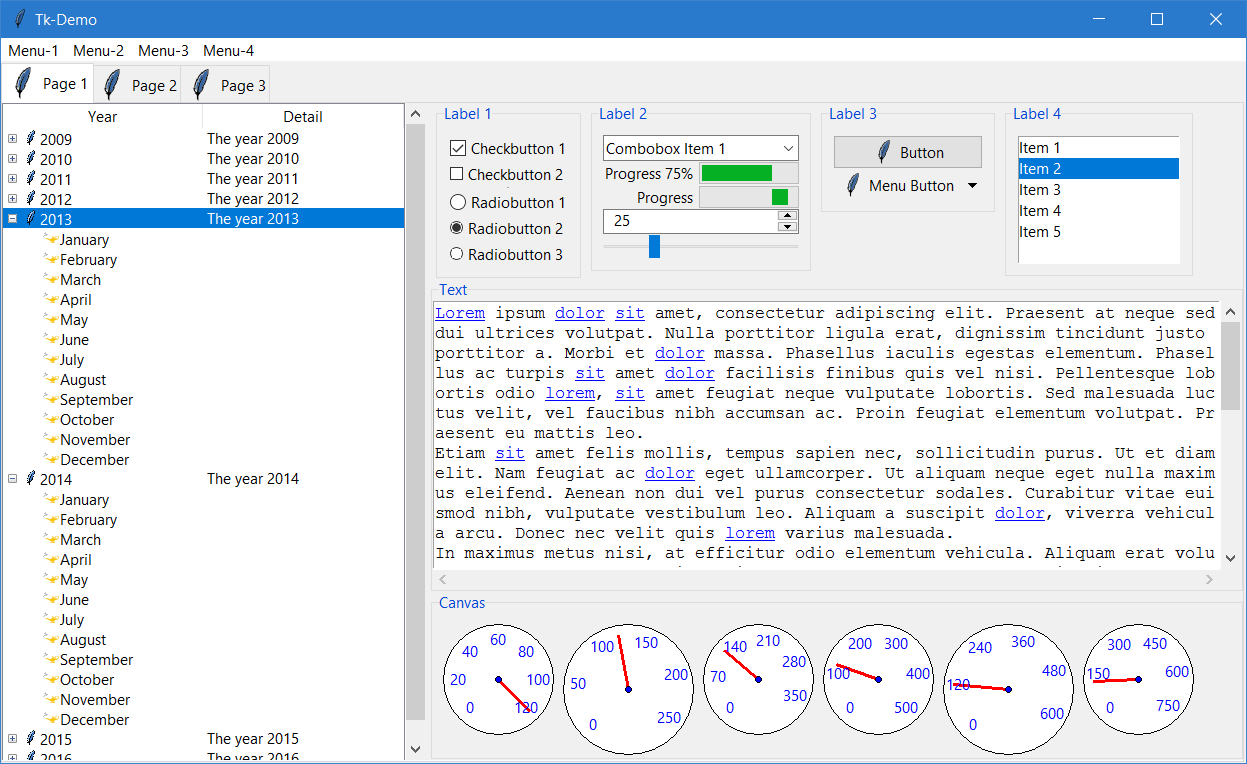
Tk provides many widgets commonly needed to develop desktop applications, such as button, menu, canvas, text, frame, label, etc. Tk has been ported to run on most flavors of Linux, macOS, Unix, and Microsoft Windows. Like Tcl, Tk supports Unicode within the Basic Multilingual Plane, but it has not yet been extended to handle the current extended full Unicode (e.g., UTF-16 from UCS-2 that Tk supports).
Tk was designed to be extended, and a wide range of extensions are available that offer new widgets or other capabilities.
Since Tcl/Tk 8, it offers "native look and feel" (for instance, menus and buttons are displayed in the manner of "native" software for any given platform). Highlights of version 8.5 include a new theming engine, originally called Tk Tile, but it is now generally referred to as "themed Tk", as well as improved font rendering. Highlights of version 8.6 include PNG support and angled text.
Tk was developed by John Ousterhout as an extension for the Tcl scripting language. It was first publicly released in 1991. Tk versioning was done separately from Tcl until version 8.0.
Tk was written originally for Unix/X11, and proved extremely popular with programmers in the 1990s by virtue of its being easier to learn and use than Motif and other X11 toolkits of the time. Tk was also ported to Microsoft Windows and Macintosh platforms, starting with Tk 4.2 and improved with native look and feel in Tk 8.0 (released 1997). To mark the popularity and significance of Tk in the 1990s, Ousterhout was given the ACM Software System Award in 1997 for Tcl/Tk:
For the Tcl scripting language which allows developers to create complex systems from pre-existing components. The embedded Tk provides a simple mechanism for creating graphical user interfaces. Together they make a powerful addition to the software repertoire.
Interest in Tk waned significantly from the late 1990s and onward. The default look and feel on Unix still emulated Motif, despite the mainstream replacement of Motif by toolkits such as FLTK, Qt, and GTK. Widgets that became commonly used in applications (e.g. trees, combo boxes, tabbed notebooks) were not available in the Tk core, but only via multiple, often competing add-ons.
Hub AI
Tk (software) AI simulator
(@Tk (software)_simulator)
Tk (software)
Tk is a cross-platform widget toolkit that provides a library of basic elements of GUI widgets for building a graphical user interface (GUI) in many programming languages. It is free and open-source software released under a BSD-style software license.
Tk provides many widgets commonly needed to develop desktop applications, such as button, menu, canvas, text, frame, label, etc. Tk has been ported to run on most flavors of Linux, macOS, Unix, and Microsoft Windows. Like Tcl, Tk supports Unicode within the Basic Multilingual Plane, but it has not yet been extended to handle the current extended full Unicode (e.g., UTF-16 from UCS-2 that Tk supports).
Tk was designed to be extended, and a wide range of extensions are available that offer new widgets or other capabilities.
Since Tcl/Tk 8, it offers "native look and feel" (for instance, menus and buttons are displayed in the manner of "native" software for any given platform). Highlights of version 8.5 include a new theming engine, originally called Tk Tile, but it is now generally referred to as "themed Tk", as well as improved font rendering. Highlights of version 8.6 include PNG support and angled text.
Tk was developed by John Ousterhout as an extension for the Tcl scripting language. It was first publicly released in 1991. Tk versioning was done separately from Tcl until version 8.0.
Tk was written originally for Unix/X11, and proved extremely popular with programmers in the 1990s by virtue of its being easier to learn and use than Motif and other X11 toolkits of the time. Tk was also ported to Microsoft Windows and Macintosh platforms, starting with Tk 4.2 and improved with native look and feel in Tk 8.0 (released 1997). To mark the popularity and significance of Tk in the 1990s, Ousterhout was given the ACM Software System Award in 1997 for Tcl/Tk:
For the Tcl scripting language which allows developers to create complex systems from pre-existing components. The embedded Tk provides a simple mechanism for creating graphical user interfaces. Together they make a powerful addition to the software repertoire.
Interest in Tk waned significantly from the late 1990s and onward. The default look and feel on Unix still emulated Motif, despite the mainstream replacement of Motif by toolkits such as FLTK, Qt, and GTK. Widgets that became commonly used in applications (e.g. trees, combo boxes, tabbed notebooks) were not available in the Tk core, but only via multiple, often competing add-ons.