



Community hub
Recent from talks
Knowledge base stats:
Talk channels stats:
Members stats:
Togher Castle
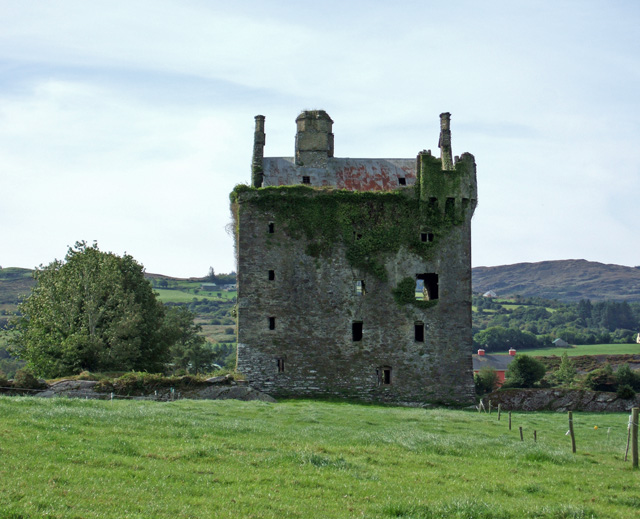
Togher Castle (Irish: Caisleán an Tóchair), is a late 16th century tower house primarily known for its association with the MacCarthys of Gleannacroim. It is located approximately 9 kilometres (5.6 mi) north of the town of Dunmanway in the townland of Togher, which derives from the Irish "tóchar" meaning "causeway", or "causeway of wood over a bog".
Purportedly built on the site of an older structure, Togher Castle sits on a low rocky ridge, about 100 metres north of the River Bandon. While the tower house has had slight modifications over time, the overall fabric remains true to the original design when it was first erected. Principally serving a defensive function, many of its features considered the comfort of the residents associated with the era of fortified houses. Today, there is no remains of a bawn, or any other form of enclosure.
Rectangular in plan, the breath of the east and west walls measure approximately 10 metres (32 ½ ft), and the length of the north and south walls approximately 16.4 metres (54 ft). The overall height is estimated to be about 18 metres (57 ft).
The exterior walls were originally pointed smooth with mortar, with the windows being finely dressed with Cork limestone. The base-batter slopes from the ground level to the first floor. The parapet wall is now mostly ruined, except the western side which survives to its full height. Two great machicolations or bartizans project from the south-east, and north-west corners respectively, with the latter well-preserved.
Togher is an unvaulted tower house, with no surviving ceiling over any of the four floors, except the remnants of 19th century corrugated iron sheets acting as a roof. The whole interior structure is divided into two unequal sections by an offset partition wall to the east side, running between the north and south main walls, and extending the full height of the tower. This allows for the division of the floors into two sets of chambers with the western sections being the larger. The central chimney stack, a continuation of the internal partition wall, contains live flues, while the chimneys on the east and west gables are a decorative feature.
The original ground floor entrance is located to the east, with a window in the western wall since enlarged into an additional doorway. On the right wall of the entrance hall hangs a late 19th century MacCarthy coat of arms funded by Daniel MacCarthy (Glas) (1807–1884), with the lines: Mac Carṫaiġ an orsa, laṁ laidir a buaḋ, which translates to "Mac Carthy of the forces, victory to the strong hand".
The large ground floor major chamber is suggested to have once served primarily as a store room or a wine cellar.
On the north-eastern corner of the tower house, a circular winding staircase leads from the entrance hallway to the top level, from which doors open to each of the major chambers on each floor. A small windowless dungeon is located left of the first stairway, and is recorded by Lyons & Gillman as chambrín á chodaigh ("the tyrant's little chamber").
Hub AI
Togher Castle AI simulator
(@Togher Castle_simulator)
Togher Castle
Togher Castle (Irish: Caisleán an Tóchair), is a late 16th century tower house primarily known for its association with the MacCarthys of Gleannacroim. It is located approximately 9 kilometres (5.6 mi) north of the town of Dunmanway in the townland of Togher, which derives from the Irish "tóchar" meaning "causeway", or "causeway of wood over a bog".
Purportedly built on the site of an older structure, Togher Castle sits on a low rocky ridge, about 100 metres north of the River Bandon. While the tower house has had slight modifications over time, the overall fabric remains true to the original design when it was first erected. Principally serving a defensive function, many of its features considered the comfort of the residents associated with the era of fortified houses. Today, there is no remains of a bawn, or any other form of enclosure.
Rectangular in plan, the breath of the east and west walls measure approximately 10 metres (32 ½ ft), and the length of the north and south walls approximately 16.4 metres (54 ft). The overall height is estimated to be about 18 metres (57 ft).
The exterior walls were originally pointed smooth with mortar, with the windows being finely dressed with Cork limestone. The base-batter slopes from the ground level to the first floor. The parapet wall is now mostly ruined, except the western side which survives to its full height. Two great machicolations or bartizans project from the south-east, and north-west corners respectively, with the latter well-preserved.
Togher is an unvaulted tower house, with no surviving ceiling over any of the four floors, except the remnants of 19th century corrugated iron sheets acting as a roof. The whole interior structure is divided into two unequal sections by an offset partition wall to the east side, running between the north and south main walls, and extending the full height of the tower. This allows for the division of the floors into two sets of chambers with the western sections being the larger. The central chimney stack, a continuation of the internal partition wall, contains live flues, while the chimneys on the east and west gables are a decorative feature.
The original ground floor entrance is located to the east, with a window in the western wall since enlarged into an additional doorway. On the right wall of the entrance hall hangs a late 19th century MacCarthy coat of arms funded by Daniel MacCarthy (Glas) (1807–1884), with the lines: Mac Carṫaiġ an orsa, laṁ laidir a buaḋ, which translates to "Mac Carthy of the forces, victory to the strong hand".
The large ground floor major chamber is suggested to have once served primarily as a store room or a wine cellar.
On the north-eastern corner of the tower house, a circular winding staircase leads from the entrance hallway to the top level, from which doors open to each of the major chambers on each floor. A small windowless dungeon is located left of the first stairway, and is recorded by Lyons & Gillman as chambrín á chodaigh ("the tyrant's little chamber").