
.jpg/250px-Tom_MacArthur_official_congressional_photo_(cropped).jpg)


.jpg/1516px-Tom_MacArthur_official_congressional_photo_(cropped).jpg)
Community hub
Recent from talks
Contribute something
Nothing was collected or created yet.
Tom MacArthur
View on Wikipedia
Thomas Charles MacArthur (born October 16, 1960) is an American former insurance executive and politician.[1] He served as the U.S. representative for New Jersey's 3rd congressional district from 2015 to 2019. A Republican, MacArthur served on the city council of Randolph, New Jersey, from 2011 through 2013, and as its mayor in 2013. He was elected to the U.S. House of Representatives in 2014.[2] After leaving Congress MacArthur returned to private business.
Key Information

.jpg)
Early life, education, and career
[edit]MacArthur grew up in Hebron, Connecticut. He received his bachelor's degree from Hofstra University.[3] After graduating from Hofstra, MacArthur became an insurance adjuster.[4] He served as the chairman and CEO of York Risk Services Group, a multi-national organization that provides insurance services. He was chairman and chief executive officer of York Risk Services Group for 11 years. He served on the Randolph, New Jersey, Township Council from 2011 through 2013, including a tenure as mayor in 2013.[3][5][6][7]
U.S. House of Representatives
[edit]Elections
[edit]2014
[edit]When Jon Runyan, a Republican who represented New Jersey's 3rd congressional district in the United States House of Representatives, announced that he would not run for reelection in 2014, MacArthur chose to run for the Republican Party nomination. MacArthur resigned from the Randolph council to move into the congressional district, where he had owned a home.[8][9] He ran against Steve Lonegan in the Republican Party's primary election, and defeated him.[10]
MacArthur faced Democratic nominee Aimee Belgard, a Burlington County freeholder, in the general election. MacArthur's campaign expenditures totaled $5.6 million, with MacArthur personally contributing over $5 million to his campaign from his personal fortune.[11][12] MacArthur outspent Belgard by about three to one (with both campaigns' spending equaling a combined total of $7.4 million), making the race the most expensive open-seat contest in the country in 2014.[13][12] MacArthur defeated Belgard by nearly a 10-point margin.[14]
He was sworn in on January 6, 2015, along with 58 other new members of the House of Representatives.[15] He was assigned to the Armed Services Committee and two of its subcommittees, the Subcommittee on Tactical Air and Land Forces and Subcommittee on Military Personnel. MacArthur was elected Vice Chairman of the latter subcommittee. He was also assigned to the Natural Resources Committee as well as two of its subcommittees, the Subcommittee on Federal Lands and the Subcommittee on Water, Power, and Oceans.[16]
On February 2, 2015, MacArthur introduced the "Disaster Assistance Fairness and Accountability Act of 2015"[17] that will prevent the Federal Emergency Management Agency from taking back disaster relief funds from individuals who applied for them in good faith.[18] On March 25, 2015, MacArthur introduced the "Veterans' Mental Health Care Access Act"[19] to allow veterans with a Choice Card to access mental health care at any facility eligible for reimbursement by the Centers for Medicare and Medicaid Services.[20][21] Both bills were considered "dead," by virtue of a failure to garner approval from Republican-led subcommittees, before the final sine die Adjournment of the 114th Congress.[22][23][24][25][26] MacArthur's legislation to reform FEMA was re-introduced in the 115th Congress and became law.[27]
2016
[edit]MacArthur ran for re-election in 2016.[28] He ran unopposed in the Republican primary. In the general election, he faced Democrat Frederick John Lavergne.[29] MacArthur won the election with 60% of the vote.[30]
At his second term MacArthur was appointed to the Committee on Financial Services and stepped down from the Armed Services Committee and the Natural Resources Committee.[31][32] He was also a member of the Republican Main Street Partnership[33] and the Climate Solutions Caucus.[34]
2018
[edit]MacArthur was defeated by Democrat Andy Kim, a former national security aide to President Obama, in the midterm election on November 6.[35] The race was not officially called for eight days, after which Kim was declared the winner.[36] With a margin of victory of fewer than 4,000 votes, or slightly over one percent of votes cast, this congressional race was the closest in New Jersey.[37][38]
During the campaign, MacArthur emphasized his bipartisan record, willingness to oppose his own party, and his record of constituent service, while seeking to highlight Kim's apparent exaggeration of his resume and portray him as a "radical resistance" figure.[39][40][41][42] Kim highlighted MacArthur's prominent role in the Republican efforts to repeal and replace the Affordable Care Act, while emphasizing his own experience in national security and his refusal to accept corporate PAC donations.[43][44][45]
During the campaign, MacArthur sought to portray Kim as a D.C. elitist and outsider. In an ad run by the New Jersey Republican Party, Kim was described as "Real Fishy" in wonton font, a font that has been associated with expressing "Asianness," on a picture of dead fish. MacArthur dismissed charges that the ad was racist, "Some fish on a piece of paper is suddenly racist? What is racist about a picture of fish? Now we're politicizing fonts? It's not a racist font, it's a font meant to stand out."[46][47] When MacArthur was accused of bigotry by U.S. Rep Adam Schiff in reference to another controversial ad that described Kim as "not one of us," MacArthur demanded an apology to his two adopted children, who are Korean American, and highlighted that the ad in question was not authorized by his campaign.[48][49][50]
Committee assignments
[edit]- 115th Congress
- 114th Congress
Caucus and leadership positions
[edit]MacArthur was elected or assigned to several leadership roles during his tenure, including Co-Chair of the Tuesday Group (a group of moderate or centrist Republicans), Co-Chair of the Bipartisan Heroin and Opioid Taskforce,[51] and Commissioner of the Puerto Rico Growth Commission.[52] MacArthur also was a member of the Board of Directors of the National Republican Campaign Committee, and Trustee of the Kennedy Center of the Performing Arts.[53]
Political positions
[edit]MacArthur was ranked as the 15th most bipartisan member of the U.S. House of Representatives during the 115th Congress and the 44th most bipartisan in the 114th United States Congress in the Lugar Center – Georgetown University McCourt School of Public Policy Bipartisan Index.[54][55] As of October 2018, MacArthur had voted with his party in 89.3% of votes in the 115th United States Congress.[56] As of October 2018, FiveThirtyEight found that MacArthur had voted in line with President Trump's position 94.6% of the time.[57] As of September 2018, he had voted in line with President Trump's position more than any other member of Congress from the state of New Jersey.[58]
Economic issues
[edit]MacArthur was the only member of Congress from the New Jersey congressional delegation to vote yes for the federal Tax Cuts and Jobs Act of 2017; other lawmakers harshly criticized the adverse impact of the bill on New Jersey taxpayers.[59][60][61] The tax plan would lead to an aggregate tax cut in most states, but has stirred controversy in New Jersey due to the decrease in the State and Local Tax (SALT) deduction to $10,000, which means that the bill raises taxes on many New Jersey citizens.[62][59][60] MacArthur explained his vote by asserting that "nearly all taxpayers" in his district do not need SALT deductions above $10,000, and citing his efforts to restore the deduction to $10,000 after prior versions of the bill eliminated it entirely.[59][60][63][64] When asked to elaborate by the Washington Post fact-checker, MacArthur said that 93% of his constituents did not pay SALT higher than $10,000 and shared his team's calculations with the Washington Post.[60] The Washington Post fact-checker gave MacArthur "Two Pinocchios", writing that "even that accounting ignores the interaction of the property tax provision with other parts of the tax bill, so even people who would benefit from the cap still might find themselves with an increase in taxes. MacArthur appears to have worked diligently to tilt the bill so that it would benefit his constituents, but he oversells his achievement."[60]
MacArthur was the only member of the New Jersey congressional delegation to vote in favor of a bill that funded farm subsidies for five additional years while imposing work requirements and new restrictions on food stamp usage.[65] According to NJ.com, the bill, which did not pass, would have cost 35,000 New Jersey residents their access to food stamps.[65] According to Vote Smart's 2016 analysis, MacArthur generally opposes allowing individuals to divert a portion of their Social Security taxes into personal retirement accounts.[66]
Environment
[edit]MacArthur introduced legislation to combat pollution in Barnegat Bay and cosponsored legislation to reauthorize the National Estuaries Program.[67][68] The League of Conservation Voters has given him a lifetime score of 10%.[69] MacArthur opposes the Trump administration's proposal to open New Jersey's waters to offshore oil and gas drilling.[70] According to Vote Smart's 2016 analysis, MacArthur generally supports the building of the Keystone Pipeline, supports government funding for the development of renewable energy, and opposes the federal regulation of greenhouse gas emissions.[66]
Gun policy
[edit]MacArthur had described himself as a supporter of the Second Amendment and was endorsed by the NRA Political Victory Fund with a 93% ("AQ") rating.[71][72][73][74]
Healthcare
[edit]MacArthur became a key player in efforts to repeal and replace the Affordable Care Act, citing the loss of his first child and his own background in insurance as motivating factors.[75] Then-candidate Andy Kim cited MacArthur involvement as a motivating factor for his own run against MacArthur, and healthcare became a dominant theme in the campaign.[76] MacArthur has repeatedly called for repealing the Affordable Care Act and helped craft legislation for its repeal.[77][78][79] However, in January 2017, he was one of nine Republicans who voted no on its repeal.[80]
On March 20, 2017, MacArthur announced his support for the American Health Care Act of 2017.[81]
On April 25, 2017, MacArthur introduced an amendment to the Act which became known as the MacArthur Amendment.[82] It permits states to waive out of Obamacare's ban on pre-existing conditions, allowing insurers to charge sick people higher premiums than healthy people. It also dictates that health insurance offered to members of Congress and their staffs not be included in the exemption from covering pre-existing conditions.[83] A Washington Post-ABC News poll conducted in April 2017, found that 70 per cent of Americans favored protections for pre-existing conditions.[84]
In response to MacArthur's vote to pass the AHCA, which would partially repeal and replace Obamacare, there were protests in his district, and MacArthur held town halls where some constituents questioned MacArthur about his vote.[85][86][87]
MacArthur resigned as chair of the Tuesday Group in May 2017 due to disagreements among its members over the AHCA.[88]
The repeal effort was defeated in the Senate in a narrow vote where Republican senators Susan Collins, Lisa Murkowski, and John McCain joined with all Senate Democrats in voting against it.[89][90]
LGBT rights
[edit]MacArthur's 2014 campaign website stated that he believes marriage is "between one man and one woman," and that questions of marriage should be resolved at the state level.[91][92] It would appear later versions of MacArthur's campaign website did not contain this language. MacArthur led a bipartisan effort to include sexual orientation and gender identity in the 2020 Census, and opposed the Trump Administration's efforts to ban transgender persons from military service.[93][94] Garden State Equality, a New Jersey LGBT advocacy organization, endorsed MacArthur for re-election in 2016.[95] In 2018 Garden State Equality stated that MacArthur was "one of the most pro-LGBTQ Republicans in the nation and has proven a steadfast ally to the LGBTQ community," though the organization withheld an endorsement in the race due to differences with MacArthur over healthcare policy.[96]
Personal life
[edit]MacArthur lives in Toms River, New Jersey, and also owns homes in Randolph and Barnegat Light, New Jersey.[97][98] He is married to his wife Debbie and has two children, a son and daughter, both adopted.[99] Their first child, Gracie, was born with special needs and died in 1996 at the age of 11.[3][100]
MacArthur and his wife, Debbie, have been active in charity work. Since 2005 they have operated In God's Hands Charitable Foundation, a private grantmaking foundation, in memory of their late daughter.[101][102] The charity's tax returns show funding for a variety of programs, including support for people with disabilities, veterans, orphans, prison inmates and their families, and people affected by natural disasters, hunger, and homelessness.[103]
During his time in office, MacArthur was the wealthiest member of New Jersey's congressional delegation, with minimum reported assets worth about $31.8 million as of July 2017.[104] Other sources place his net worth at almost $53 million.[105]
MacArthur is an Episcopalian.[106]
MacArthur owns and operates multiple businesses in the marina and hospitality sectors, including the Bayview Harbor marina[107][108] and the affiliated Sandcastle Luxury Bed and Breakfast,[109] both in Barnegat Light, NJ, and a yacht holding company which operates a vacation rental and charter yacht.[110][111]
Electoral history
[edit]| Party | Candidate | Votes | % | |
|---|---|---|---|---|
| Republican | Tom MacArthur | 4,650 | 22.38 | |
| Republican | James Loveys | 4,612 | 22.20 | |
| Republican | Michael Guadagno | 4,522 | 21.76 | |
| Republican | Allen Napoliello | 4,317 | 20.78 | |
| Democratic | Nancie Ludwig | 2,672 | 12.86 | |
| Party | Candidate | Votes | % | ±% | |
|---|---|---|---|---|---|
| Republican | Tom MacArthur | 15,908 | 59.7 | ||
| Republican | Steve Lonegan | 10,643 | 40.3 | ||
| Turnout | 26,551 | 100.0 | |||
| Party | Candidate | Votes | % | ±% | |
|---|---|---|---|---|---|
| Republican | Tom MacArthur | 100,471 | 53.76 | ||
| Democratic | Aimee Belgard | 82,537 | 44.09 | ||
| D-R Party | Frederick John Lavergne | 3,095 | 1.61 | ||
| Turnout | 186,103 | 100.0 | |||
| Party | Candidate | Votes | % | ±% | |
|---|---|---|---|---|---|
| Republican | Tom MacArthur | 194,596 | 59.31 | ||
| Democratic | Frederick John LaVergne | 127,526 | 38.87 | ||
| Constitution Party | Lawrence Bolinski | 5,938 | 1.81 | ||
| Turnout | 328,060 | 100.0 | |||
| Party | Candidate | Votes | % | ±% | |
|---|---|---|---|---|---|
| Democratic | Andy Kim | 153,473 | 50.0 | ||
| Republican | Tom MacArthur | 149,500 | 48.7 | ||
| Constitution Party | Lawrence Bolinski | 3,902 | 1.3 | ||
| Turnout | 306,875 | 100.0 | |||
References
[edit]- ^ "N.J. GOP Rep. Tom MacArthur, Dem challenger Andy Kim face off in forum". WHYY. Retrieved September 10, 2018.
- ^ "N.J.'s rookie Republican learns: Even in divided D.C., he's got to deal with Dems". NJ.com. April 11, 2015. Retrieved May 14, 2015.
- ^ a b c "A look at congressional candidate Tom MacArthur". Associated Press. May 3, 2014. Retrieved November 5, 2014.
- ^ Marcos, Christina (April 25, 2017). "Meet the centrist trying to strike a deal on healthcare". The Hill. Retrieved May 16, 2018.
- ^ "Highlands Council Meeting" (PDF). New Jersey Highlands Council. Retrieved December 17, 2022.
- ^ "Minutes: January 1, 2013". Township of Randolph, New Jersey. Retrieved December 17, 2022.
- ^ "Minutes: January 1, 2014". Township of Randolph, New Jersey. Retrieved December 17, 2022.
- ^ Knapp, Claire. "Former fire chief is new Randolph Councilman; Forstenhausler will fill MacArthur's term", Randolph Reporter, February 10, 2014; accessed July 6, 2014; "Mark Forstenhausler, 54, was sworn in as a member of the Township Council on Thursday, Feb. 6, to complete the term vacated by Tom MacArthur."
- ^ "Congressman Tom MacArthur Faces Tough Battle to Keep 3rd District". New Jersey Monthly. October 10, 2018. Retrieved March 16, 2019.
- ^ "MacArthur, Belgard to compete for N.J.'s Third District seat". Philly.com. June 5, 2014. Archived from the original on December 10, 2014.
- ^ "Rep. Thomas MacArthur, Cycle Fundraising, 2013-14". OpenSecrets.
- ^ a b "N.J. scrap was nation's most expensive for open U.S. House seat in 2014". NJ.com. April 7, 2015. Retrieved May 2, 2017.
- ^ "New Jersey Congressional Races in 2014". OpenSecrets.
- ^ a b "Official List Candidates for House of Representatives for General Election" (PDF). 2014 Election Information Archive. State of New Jersey, Department of State. December 2, 2014. p. 6. Retrieved May 15, 2015.
- ^ Dooley, Erin; Saenz, Arlette; Parkinson, John (January 6, 2015). "Home - Politics 114th Congress' Opening Day: Republicans Take the Reins on Capitol Hill". ABC News. Retrieved May 15, 2015.
- ^ "Congressman Tom MacArthur, 3rd District of New Jersey, Committees and Caucuses". House of Representatives. 2015. Retrieved May 15, 2015.
- ^ "H.R. 638 – Disaster Assistance Fairness and Accountability Act of 2015". Congress.gov. February 5, 2015. Retrieved May 5, 2015.
- ^ Zimmer, Russ (February 3, 2015). "Another proposal to stop FEMA's Sandy aid clawbacks". Asbury Park Press. Retrieved May 6, 2015.
- ^ "H.R. 1604 – Veterans' Mental Health Care Access Act". Congress.gov. April 7, 2015. Retrieved May 6, 2015.
- ^ Joyce, Tom (April 24, 2015). "Congressman MacArthur pushing to expand mental health service options for veterans". Newsworks. Retrieved April 24, 2015.
- ^ Levinsky, David (April 26, 2015). "MacArthur: Veterans need better access to mental health care services". Burlington County Times. Retrieved May 6, 2015.
- ^ "All Actions H.R.1604 — 114th Congress (2015-2016)". Congress.gov. Library of Congress. April 7, 2015. Retrieved May 16, 2015.
- ^ "All Actions H.R.638 — 114th Congress (2015-2016)". Congress.gov. Library of Congress. February 5, 2015. Retrieved May 16, 2015.
- ^ "Legislative Research: US HB638 | 2015-2016 | 114th Congress". LegiScan. Retrieved May 2, 2017.
- ^ Tom MacArthur (March 25, 2015). "Veterans' Mental Health Care Access Act (2015; 114th Congress H.R. 1604)". GovTrack.us. Retrieved May 2, 2017.
- ^ Tom MacArthur (February 2, 2015). "Disaster Assistance Fairness and Accountability Act of 2015 (2015; 114th Congress H.R. 638)". GovTrack.us. Retrieved May 2, 2017.
- ^ Levinsky, David. "Legislation to reform disaster aid process now federal law". Burlington County Times. Retrieved March 16, 2019.
- ^ Levinsky, David (March 31, 2016). "Tom MacArthur kicks off congressional re-election campaign". Burlington County Times. Retrieved April 29, 2016.
- ^ Hefler, Jan (June 8, 2016). "Frederick LaVergne to face Rep. Tom MacArthur in fall". Philly.com. Retrieved June 8, 2016.
- ^ Melisurgo, Len (November 8, 2016). "Live congressional election results, ballot questions in N.J." NJ.com. Retrieved November 11, 2016.
- ^ Levinsky, David (January 5, 2017). "MacArthur moving from Armed Services Committee to Financial Services". Burlington County Times. Retrieved September 20, 2017.
- ^ "Tom MacArthur's Biography". Vote Smart. Retrieved September 20, 2017.
- ^ "Members". Republican Mains Street Partnership. Retrieved October 4, 2017.
- ^ "90 Current Climate Solutions Caucus Members". Citizen's Climate Lobby. Retrieved October 20, 2018.
- ^ Reilly, Ryan J. (October 30, 2018). "Andy Kim Is A South Jersey Boy. The GOP Calls Him 'Not One Of Us.'". Huffington Post. Retrieved October 30, 2018.
- ^ "NJ election results 2018: MacArthur concedes, Andy Kim wins 3rd District race". Asbury Park Press. Retrieved March 16, 2019.
- ^ "New Jersey's 3rd Congressional District election, 2018". Ballotpedia. Retrieved March 16, 2019.
- ^ "Surprises Amid Flips from Red to Blue, and MacArthur-Kim Still Undecided - NJ Spotlight". www.njspotlight.com. November 7, 2018. Retrieved March 16, 2019.
- ^ "New Jersey's 3rd Congressional District election, 2018". Ballotpedia. Retrieved March 16, 2019.
- ^ Rizzo, Salvador (September 10, 2018). "Obama adviser running for Congress claims he also worked for Bush". The Washington Post. Retrieved March 16, 2019.
- ^ MacArthur for Congress (October 24, 2018), BCT, retrieved March 16, 2019
- ^ MacArthur for Congress (October 17, 2018), Linda, retrieved March 16, 2019
- ^ "New Jersey's 3rd Congressional District election, 2018". Ballotpedia. Retrieved March 16, 2019.
- ^ Andy Kim For Congress (September 20, 2017), Andy Kim for Congress - Official Launch Video, retrieved March 16, 2019
- ^ Levinsky, David. "Tom MacArthur and Andy Kim campaigns battle over pledge to refuse corporate PAC money". Burlington County Times. Retrieved March 16, 2019.
- ^ Willis, Jay (October 31, 2018). "Republican Candidates Sure do Love Sending Gross, Bigoted Mailers to Prospective Voters". GQ. Retrieved October 17, 2024.
- ^ "There are still 6,400 votes to count. MacArthur's chances of beating Kim are slim". November 10, 2018.
- ^ Lott, Maxim (October 19, 2018). "GOP rep slams Dem's 'false' charge of bigotry". Fox News. Retrieved June 17, 2019.
- ^ Rodrigo, Chris Mills (October 18, 2018). "GOP Rep to top-ranking Dem who accused him of bigotry: 'Apologize to my children'". TheHill. Retrieved June 17, 2019.
- ^ Rachel Ventresca (October 19, 2018). "GOP rep slams Schiff over accusation of racism". CNN. Retrieved June 17, 2019.
- ^ Levinsky, David. "Bipartisan Heroin Task Force to push agenda that includes 'robust funding' to address opioid crisis". Burlington County Times. Retrieved April 7, 2019.
- ^ Lane, Sylvan (July 15, 2016). "Leaders appoint allies, adversaries to Puerto Rico growth task force". TheHill. Retrieved April 7, 2019.
- ^ "The Kennedy Center: FY 2018 Annual Report". www.kennedy-center.org. Retrieved April 7, 2019.
- ^ "Our Work". www.thelugarcenter.org. Retrieved April 7, 2019.
- ^ The Bipartisan Index ranks members of the United States Congress by their degree of bipartisanship (by measuring the frequency each member's bills attract co-sponsors from the opposite party and each member's co-sponsorship of bills by members of the opposite party). "Our Work: Bipartisan Index". The Lugar Center. Retrieved September 20, 2017. The Lugar Center - McCourt School Bipartisan Index (PDF), The Lugar Center, March 7, 2016, retrieved April 30, 2017
- ^ Willis, Derek. "Represent". ProPublica. Retrieved March 3, 2017.
- ^ Tracking Congress in the Age of Trump, accessed September 27, 2018
- ^ You'll never believe who the Tea Party just endorsed in N.J., accessed September 27, 2018
- ^ a b c "MacArthur Votes for GOP Tax Overhaul". Observer. November 17, 2017. Retrieved September 9, 2018.
- ^ a b c d e Kessler, Glenn (December 4, 2017). "Analysis | The GOP's $10,000 cap on property tax deductions and how it affects one congressional district". Washington Post. ISSN 0190-8286. Retrieved December 8, 2017.
- ^ "Why this N.J. Republican keeps voting for things that could hurt Jersey". NJ.com. Retrieved September 10, 2018.
- ^ "This pro-Trump Jersey congressman could be in real trouble. Here's why". NJ.com. Retrieved September 9, 2018.
- ^ Levinsky, David. "Rep. Tom MacArthur lone NJ 'yes' on Tax Reform 2.0". Burlington County Times. Retrieved April 7, 2019.
- ^ "MacArthur Votes for GOP Tax Overhaul". Observer. November 17, 2017. Retrieved April 7, 2019.
- ^ a b "This Republican was only Jersey politico to back bill that would have cut N.J. food stamps". NJ.com. Retrieved May 22, 2018.
- ^ a b "Tom McArthur's Issue Positions (Political Courage Test)". Vote Smart. Retrieved January 10, 2018.
- ^ "MacArthur announces bill to protect Barnegat Bay". Press of Atlantic City. October 2015. Retrieved April 7, 2019.
- ^ LoBiondo, Frank A. (June 2, 2015). "Cosponsors - H.R.944 - 114th Congress (2015-2016): To reauthorize the National Estuary Program, and for other purposes". www.congress.gov. Retrieved April 7, 2019.
- ^ "Check out Representative Tom MacArthur's Environmental Voting Record". League of Conservation Voters Scorecard. Retrieved March 3, 2017.
- ^ "Atlantic oil drilling: Phil Murphy, lawmakers don't want it off NJ". Asbury Park Press. Archived from the original on August 23, 2023. Retrieved January 9, 2018.
- ^ "NRA-PVF | Grades | New Jersey". nrapvf.org. NRA-PVF. Archived from the original on November 4, 2014.
- ^ "Your Freedom is Under Attack! Vote On or Before November 6th!". nrapvf.org. NRA-PVF. Archived from the original on August 23, 2023. Retrieved August 23, 2023.
Tom MacArthur has received our endorsement and "A" rating:
- ^ "N.J. Republican just did a big switch on guns after Florida shooting". NJ.com. Archived from the original on February 22, 2018. Retrieved September 10, 2018.
- ^ "On guns, N.J. Congressman's rhetoric doesn't match his horrid record | Editorial". NJ.com. Retrieved September 10, 2018.
- ^ "GOP congressman's push to pass health care stems from daughter's death". NBC News. May 2, 2017. Retrieved April 7, 2019.
- ^ "Democrat Andy Kim beats GOP incumbent in New Jersey". PBS NewsHour. November 14, 2018. Retrieved April 7, 2019.
- ^ "The Voter's Self Defense System". Project Vote Smart. Retrieved March 3, 2017.
- ^ "Tom MacArthur is trying to fool you. He's a partisan warrior. | Moran". NJ.com. Retrieved September 9, 2018.
- ^ "Midterm election poll: Tom MacArthur, Andy Kim are in a virtual tie". North Jersey. Retrieved September 10, 2018.
- ^ "N.J. GOP Congressman MacArthur votes no on Obamacare repeal". North Jersey. Retrieved March 3, 2017.
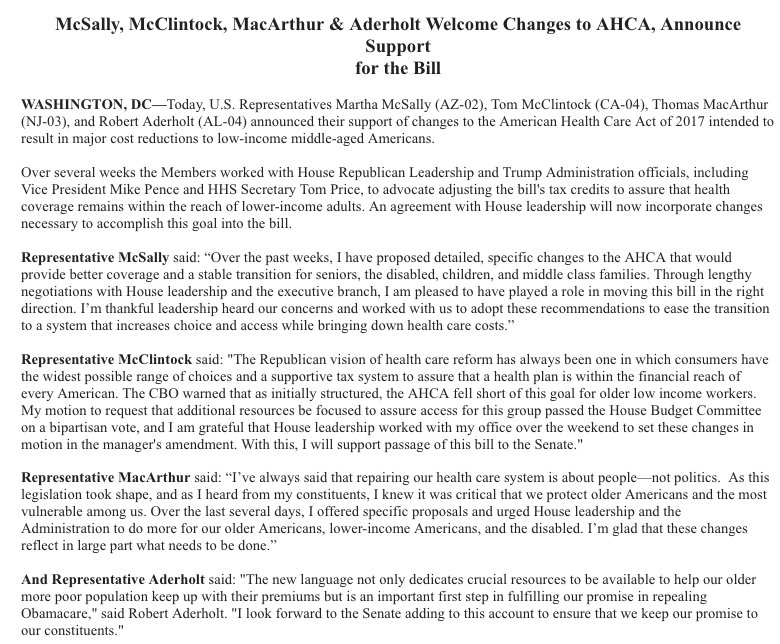
- ^ "McSally, McClintock, MacArthur & Aderholt Welcome Changes to AHCA" (JPG). Pbs.twimg.com. Retrieved May 18, 2017.
- ^ Huetteman, Emmarie (May 11, 2017). "In New Jersey, Democrats Hope No Good Health Care Compromise Goes Unpunished". The New York Times. Retrieved September 10, 2018.
- ^ Kliff, Sarah. "Republicans exempt their own insurance from their latest health care proposal", "Vox", April 25, 2017, Retrieved April 26, 2017
- ^ Kliff, Sarah. "Republicans’ new health amendment lets insurers charge sick people more, cover less", "Vox", April 25, 2017. Retrieved April 26, 2017
- ^ Berman, Russell. "A Republican Congressman Meets His Angry Constituency". The Atlantic. Retrieved December 2, 2017.
- ^ Fox, Lauren. "MacArthur defends his linchpin health care amendment to raucous crowd". CNN. Retrieved September 10, 2018.
- ^ Pathé, Simone (May 11, 2017). "Tom MacArthur Feels Heat at Home Over Health Care, Russia". Roll Call. Retrieved September 10, 2018.
- ^ "MacArthur resigns as co-chairman of 'clearly divided' Tuesday Group". Politico PRO. Retrieved October 15, 2018.
- ^ "Can Tom MacArthur, the Republican author of a failed Obamacare repeal bill, survive the midterms?". Mic. October 2, 2018. Retrieved January 11, 2020.
- ^ "Obamacare repeal architect Tom MacArthur defeated by former Obama adviser". Salon. November 16, 2018. Retrieved January 11, 2020.
- ^ Gangitano, Alex; Gangitano, Alex (March 5, 2018). "LGBT Staff Association Has Republican on Board for First Time in Decade". Roll Call. Retrieved September 10, 2018.
- ^ "The Voter's Self Defense System". Vote Smart. Retrieved March 16, 2019.
- ^ Gangitano, Alex; Gangitano, Alex (March 5, 2018). "LGBT Staff Association Has Republican on Board for First Time in Decade". Retrieved March 16, 2019.
- ^ "GOP congressmen who bucked party on transgender issue now question Trump's military ban". North Jersey. Retrieved March 16, 2019.
- ^ "Garden State Equality Announces List of Bipartisan Congressional Endorsements". Garden State Equality. October 13, 2016. Retrieved March 16, 2019.
- ^ "Garden State Equality: (Full!) List of Endorsements". Insider NJ. September 25, 2018. Retrieved March 16, 2019.
- ^ "MacArthur wins vs. Belgard in 3rd Congressional District". Asbury Park Press. USA Today Network. November 4, 2014. Retrieved May 16, 2018.
- ^ "Big bucks flowing to Tom MacArthur, Andy Kim in 3rd District race". Burlington County Times. GateHouse Media. October 17, 2017. Retrieved May 16, 2018.
- ^ Salant, Jonathan D. (February 11, 2015). "N.J.'s rookie Republican: Rep. Tom MacArthur focuses on the folks back home". NJ.com. Retrieved September 20, 2017.
- ^ "MacArthur leaving Randolph; Set to pursue seat in Congress". New Jersey Hills Media Group. December 13, 2013. Retrieved November 5, 2014.
- ^ "New Members Guide 2015". The Hill. Archived from the original on November 28, 2014. Retrieved May 16, 2018.
- ^ "Igh Charitable Foundation Inc - GuideStar Profile". www.guidestar.org. Retrieved April 16, 2025.
- ^ "IGH Charitable Foundation Inc. (2022). Return of private foundation [Form 990-PF]" (PDF). Guidestar.
- ^ Salant, Jonathan D. (July 11, 2017). "Who is N.J.'s richest member of Congress? The poorest? They're all ranked here". NJ.com. Retrieved September 20, 2017.
- ^ D, Jonathan (May 4, 2017). "Meet Tom MacArthur: 9 things to know about N.J. lawmaker at center of health care bill". nj.com. Retrieved April 7, 2019.
- ^ "Religious affiliation of members of 115th Congress" (PDF). Pew Research Center. Archived (PDF) from the original on March 25, 2023.
- ^ Wilson, Gordon (August 23, 2022). "Bayview Harbor Upgrades Marina Basin". Marina Dock Age.
- ^ Ford, Victoria (March 27, 2024). "Upgrades Ok'd at MacArthurs' Dual Marinas". The SandPaper.
- ^ "The Sand Castle Bed & Breakfast". www.bayviewharbor.com. September 6, 2022.
- ^ "BVH YACHT HOLDINGS, LLC". bizapedia.com. February 2, 2024.
- ^ "Lady Grace". www.bayviewharbor.com. March 10, 2023.
- ^ "Morris County general election results 2010". NJ.com. November 2, 2010. Retrieved May 2, 2017.
- ^ "Official List Candidates for House of Representatives for Primary Election" (PDF). 2014 Election Information Archive. State of New Jersey, Department of State. August 6, 2014. p. 6. Retrieved May 15, 2015.
- ^ "Official List Candidates for House of Representatives for General Election" (PDF). 2016 Election Information Archive. State of New Jersey, Department of State. December 6, 2016. p. 6. Retrieved February 21, 2016.
- ^ "New Jersey Election Results: Third House District". New York Times. November 6, 2018. Retrieved November 15, 2018.
External links
[edit]

Tom MacArthur
View on GrokipediaEarly life, education, and business career
Childhood and family origins
Thomas Charles MacArthur was born on October 16, 1960, in Milford, New Haven County, Connecticut.[1][9] He spent his childhood in the Hebron area of Connecticut.[10] MacArthur's father was a military veteran.[11] Limited public records detail the family's socioeconomic or ethnic background, though MacArthur grew up in a middle-class suburban environment typical of small-town Connecticut during the 1960s and 1970s. No verified information on his mother's profession or siblings appears in official congressional biographies or contemporaneous reporting.Formal education
MacArthur attended RHAM High School in Hebron, Connecticut, graduating in 1978.[1] He subsequently enrolled at Hofstra University in Hempstead, New York, earning his degree in 1982.[12] No specific field of study or advanced degrees are documented in available biographical records.[1][12]Rise in the insurance industry
MacArthur entered the insurance industry shortly after graduating from Hofstra University in 1982, beginning his career as an insurance adjuster with an annual salary of $13,000.[2][5] Over the subsequent decades, he advanced through various roles, accumulating approximately 28 to 30 years of experience in claims administration and risk services.[13][10][2] In the late 1980s or early 1990s, MacArthur founded York Risk Services Group (later known as York Insurance Services Group, Inc.), a third-party claims administrator specializing in insurance services for high-risk clients and complex claims handling.[14][15] He assumed the role of chairman and chief executive officer in 1999, leading the company until his retirement in 2010.[3][13] Under his leadership, York expanded nationally, exemplified by a 2006 investment in Southern California Risk Management that integrated operations to form an organization with approximately 1,000 employees across 22 states.[16] MacArthur's business achievements earned recognition, including the 2005 Ernst & Young Entrepreneur of the Year award for New Jersey, highlighting York's innovative approach to claims administration and client service in a competitive sector.[17] By the time of his departure from the industry, York had established itself as a multinational provider of specialized insurance solutions, reflecting MacArthur's progression from entry-level adjuster to executive oversight of a substantial enterprise.[15][16]Local political involvement
Entry into Randolph Township governance
Tom MacArthur, a longtime resident of Randolph Township, New Jersey, entered local governance through his successful candidacy for the Township Committee in the November 2, 2010, general election. As a political novice with a background in the insurance industry, MacArthur campaigned on themes of fiscal responsibility and efficient management, aligning with the township's predominantly Republican electorate. Randolph's Township Committee elections are non-partisan, but the slate that year was effectively all-Republican, reflecting the area's conservative leanings. MacArthur took office on January 3, 2011, joining a five-member committee that functions as the township's legislative and governing body, responsible for enacting ordinances, approving budgets, and overseeing administration.[1] His election marked the beginning of a rapid ascent in local leadership, as committee members rotate into deputy mayor and mayor roles annually; MacArthur served as deputy mayor from 2012 to 2013 before becoming mayor in 2013.[3] During his initial term, he focused on streamlining township operations and advocating for property tax relief, drawing on his executive experience to propose cost-saving measures.[10]Mayoral tenure and local achievements
MacArthur joined the Randolph Township Committee in 2011 following his election that year.[3] He advanced to deputy mayor in 2012 and then served as mayor from 2013 until early 2014, when he resigned to pursue a congressional campaign.[1] [18] As mayor, MacArthur prioritized fiscal management amid New Jersey's high property tax environment. Under the township committee's oversight during his tenure, Randolph's effective property tax rate declined annually from 2.525 per $100 of assessed value in 2011 to 2.522 in 2012, 2.423 in 2013, and 2.364 in 2014.[19] This reduction occurred despite state-level pressures on municipal budgets, reflecting local efforts to control spending and leverage ratables from commercial development while preserving the township's appeal as a residential community with strong schools and low debt. Critics during his 2014 congressional bid, including Democratic opponents, asserted that MacArthur had supported tax increases each year on the committee, but state tax records contradict this by documenting the downward trend in rates.[20] [21] Randolph maintained its status as a fiscally stable suburb during MacArthur's leadership, with no reported budget deficits or reliance on state aid bailouts, aligning with his emphasis on prudent governance drawn from prior business experience.[22] The township's governance focused on sustaining infrastructure and community services without expanding the municipal footprint, contributing to steady population growth and property values in Morris County.[23]U.S. House of Representatives tenure
2014 congressional election
In the Republican primary for New Jersey's 3rd congressional district on June 3, 2014, Tom MacArthur, a retired insurance executive and former mayor of Randolph Township, defeated Steve Lonegan, a conservative activist and former Bogota mayoral candidate who had previously run unsuccessfully for U.S. Senate and governor.[24][25] MacArthur secured 29,273 votes (59.2%), while Lonegan received 20,195 votes (40.8%). The contest pitted the Republican establishment-backed MacArthur against the Tea Party-aligned Lonegan in a race marked by personal attacks, including Lonegan's accusations that MacArthur was a "carpetbagger" for relocating from Morris County to the district shortly before announcing his candidacy.[25][26] MacArthur positioned himself as a pragmatic conservative focused on fiscal responsibility and local governance experience, while Lonegan emphasized ideological purity on issues like opposition to the Affordable Care Act and immigration reform.[27] The general election pitted MacArthur against Democrat Aimee Belgard, a Burlington County freeholder who won her party's primary unopposed after raising the most funds and securing endorsements from Democratic leaders. The open seat, vacated by retiring Republican incumbent Jon Runyan, drew national attention as one of the most expensive House races in the 2014 cycle, with combined spending exceeding $15 million fueled by outside groups and attack ads.[28][29] Debates and campaigns highlighted stark differences: MacArthur advocated repealing the Affordable Care Act, citing its costs and mandates as harmful to small businesses and individuals; Belgard defended the law's protections for preexisting conditions while criticizing MacArthur's insurance industry background.[30] On economic issues, MacArthur supported tax cuts and deregulation to spur job growth, opposing extensions of unemployment benefits without offsets, whereas Belgard favored raising the minimum wage and investing in infrastructure.[30] Both candidates agreed on protecting Social Security and Medicare but diverged on abortion—MacArthur favored restrictions with exceptions for rape, incest, and maternal health, while Belgard supported Roe v. Wade—and gun rights, with MacArthur backing Second Amendment protections and Belgard pushing background checks.[30][31] Ads from both sides escalated negativity, with Belgard questioning MacArthur's residency and business ties, and MacArthur portraying Belgard as overly partisan.[32][20] On November 4, 2014, MacArthur won the general election with 111,016 votes (55.9%), defeating Belgard who received 85,004 votes (42.9%); independent and other candidates took the remainder.[28][33] The victory maintained Republican control of the district, which had a Cook Partisan Voting Index rating leaning Republican, amid a national Republican wave that year.[34] MacArthur's win was attributed to strong turnout in suburban Ocean and Monmouth counties and his appeal as a self-made businessman emphasizing practical solutions over ideology.[35][34]2016 reelection campaign
Incumbent Tom MacArthur sought reelection to represent New Jersey's 3rd congressional district in the 2016 cycle, following his initial victory in 2014.[3] He faced no challengers in the Republican primary election on June 7, 2016. In the general election on November 8, 2016, MacArthur defeated Democratic nominee Frederick LaVergne, a former U.S. Marine and attorney who had won his party's primary with 62.8% of the vote against Jim Keady, and Constitution Party candidate Lawrence Berlinski Jr. MacArthur garnered 194,596 votes (59.3%), while LaVergne received 127,526 votes (38.9%) and Berlinski 5,938 votes (1.8%), yielding a total of 328,060 votes cast and a margin of victory of 20.4 percentage points for the incumbent.[36] The district, encompassing suburban areas in Burlington, Monmouth, and Ocean counties, leaned Republican at the time, contributing to MacArthur's comfortable win despite Hillary Clinton carrying New Jersey statewide in the concurrent presidential election.[37] MacArthur's campaign emphasized his record as a freshman representative focused on economic growth, veterans' issues, and opposition to the Affordable Care Act, aligning with broader Republican priorities.[3] On May 5, 2016, he publicly endorsed Donald Trump as the Republican presidential nominee, citing the need to unify the party behind a single candidate. The race drew limited national attention, as polling and early indicators suggested a non-competitive contest in the district's favorable terrain for the incumbent Republican.[36]2018 election defeat
In the 2018 United States House of Representatives elections held on November 6, Democrat Andy Kim defeated two-term incumbent Republican Tom MacArthur in New Jersey's 3rd congressional district by a margin of 3,973 votes, flipping the seat from Republican control.[38] MacArthur, who had won reelection in 2016 by approximately 20 percentage points in a district that supported Donald Trump in the 2016 presidential election, did not concede on election night amid ongoing counts of mail-in and provisional ballots; Kim declared victory on November 7, and MacArthur formally conceded on November 14 after confirming the results.[39][40][41] MacArthur's defeat was attributed in part to voter backlash against his pivotal role in advancing the American Health Care Act (AHCA) in 2017, which sought to repeal major provisions of the Affordable Care Act and included amendments he negotiated to secure narrow House passage, such as weakening essential health benefits requirements and allowing states to opt out of certain consumer protections.[8][42] Democrats framed the AHCA as harmful to preexisting conditions coverage, a charge MacArthur defended by emphasizing premium reductions and state flexibility, though polls in the district showed healthcare as a top voter concern.[8] His support for the 2017 Tax Cuts and Jobs Act also drew criticism for benefiting corporations over middle-class families, contributing to perceptions of misalignment with suburban district priorities amid broader midterm anti-incumbent sentiment.[8] The race occurred during a Democratic wave in the 2018 midterms, with New Jersey seeing all but one Republican House seat flip; Kim, a former Obama administration national security official with no prior elective experience, campaigned on restoring bipartisanship and foreign policy expertise, appealing to moderate voters in the district's mix of Burlington, Monmouth, and Ocean counties.[43][44] MacArthur raised over $4 million but faced heavy outside spending from Democratic-aligned groups targeting his healthcare record, while his campaign emphasized economic growth and opposition to sanctuary policies.[8] The outcome marked the first time in over two decades a Korean American was elected to Congress, though analyses emphasized local issues over identity as decisive.[44]Committee assignments
During his first term in the 114th Congress (2015–2017), MacArthur was assigned to the House Committee on Armed Services and the House Committee on Natural Resources.[45][46] In the subsequent 115th Congress (2017–2019), MacArthur transitioned to the House Committee on Financial Services, focusing on issues such as housing policy, insurance regulation, and capital markets.[47] He served on its Subcommittee on Housing and Insurance, where he contributed to legislation addressing affordable housing access and insurance market reforms.[48]| Congress | Full Committees | Subcommittees |
|---|---|---|
| 114th (2015–2017) | Armed Services; Natural Resources | Not specified in primary announcements |
| 115th (2017–2019) | Financial Services | Housing and Insurance |
Caucus memberships and leadership roles
During his tenure in the U.S. House of Representatives from 2015 to 2019, Tom MacArthur served as co-chair of the Tuesday Group, an informal caucus of moderate Republican members focused on bipartisan policy discussions and legislative compromise.[50] He assumed this leadership role to bridge divides within the Republican conference, particularly on issues like healthcare reform.[51] MacArthur resigned as co-chair on May 23, 2017, citing irreconcilable divisions within the group, exacerbated by intra-party tensions over the American Health Care Act and negotiations with the House Freedom Caucus.[52] His departure followed backlash from some Tuesday Group members who opposed his amendments strengthening the bill's Obamacare repeal provisions, which they viewed as insufficiently protective of pre-existing conditions coverage.[53] Despite the resignation, MacArthur maintained that the group's fractures predated the healthcare debate and reflected broader ideological rifts.[54] In addition to the Tuesday Group, MacArthur was a member of the Congressional Hellenic Caucus, which advocates for U.S.-Greece relations and issues affecting the Greek-American community.[55] He joined the bipartisan Civility and Respect Caucus on February 1, 2018, alongside South Jersey colleague Rep. Donald Norcross (D-NJ), an informal group aimed at promoting respectful discourse and reducing partisan acrimony in congressional proceedings.[56] No other formal leadership positions in House caucuses are documented for MacArthur during his service.Legislative initiatives and positions
Economic and fiscal policies
MacArthur supported comprehensive tax reform aimed at reducing rates to boost economic growth and provide relief to middle-class families and businesses. During his tenure, he voted for the Tax Cuts and Jobs Act (TCJA) of 2017, which lowered the corporate tax rate from 35% to 21%, doubled the standard deduction, and expanded the child tax credit, measures he argued would stimulate investment and job creation.[57][58] As one of only two New Jersey Republicans to back the bill, MacArthur negotiated amendments to cap the state and local tax (SALT) deduction at $10,000 while aligning it with state law, preserving benefits for residents in high-tax areas like his district, where average property taxes exceeded $6,000 annually.[59][60] He defended the TCJA as a "win for New Jersey," claiming it returned hundreds to thousands of dollars to taxpayers' pockets through lower federal rates offsetting the SALT cap's impact, and projected long-term economic benefits from repatriated corporate funds and increased wages.[61] In 2018, MacArthur voted to make the TCJA's individual tax cuts permanent, arguing that expiration would raise taxes on families and hinder recovery in a state burdened by high costs.[62] Critics, including opponents in his reelection campaign, contended the law disproportionately benefited the wealthy and corporations while adding $1.9 trillion to the federal deficit over a decade, though MacArthur countered that dynamic scoring from growth would mitigate debt increases.[63] On broader fiscal matters, MacArthur's record reflected a pragmatic conservatism, supporting the Bipartisan Budget Act of 2018 that raised spending caps by $300 billion for defense and non-defense discretionary programs to avert a shutdown, despite conservative pushback against deficit expansion.[64] His Heritage Action scorecard rated him at 34% for the 115th Congress, indicating alignment with fiscal hawks on tax relief but divergence on some spending restraint votes, consistent with his moderate Republican profile in a swing district.[65] MacArthur prioritized economic deregulation indirectly through tax policy, viewing lower burdens as essential to unleashing private sector innovation, though he sponsored no major standalone deregulation bills during his term.[66]Healthcare reform efforts
MacArthur campaigned in both 2014 and 2016 on promises to repeal and replace the Affordable Care Act (ACA), arguing that its mandates drove up insurance premiums and destabilized markets by discouraging healthy individuals from purchasing coverage.[8] As a former insurance executive, he emphasized the need for market-based reforms to enhance affordability and choice, drawing on personal experience with high-risk pregnancies that highlighted pre-ACA coverage gaps.[67] In early 2017, as co-chair of the moderate Tuesday Group, MacArthur played a pivotal role in bridging divides within the House Republican conference to advance the American Health Care Act (AHCA), the party's legislative vehicle for partial ACA repeal. He collaborated with House Freedom Caucus Chairman Mark Meadows to produce the MacArthur Amendment, adopted on April 25, 2017, which empowered states to seek waivers from key ACA provisions—including essential health benefits requirements, limits on age-based premium variations, and community rating rules that restricted premium differentiation based on health status—provided states implemented alternative mechanisms to ensure access and affordability.[68][4] This flexibility aimed to foster state-level innovation, such as high-risk pools or reinsurance programs, to stabilize premiums without federal mandates, while preserving protections for pre-existing conditions through continuous coverage incentives and federal fallback standards.[69] The amendment secured support from wavering Republicans, enabling the AHCA's narrow House passage on May 4, 2017, by a vote of 217-213, with MacArthur voting in favor.[4] He contended that rigid ACA rules had led to insurer exits and premium hikes—evidenced by average individual market increases exceeding 20% annually from 2014 to 2017—necessitating targeted reforms to promote competition and lower costs without unraveling coverage gains.[67] MacArthur also supported earlier AHCA adjustments in March 2017, including enhanced funding for high-risk pools estimated at $15 billion over a decade, to mitigate impacts on vulnerable populations.[70]Environmental and energy stances
MacArthur advocated an "all-of-the-above" approach to energy policy, supporting both fossil fuel development and certain renewable incentives. He endorsed domestic oil drilling, the Keystone XL pipeline, and expansion of liquefied natural gas exports to enhance U.S. energy independence.[30] In 2016, he voted for the Energy Policy Modernization Act, which streamlined permitting for energy infrastructure, promoted LNG exports, and updated safety regulations for pipelines and refineries.[71] On climate change, MacArthur opposed a national cap-and-trade system to limit carbon emissions, arguing it would impose undue economic burdens without sufficient environmental gains.[30] Despite this, in May 2018, he joined the bipartisan Climate Solutions Caucus, co-chaired by Rep. Carlos Curbelo (R-FL), to explore innovative, market-oriented strategies for reducing emissions rather than relying on federal mandates.[72] His voting record reflected skepticism toward expansive regulatory measures; the League of Conservation Voters, an advocacy group favoring stringent environmental protections, assigned him lifetime and annual scores ranging from 6% in 2015 to 23% in 2017 and 2018, based on opposition to bills restricting fossil fuel production and public land conservation.[73] Locally, MacArthur emphasized protecting New Jersey's natural resources, including stewardship of Barnegat Bay and the Pinelands Preservation Area, through targeted conservation efforts rather than broad federal interventions.[30] He also backed wind power development and extensions of renewable energy tax credits to encourage private-sector innovation in clean technologies.[30] These positions aligned with his broader fiscal conservatism, prioritizing cost-effective policies that balanced environmental concerns with economic growth and energy affordability.Second Amendment advocacy
MacArthur described himself as a strong supporter of the Second Amendment, noting his background as a recreational shooter and receipt of endorsements from the National Rifle Association (NRA).[74][75] The NRA Political Victory Fund awarded him an "A" rating for his support of right-to-carry measures and opposition to gun control expansions.[75] He earned a 93 percent lifetime score from the NRA, reflecting consistent alignment with pro-gun rights positions during his tenure.[76] In 2017, MacArthur became the first New Jersey congressman to cosponsor H.R. 38, the Concealed Carry Reciprocity Act, which sought to require states to recognize valid concealed carry permits from other states for law-abiding citizens not federally prohibited from possessing firearms.[77][78] He voted in favor of the bill when it passed the House on December 6, 2017, by a 231-198 margin, arguing it protected interstate travelers from inconsistent state laws without overriding local restrictions on criminals or the mentally ill.[79][80] Earlier, he supported H.R. 1181, the Veterans 2nd Amendment Protection Act, voting yea on March 16, 2017, to prevent automatic denial of gun rights for veterans receiving disability benefits unless adjudicated as mentally incompetent.[81] MacArthur also voted for H.R. 2406, the Sportsmen’s Heritage and Recreational Enhancement (SHARE) Act, on February 26, 2016, which included provisions to ease restrictions on suppressors, expand hunting access on federal lands, and prohibit certain regulations on ammunition components.[82] Following the February 2018 Parkland shooting, he advocated for universal background checks covering private sales but rejected broader gun control, emphasizing enforcement of existing laws, mental health interventions, and prevention over restrictions on law-abiding owners.[83][84] He supported H.R. 4909, the Stop School Violence Act, which passed the House unanimously on March 14, 2018, to fund school safety training without mandating firearm confiscation.[85]Other issue positions including immigration and national security
MacArthur supported comprehensive immigration reform emphasizing strong border security measures, mandatory E-Verify systems to prevent unauthorized employment, and limited pathways to legal status for undocumented individuals brought to the United States as children who demonstrate societal contributions, such as through education or work.[86] He advocated prioritizing border enforcement, including physical barriers and technological enhancements, before extending protections for Deferred Action for Childhood Arrivals (DACA) recipients, aligning with efforts to condition Dreamer relief on broader security reforms.[87] In June 2018, MacArthur endorsed the Border Security and Immigration Reform Act (H.R. 6136), a compromise measure allocating $25 billion for border wall construction and related infrastructure while offering legal status to approximately 1.8 million young unauthorized immigrants, though the bill ultimately failed on the House floor.[88] [89] His campaign also highlighted casework assisting constituents with family-based immigration challenges, such as spousal visas, reflecting a pragmatic approach to legal immigration processes.[90] On national security, MacArthur opposed reductions in military spending proposed under the Obama administration, arguing they endangered key assets like Joint Base McGuire-Dix-Lakehurst in New Jersey, which he described as vital for defense operations while sustaining over 40,000 jobs and injecting $7 billion annually into the regional economy.[91] He sponsored H.R. 1244, the National September 11 Memorial & Museum Act, enacted in 2018, which granted federal recognition to the 9/11 Memorial and authorized competitive grants for its security, maintenance, and operations to commemorate victims of the September 11 terrorist attacks.[92] In late 2018, as he prepared to leave office, MacArthur publicly warned of inadequate anti-terrorism protections at the 9/11 Memorial site, citing intelligence gaps and structural vulnerabilities that could expose visitors to attacks, and urged enhanced federal countermeasures.[93] Regarding intelligence practices, he endorsed National Security Agency activities targeted at foreign terrorists and criminals but criticized overreach into surveillance of domestic, law-abiding Americans uninvolved in threats.[91]Healthcare reform controversies
Role in American Health Care Act passage
Tom MacArthur, a Republican representative from New Jersey's 3rd congressional district, emerged as a central figure in bridging intraparty divisions to secure passage of the American Health Care Act (AHCA) in the U.S. House of Representatives. Initially, the AHCA, introduced in March 2017 as the Republican-led effort to repeal and replace the Affordable Care Act (ACA), faced opposition from both conservative members of the House Freedom Caucus, who sought deeper reductions in federal spending and more deregulation, and moderate Republicans concerned about protections for pre-existing conditions. MacArthur, affiliated with the moderate Tuesday Group, initiated negotiations with Freedom Caucus Chairman Mark Meadows in late April 2017 to revise the bill and garner sufficient support for a vote.[4] The resulting MacArthur-Meadows amendment, unveiled on April 26, 2017, expanded state waiver authority under Section 1332 of the ACA to include exemptions from key consumer protections, such as essential health benefits requirements, limits on age-based premium variations, and community rating rules that prohibited insurers from charging higher premiums based on health status in the individual market. This provision aimed to provide states with flexibility to experiment with alternative coverage models, potentially lowering costs through high-risk pools or other mechanisms, while requiring states opting for waivers to demonstrate no net premium increases or coverage losses. The amendment satisfied conservatives by allowing potential circumvention of ACA mandates but drew criticism from moderates and Democrats for risking weakened protections against discrimination for individuals with pre-existing conditions.[94][68] MacArthur's diplomatic efforts, including private meetings and public endorsements, persuaded the Freedom Caucus to back the revised AHCA on April 28, 2017, providing the narrow margin needed for House leadership to schedule a vote. On May 4, 2017, the House passed the AHCA by a 217-213 margin, with no Democratic support and relying on unified Republican votes facilitated by the amendment. MacArthur's role was credited by GOP leaders for resurrecting the legislation after its earlier collapse, though it ultimately stalled in the Senate.[95][96]Public backlash and town hall confrontations
Following the U.S. House of Representatives' passage of the American Health Care Act (AHCA) on May 4, 2017, Representative Tom MacArthur encountered intense public opposition in his New Jersey district, primarily due to his amendment that enabled states to seek waivers from certain Affordable Care Act (ACA) requirements, including protections for pre-existing conditions.[97][98] This provision, which MacArthur negotiated to bridge moderate and conservative Republican factions, drew accusations that it would allow insurers to discriminate against sick individuals or charge higher premiums based on health status.[4] Critics, including constituents and advocacy groups, argued the changes undermined essential coverage guarantees, projecting via Congressional Budget Office estimates that the AHCA could result in 23 million fewer insured Americans by 2026.[99] MacArthur's first public forum after the vote was a town hall meeting on May 10, 2017, at the Willingboro Public Library, attended by approximately 500 people in a venue intended for far fewer.[98][100] The event devolved into frequent heckling, booing, and chants, with attendees waving red flags signaling disapproval and some labeling MacArthur a "killer" for his role in the bill.[97][101] Constituents confronted him over specifics, such as a question from a cancer survivor decrying potential loss of coverage and another from a husband worried about his wife's pre-existing condition, prompting MacArthur to reiterate that the amendment preserved federal protections unless states demonstrated equivalent alternatives.[102][103] Throughout the nearly three-hour session, MacArthur defended the AHCA as a targeted reform addressing ACA shortcomings like rising premiums—averaging over 100% increases in New Jersey's individual market since 2013—rather than a full repeal, while dismissing some criticisms as distortions by opponents.[100][104] He engaged with demands for single-payer alternatives by highlighting fiscal unsustainability, such as Medicare's projected insolvency.[103] The confrontations reflected broader post-passage unrest at Republican town halls nationwide, amplified by organized protests from groups opposing the bill's Medicaid cuts, estimated at $834 billion over a decade.[105][99] This backlash persisted into subsequent public appearances and contributed to MacArthur's vulnerability in the 2018 election cycle, where healthcare dominated voter concerns in his district.[8] Despite the hostility, MacArthur maintained that the event allowed him to clarify misconceptions, though attendee sentiment largely turned against him, with some declaring they would not vote for reelection.[98][106]Defenses of reform rationale against ACA failures
MacArthur argued that the Affordable Care Act (ACA) had demonstrably failed to curb healthcare costs, as evidenced by sharp premium increases in states like New Jersey, where individual market rates rose by an average of 40% in 2017 alone, far outpacing general inflation. He contended that the ACA's one-size-fits-all mandates, including essential health benefits requirements and prohibitions on premium variations based on age or health status beyond certain limits, distorted market incentives and discouraged insurer participation, leading to collapsed exchanges in some regions.[4][97] In statements responding to critiques, MacArthur emphasized empirical shortcomings of the ACA, such as unfulfilled promises of affordability—President Obama had projected family premiums would drop by $2,500 annually, yet national averages climbed from $15,073 in 2010 to $18,142 by 2016—while coverage expansions masked underlying inefficiencies like narrow provider networks and high deductibles that left many underinsured. He asserted that without reform, these dynamics would perpetuate a cycle of rising costs and insurer exits, as seen in New Jersey where only two carriers remained in the individual market by 2017.[107][108] Defenders of MacArthur's rationale, including himself in town hall defenses, highlighted causal links between ACA regulations and cost escalation: community rating compressed premiums for the unhealthy at the expense of the healthy, subsidizing expansions but inflating overall prices without addressing supply-side drivers like defensive medicine or administrative bloat. The proposed American Health Care Act (AHCA), via the MacArthur amendment, sought to rectify this by empowering states to waive select rules in favor of targeted high-risk pools funded at $100 billion over a decade, theoretically stabilizing markets while fostering competition through continuous coverage incentives and interstate sales.[97][4] MacArthur maintained that such flexibility preserved core protections—insurers could not deny coverage for pre-existing conditions if applicants maintained continuous insurance—while enabling customized reforms to lower premiums for the broader population, countering the ACA's uniform approach that he viewed as empirically flawed given persistent uninsured rates around 28 million post-implementation and per capita healthcare spending growth exceeding 5% annually. Critics from progressive outlets disputed these claims, citing CBO projections of AHCA-induced coverage losses, but MacArthur countered that static scoring overlooked dynamic market responses to deregulation.[107][101]Personal life and post-Congress activities
Family and personal challenges
MacArthur has been married to his wife, Debbie, since the early 1980s, and the couple has three children: David, Isabella, and Grace.[109] David and Isabella were adopted from Korea.[110] The family's most significant personal challenge involved their eldest daughter, Grace, who was diagnosed prenatally during the fourth month of Debbie's pregnancy with holoprosencephaly, a rare congenital disorder characterized by incomplete forebrain division, leading to severe mental and physical disabilities.[6][111] Grace survived until age 11, during which time her care generated medical bills exceeding $1 million, placing substantial financial strain on the family despite their insurance coverage.[6][111][112] Earlier in life, MacArthur experienced the death of his mother from illness when he was four years old, after which his father spent years repaying the associated medical bills, contributing to his early exposure to the burdens of uncovered health costs.[113][114] These family hardships, spanning generations, underscored persistent vulnerabilities in health care access and affordability for the MacArthurs.[113][115]Activities after leaving office
After departing the U.S. House of Representatives on January 3, 2019, following his electoral defeat, Tom MacArthur returned to private life in New Jersey, where he had previously served as mayor of Randolph Township from 2013 to 2014.[3] With over a decade of prior experience as chairman and CEO of York Risk Services Group, Inc., a firm specializing in insurance claims administration and risk management from 1999 to 2010, MacArthur has drawn on his insurance industry background in subsequent endeavors, though detailed public records of specific roles remain limited.[116] No major political campaigns or public appointments have been reported since his time in Congress ended.[49]Electoral history
Summary of key races
Tom MacArthur entered elective office as mayor of Randolph Township, New Jersey, winning the position in 2012 after serving on the township council since 2008.[117] He was re-elected mayor in 2013 before resigning in 2014 to pursue a congressional bid.[117] In the 2014 U.S. House election for New Jersey's 3rd congressional district, an open seat following Jon Runyan's retirement, MacArthur secured the Republican primary over Steve Lonegan before defeating Democrat Aimee Belgard in the general election by nearly 10 percentage points.[28] [118] MacArthur won re-election in 2016 against Democrat Jim Lavergne by 20 percentage points, capturing approximately 60% of the vote in the district.[36] [118] His tenure ended with a narrow defeat in the 2018 midterm election to Democrat Andy Kim by 3,973 votes, amid a Democratic wave that flipped the district.[38]Detailed vote breakdowns
In the 2014 Republican primary for New Jersey's 3rd congressional district, MacArthur defeated Steve Lonegan, receiving 15,908 votes (59.9%) to Lonegan's 10,643 votes (40.1%), with a total of 26,551 votes cast.[3] In the general election on November 4, 2014, MacArthur won the open seat against Democrat Aimee Belgard and independent Frederick John LaVergne.| Candidate | Party | Votes | Percentage |
|---|---|---|---|
| Tom MacArthur | Republican | 100,471 | 54.0% |
| Aimee Belgard | Democratic | 82,537 | 44.4% |
| Frederick John LaVergne | Democratic-Republican | 3,095 | 1.7% |
| Total | 186,103 | 100% |
| Candidate | Party | Votes | Percentage |
|---|---|---|---|
| Tom MacArthur | Republican | 194,596 | 59.3% |
| Frederick John LaVergne | Democratic | 127,526 | 38.9% |
| Lawrence Berlinski Jr. | Constitution | 5,938 | 1.8% |
| Total | 328,060 | 100% |
| Candidate | Party | Votes | Percentage |
|---|---|---|---|
| Andy Kim | Democratic | 153,473 | 50.0% |
| Tom MacArthur | Republican | 149,500 | 48.7% |
| Lawrence Berlinski Jr. | Constitution | 3,902 | 1.3% |
| Total | 306,875 | 100% |