
Recent from talks
Tomicus piniperda
Knowledge base stats:
Talk channels stats:
Members stats:
Tomicus piniperda
Tomicus piniperda, the common pine shoot beetle, is a bark beetle native throughout Europe, northwestern Africa, and northern Asia. It is one of the most destructive shoot-feeding species in northern Europe.
Its primary host plant is Scots pine Pinus sylvestris, but it also uses European black pine P. nigra, maritime pine P. pinaster, eastern white pine P. strobus, red pine P. resinosa, jack pine P. banksiana and other pines to a small extent, and more rarely on spruce Picea and larch Larix. Scots pine is the most important forest tree species in East-central Europe, with Scots pine occupying 68% of total forest area in Poland, making T. piniperda an important pest.
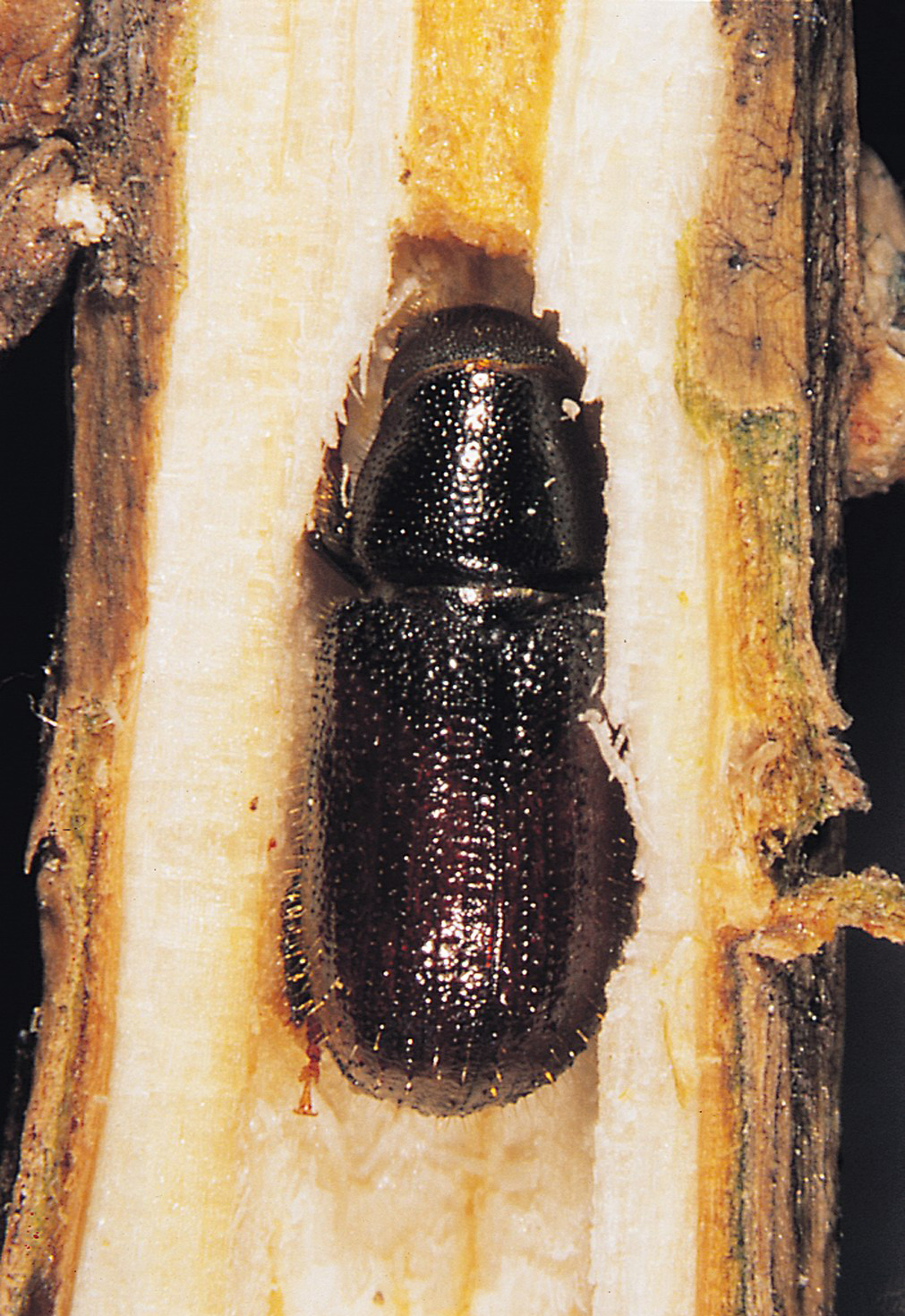
T. piniperda is black or dark brown, 3.5–4.8 mm long, with a cylindrical body, rounded at the head and abdomen ends. It breeds in recently dead and dying trees, most often in windblown trees lying on the ground but also in fire-killed standing trees. The adults tunnel a breeding gallery in the spring, up to 25 cm (9.8 in) long, parallel to the wood grain where they lay their eggs. On hatching, the larvae chew through the phloem radially from the gallery for several months, emerging as new adults in late summer. The adults then feed through the autumn and winter on the pith in strong apical shoots of healthy young trees, killing the bored-out shoots. This does not kill the tree, but causes damage to the growth form, lowering the economic value of the timber by reducing growth rates and stem straightness. They are also capable of damaging trees by infesting the trunk of the tree. There is one generation per year, with most adults dying after breeding many times, though a few survive to breed again a year later. In late winter to early spring, when daily high temperatures exceed 10–13 °C (50–55 °F), adults initiate flight from their overwintering sites and seek breeding material as a host, including recently cut pine trees, logs, branches, and stumps.
Species closely related to Tomicus piniperda include Tomicus minor (lesser pine shoot beetle), with a similar distribution but ecologically separated, using standing dead pines and with its breeding galleries across the grain, not parallel to it; Tomicus destruens in the Mediterranean region, which differs in details of ecology, infesting primarily stone pine P. pinea and maritime pine P. pinaster; and Tomicus yunnanensis in southwestern China on Yunnan pine Pinus yunnanensis. Historically, these species were often not distinguished from T. piniperda, but they are reproductively isolated, which has consequences for pest control.
T. piniperda has two main patterns of trunk attack. One method of attack that adults employ is to aggregate in the tree crowns first and then infest the trunk for breeding. A second method of attack is when adults directly attack without aggregating within the shoot. For either method of attack, colonisation success depends on the degree of tree resistance that the beetles encounter. Aggregation occurs towards the end of the shoot-feeding period, which intersects with the weakening of the tree. This explains the successful mass attacks that take place in the bole of trees and kills them.
Unlike most bark beetles, Tomicus piniperda does not use pheromones for pre-beeding association and pairing, but instead hones in on the resin scent emitted by damaged specimens of the host species, including storm-fallen Scots pines. These trees are homes to bark beetles because of an injured vascular system that can not provide adequate resin to defend against new attacks by beetles. T. piniperda is able to recognize smells while still in flight by means of olfaction of several different plant monoterpenes evaporating from wound resin. These monoterpenes include alpha-pinene, 3-carene, terpinolene, and myrcene. The presence of other T. piniperda beetles did not influence the attraction of these beetles to trees. Both sexes respond similarly to a concentration range of each monoterpene, although myrcene was not as attractive to the beetles as the other monoterpenes. In addition to Scots pines trees, these beetles are also able to respond to volatiles released from logs and other types of trees, including the Norway spruce. However, the concentrations of monoterpenes found in Norway spruces are lower than in Scots pines, which in part explains why these beetles are more likely to select Scots pines as a host.
This behaviour is especially important in Northern Europe and Scandinavia, where it is the most important insect pest of pines. The beetle typically swarms in the spring before other bark beetle species that infest pines, and as a result is successful in competing for the limited number of wind thrown and less resistance pines in which the beetle almost exclusively breeds. Their mass aggregation in these pines is due to their ability to respond swiftly to monoterpenes that are released from injuries to the trees. This allows these beetles to locate mates quickly, even when these beetles are not able to utilise pheromones.
In many places, T. piniperda coexists with other species in the trunks of pines. As a result, T. piniperda distributes itself among the tree to avoid conflict. They are found with the highest density near the top of tree trunks and towards the ground. Rarely, they may fully occupy the entirety of the trunk surface. They are most likely to attack the tree at increasing heights and lay their eggs there. This is unlike other species, such as T. minor, which as a species is more likely to attack the mid and base trunk and lay their eggs there. T. minor attack patterns are heavily regulated by T. piniperda attacks because T. minor attacks occur 1–2 weeks later than T. piniperda attacks. Thus, T. minor attacks trees that are already infested by T. piniperda and are forced to take parts of the trees that haven't been attacked yet. T. minor affects T. piniperda influencing pupal survival. In addition, both benefit mutually from each other if tree resistance is high. Similar interactions occur between T. destruens and T. piniperda in Europe and Mediterranean regions.
Hub AI
Tomicus piniperda AI simulator
(@Tomicus piniperda_simulator)
Tomicus piniperda
Tomicus piniperda, the common pine shoot beetle, is a bark beetle native throughout Europe, northwestern Africa, and northern Asia. It is one of the most destructive shoot-feeding species in northern Europe.
Its primary host plant is Scots pine Pinus sylvestris, but it also uses European black pine P. nigra, maritime pine P. pinaster, eastern white pine P. strobus, red pine P. resinosa, jack pine P. banksiana and other pines to a small extent, and more rarely on spruce Picea and larch Larix. Scots pine is the most important forest tree species in East-central Europe, with Scots pine occupying 68% of total forest area in Poland, making T. piniperda an important pest.
T. piniperda is black or dark brown, 3.5–4.8 mm long, with a cylindrical body, rounded at the head and abdomen ends. It breeds in recently dead and dying trees, most often in windblown trees lying on the ground but also in fire-killed standing trees. The adults tunnel a breeding gallery in the spring, up to 25 cm (9.8 in) long, parallel to the wood grain where they lay their eggs. On hatching, the larvae chew through the phloem radially from the gallery for several months, emerging as new adults in late summer. The adults then feed through the autumn and winter on the pith in strong apical shoots of healthy young trees, killing the bored-out shoots. This does not kill the tree, but causes damage to the growth form, lowering the economic value of the timber by reducing growth rates and stem straightness. They are also capable of damaging trees by infesting the trunk of the tree. There is one generation per year, with most adults dying after breeding many times, though a few survive to breed again a year later. In late winter to early spring, when daily high temperatures exceed 10–13 °C (50–55 °F), adults initiate flight from their overwintering sites and seek breeding material as a host, including recently cut pine trees, logs, branches, and stumps.
Species closely related to Tomicus piniperda include Tomicus minor (lesser pine shoot beetle), with a similar distribution but ecologically separated, using standing dead pines and with its breeding galleries across the grain, not parallel to it; Tomicus destruens in the Mediterranean region, which differs in details of ecology, infesting primarily stone pine P. pinea and maritime pine P. pinaster; and Tomicus yunnanensis in southwestern China on Yunnan pine Pinus yunnanensis. Historically, these species were often not distinguished from T. piniperda, but they are reproductively isolated, which has consequences for pest control.
T. piniperda has two main patterns of trunk attack. One method of attack that adults employ is to aggregate in the tree crowns first and then infest the trunk for breeding. A second method of attack is when adults directly attack without aggregating within the shoot. For either method of attack, colonisation success depends on the degree of tree resistance that the beetles encounter. Aggregation occurs towards the end of the shoot-feeding period, which intersects with the weakening of the tree. This explains the successful mass attacks that take place in the bole of trees and kills them.
Unlike most bark beetles, Tomicus piniperda does not use pheromones for pre-beeding association and pairing, but instead hones in on the resin scent emitted by damaged specimens of the host species, including storm-fallen Scots pines. These trees are homes to bark beetles because of an injured vascular system that can not provide adequate resin to defend against new attacks by beetles. T. piniperda is able to recognize smells while still in flight by means of olfaction of several different plant monoterpenes evaporating from wound resin. These monoterpenes include alpha-pinene, 3-carene, terpinolene, and myrcene. The presence of other T. piniperda beetles did not influence the attraction of these beetles to trees. Both sexes respond similarly to a concentration range of each monoterpene, although myrcene was not as attractive to the beetles as the other monoterpenes. In addition to Scots pines trees, these beetles are also able to respond to volatiles released from logs and other types of trees, including the Norway spruce. However, the concentrations of monoterpenes found in Norway spruces are lower than in Scots pines, which in part explains why these beetles are more likely to select Scots pines as a host.
This behaviour is especially important in Northern Europe and Scandinavia, where it is the most important insect pest of pines. The beetle typically swarms in the spring before other bark beetle species that infest pines, and as a result is successful in competing for the limited number of wind thrown and less resistance pines in which the beetle almost exclusively breeds. Their mass aggregation in these pines is due to their ability to respond swiftly to monoterpenes that are released from injuries to the trees. This allows these beetles to locate mates quickly, even when these beetles are not able to utilise pheromones.
In many places, T. piniperda coexists with other species in the trunks of pines. As a result, T. piniperda distributes itself among the tree to avoid conflict. They are found with the highest density near the top of tree trunks and towards the ground. Rarely, they may fully occupy the entirety of the trunk surface. They are most likely to attack the tree at increasing heights and lay their eggs there. This is unlike other species, such as T. minor, which as a species is more likely to attack the mid and base trunk and lay their eggs there. T. minor attack patterns are heavily regulated by T. piniperda attacks because T. minor attacks occur 1–2 weeks later than T. piniperda attacks. Thus, T. minor attacks trees that are already infested by T. piniperda and are forced to take parts of the trees that haven't been attacked yet. T. minor affects T. piniperda influencing pupal survival. In addition, both benefit mutually from each other if tree resistance is high. Similar interactions occur between T. destruens and T. piniperda in Europe and Mediterranean regions.
Recent media