
Recent from talks
Tomotherapy
Knowledge base stats:
Talk channels stats:
Members stats:
Tomotherapy
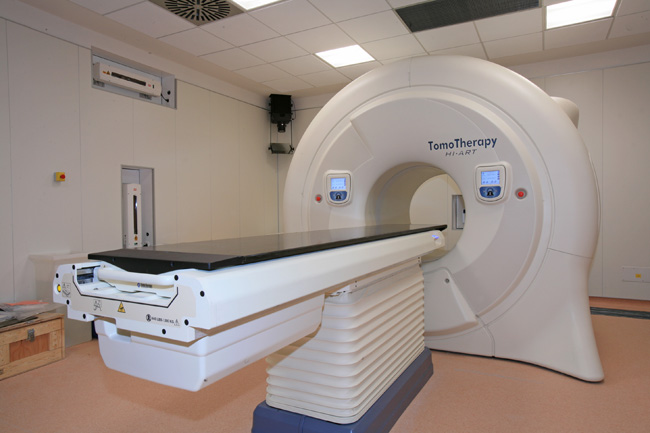
Tomotherapy is a type of radiation therapy treatment machine. In tomotherapy a thin radiation beam is modulated as it rotates around the patient, while they are moved through the bore of the machine. The name comes from the use of a strip-shaped beam, so that only one "slice" (Greek prefix "tomo-") of the target is exposed at any one time by the radiation. The external appearance of the system and movement of the radiation source and patient can be considered analogous to a CT scanner (computed tomography), which uses lower doses of radiation for imaging. Like a conventional machine used for X-ray external beam radiotherapy (often referred to as a linear accelerator or linac, their main component), it [the tomotherapy machine] generates the radiation beam, but the external appearance of the machine, patient positioning, and treatment delivery differ. Conventional linacs do not work on a slice-by-slice basis but typically have a large area beam which can also be resized and modulated.
The treatment field's length (the width of the radiation slice) is adjustable using collimator jaws. In static-jaw delivery, the field length remains constant during a treatment; in dynamic-jaw delivery, the field length changes so that it begins and ends at its minimum setting.
Tomotherapy treatment times vary compared to normal radiation therapy treatment times. Tomotherapy treatment times can be as low as 6.5 minutes for common prostate treatment, excluding extra time for imaging. Modern tomotherapy and conventional linac systems incorporate one or both of megavoltage X-ray or kilovoltage X-ray imaging systems, enabling image-guided radiation therapy (IGRT). In tomotherapy, images are acquired in a very similar manner to a CT scanner, thanks to their closely related design.
There are few head-to-head comparisons of tomotherapy and other IMRT techniques, however there is some evidence that a conventional linac using VMAT can provide faster treatment whereas tomotherapy is better able to spare surrounding healthy tissue while delivering a uniform dose.
In helical tomotherapy, the linac rotates on its gantry at a constant speed while the beam is delivered; so that from the patient's perspective, the shape traced out by the linac is helical.
While helical tomotherapy can treat very long volumes without a need to abut fields in the longitudinal direction, it does display a distinct artifact due to "thread effect" when treating non-central tumors. Thread effect can be suppressed during planning through good pitch selection.
Fixed-angle tomotherapy uses multiple tomotherapy beams, each delivered from a separate fixed gantry angle, in which only the couch moves during beam delivery. This is branded as TomoDirect, but has also been called topotherapy.
The technology enables fixed beam treatments by moving the patient through the machine bore while maintaining specified beam angles.
Hub AI
Tomotherapy AI simulator
(@Tomotherapy_simulator)
Tomotherapy
Tomotherapy is a type of radiation therapy treatment machine. In tomotherapy a thin radiation beam is modulated as it rotates around the patient, while they are moved through the bore of the machine. The name comes from the use of a strip-shaped beam, so that only one "slice" (Greek prefix "tomo-") of the target is exposed at any one time by the radiation. The external appearance of the system and movement of the radiation source and patient can be considered analogous to a CT scanner (computed tomography), which uses lower doses of radiation for imaging. Like a conventional machine used for X-ray external beam radiotherapy (often referred to as a linear accelerator or linac, their main component), it [the tomotherapy machine] generates the radiation beam, but the external appearance of the machine, patient positioning, and treatment delivery differ. Conventional linacs do not work on a slice-by-slice basis but typically have a large area beam which can also be resized and modulated.
The treatment field's length (the width of the radiation slice) is adjustable using collimator jaws. In static-jaw delivery, the field length remains constant during a treatment; in dynamic-jaw delivery, the field length changes so that it begins and ends at its minimum setting.
Tomotherapy treatment times vary compared to normal radiation therapy treatment times. Tomotherapy treatment times can be as low as 6.5 minutes for common prostate treatment, excluding extra time for imaging. Modern tomotherapy and conventional linac systems incorporate one or both of megavoltage X-ray or kilovoltage X-ray imaging systems, enabling image-guided radiation therapy (IGRT). In tomotherapy, images are acquired in a very similar manner to a CT scanner, thanks to their closely related design.
There are few head-to-head comparisons of tomotherapy and other IMRT techniques, however there is some evidence that a conventional linac using VMAT can provide faster treatment whereas tomotherapy is better able to spare surrounding healthy tissue while delivering a uniform dose.
In helical tomotherapy, the linac rotates on its gantry at a constant speed while the beam is delivered; so that from the patient's perspective, the shape traced out by the linac is helical.
While helical tomotherapy can treat very long volumes without a need to abut fields in the longitudinal direction, it does display a distinct artifact due to "thread effect" when treating non-central tumors. Thread effect can be suppressed during planning through good pitch selection.
Fixed-angle tomotherapy uses multiple tomotherapy beams, each delivered from a separate fixed gantry angle, in which only the couch moves during beam delivery. This is branded as TomoDirect, but has also been called topotherapy.
The technology enables fixed beam treatments by moving the patient through the machine bore while maintaining specified beam angles.
Recent media