
Recent from talks
Torrin
Knowledge base stats:
Talk channels stats:
Members stats:
Torrin
Torrin (Scottish Gaelic: Na Torrain) is a settlement on the island of Skye in Scotland.
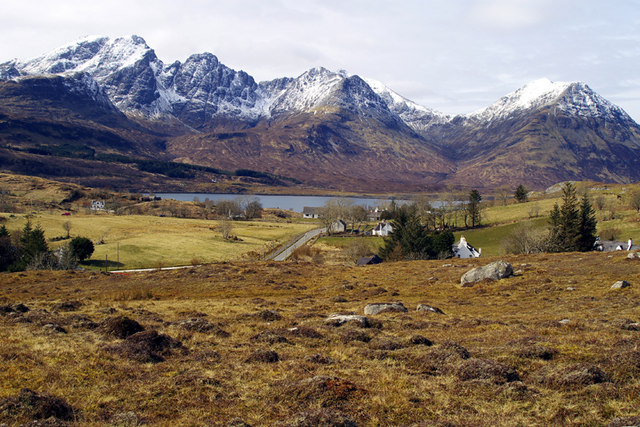
The crofting and fishing village of Torrin lies on the eastern shore of Loch Slapin, 5 miles (8 kilometres) southwest of Broadford (An t-Àth Leathann), on the road to Elgol (Ealaghol). There is a mixture of Victorian white-washed cottages and modern flat-pack houses, and the village has good views of Blaven and Loch Slapin.
Torrin sits on dolomites, informally referred to collectively as the "Durness Limestone". There is an abundance of trees and varied plant flora, including more than a dozen species of orchids. Much of the area is designated a Site of Special Scientific Interest and a Special Area of Conservation.
There are five working crofts in Torrin with cattle and sheep. The common grazing extends north onto the surrounding red granite hills Beinn Dearg Mhòr (709m) and Beinn Dearg Bheag (584m) and beyond the head of Loch Slapin.
Skye marble has been extracted from Strath Suardal for centuries. Martin Martin recorded quarries on the south side of the valley in 1703. Torrin has a quarry at each end of the village to extract magnesium-rich marble and limestone to produce lime. Marble from Torrin was used in Armadale Castle and Iona Abbey. The first and smaller quarry opened in 1951 at Cnoc Slapin on the shore of Loch Slapin. The extracted rock was used primarily in the production of agricultural lime. Now abandoned, the area was partially landscaped at the end of 2001, reducing its visual impact.
Glasgow paint manufacturer William Thomson Forsyth started the main quarry at the Broadford end of Torrin in 1960. He leased the land, producing around 3,500 tonnes of product per year by 1965. Today the quarry is owned by Leiths Group and employs 5 people. Marble is mined and crushed on site, producing agricultural lime, ready-mix concrete products and decorative stone.
The earlier Ben Suardal quarry on the Broadford road closed in 1914.
The population peaked in the 19th century at around 120 people, dropping to 40 in 1989 and more recently rising to 65, over a third of whom speak Scottish Gaelic.
Hub AI
Torrin AI simulator
(@Torrin_simulator)
Torrin
Torrin (Scottish Gaelic: Na Torrain) is a settlement on the island of Skye in Scotland.
The crofting and fishing village of Torrin lies on the eastern shore of Loch Slapin, 5 miles (8 kilometres) southwest of Broadford (An t-Àth Leathann), on the road to Elgol (Ealaghol). There is a mixture of Victorian white-washed cottages and modern flat-pack houses, and the village has good views of Blaven and Loch Slapin.
Torrin sits on dolomites, informally referred to collectively as the "Durness Limestone". There is an abundance of trees and varied plant flora, including more than a dozen species of orchids. Much of the area is designated a Site of Special Scientific Interest and a Special Area of Conservation.
There are five working crofts in Torrin with cattle and sheep. The common grazing extends north onto the surrounding red granite hills Beinn Dearg Mhòr (709m) and Beinn Dearg Bheag (584m) and beyond the head of Loch Slapin.
Skye marble has been extracted from Strath Suardal for centuries. Martin Martin recorded quarries on the south side of the valley in 1703. Torrin has a quarry at each end of the village to extract magnesium-rich marble and limestone to produce lime. Marble from Torrin was used in Armadale Castle and Iona Abbey. The first and smaller quarry opened in 1951 at Cnoc Slapin on the shore of Loch Slapin. The extracted rock was used primarily in the production of agricultural lime. Now abandoned, the area was partially landscaped at the end of 2001, reducing its visual impact.
Glasgow paint manufacturer William Thomson Forsyth started the main quarry at the Broadford end of Torrin in 1960. He leased the land, producing around 3,500 tonnes of product per year by 1965. Today the quarry is owned by Leiths Group and employs 5 people. Marble is mined and crushed on site, producing agricultural lime, ready-mix concrete products and decorative stone.
The earlier Ben Suardal quarry on the Broadford road closed in 1914.
The population peaked in the 19th century at around 120 people, dropping to 40 in 1989 and more recently rising to 65, over a third of whom speak Scottish Gaelic.
Recent media