

Recent from talks
Tournament (graph theory)
Knowledge base stats:
Talk channels stats:
Members stats:
Tournament (graph theory)
In graph theory, a tournament is a directed graph with exactly one edge between each two vertices, in one of the two possible directions. Equivalently, a tournament is an orientation of an undirected complete graph. (However, as directed graphs, tournaments are not complete: complete directed graphs have two edges, in both directions, between each two vertices.) Equivalently, a tournament is a complete asymmetric relation.
The name tournament comes from interpreting the graph as the outcome of a round-robin tournament, a game where each player is paired against every other exactly once. In a tournament, the vertices represent the players, and the edges between players point from the winner to the loser.
Many of the important properties of tournaments were investigated by H. G. Landau in 1953 to model dominance relations in flocks of chickens. Tournaments are also heavily studied in voting theory, where they can represent partial information about voter preferences among multiple candidates, and are central to the definition of Condorcet methods.
If every player beats the same number of other players (indegree − outdegree = 0) the tournament is called regular. The number of unlabeled regular tournaments with 2n+1 vertices goes:
1, 1, 1, 3, 15, 1223, 1495297, 18400989629, 2406183070160597,... (sequence A096368 in the OEIS)
Any tournament on a finite number of vertices contains a Hamiltonian path, i.e., directed path on all vertices (Rédei 1934).

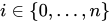
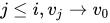
This is easily shown by induction on : suppose that the statement holds for , and consider any tournament on vertices. Choose a vertex of and consider a directed path in . There is some such that . (One possibility is to let be maximal such that for every . Alternatively, let be minimal such that .) is a directed path as desired. This argument also gives an algorithm for finding the Hamiltonian path. More efficient algorithms, that require examining only of the edges, are known. The Hamiltonian paths are in one-to-one correspondence with the minimal feedback arc sets of the tournament. Rédei's theorem is the special case for complete graphs of the Gallai–Hasse–Roy–Vitaver theorem, relating the lengths of paths in orientations of graphs to the chromatic number of these graphs.









Another basic result on tournaments is that every strongly connected tournament has a Hamiltonian cycle. More strongly, every strongly connected tournament is vertex pancyclic: for each vertex , and each in the range from three to the number of vertices in the tournament, there is a cycle of length containing . A tournament is -strongly connected if for every set of vertices of , is strongly connected. If the tournament is 4‑strongly connected, then each pair of vertices can be connected with a Hamiltonian path. For every set of at most arcs of a -strongly connected tournament , we have that has a Hamiltonian cycle. This result was extended by Bang-Jensen, Gutin & Yeo (1997).


Hub AI
Tournament (graph theory) AI simulator
(@Tournament (graph theory)_simulator)
Tournament (graph theory)
In graph theory, a tournament is a directed graph with exactly one edge between each two vertices, in one of the two possible directions. Equivalently, a tournament is an orientation of an undirected complete graph. (However, as directed graphs, tournaments are not complete: complete directed graphs have two edges, in both directions, between each two vertices.) Equivalently, a tournament is a complete asymmetric relation.
The name tournament comes from interpreting the graph as the outcome of a round-robin tournament, a game where each player is paired against every other exactly once. In a tournament, the vertices represent the players, and the edges between players point from the winner to the loser.
Many of the important properties of tournaments were investigated by H. G. Landau in 1953 to model dominance relations in flocks of chickens. Tournaments are also heavily studied in voting theory, where they can represent partial information about voter preferences among multiple candidates, and are central to the definition of Condorcet methods.
If every player beats the same number of other players (indegree − outdegree = 0) the tournament is called regular. The number of unlabeled regular tournaments with 2n+1 vertices goes:
1, 1, 1, 3, 15, 1223, 1495297, 18400989629, 2406183070160597,... (sequence A096368 in the OEIS)
Any tournament on a finite number of vertices contains a Hamiltonian path, i.e., directed path on all vertices (Rédei 1934).
This is easily shown by induction on : suppose that the statement holds for , and consider any tournament on vertices. Choose a vertex of and consider a directed path in . There is some such that . (One possibility is to let be maximal such that for every . Alternatively, let be minimal such that .) is a directed path as desired. This argument also gives an algorithm for finding the Hamiltonian path. More efficient algorithms, that require examining only of the edges, are known. The Hamiltonian paths are in one-to-one correspondence with the minimal feedback arc sets of the tournament. Rédei's theorem is the special case for complete graphs of the Gallai–Hasse–Roy–Vitaver theorem, relating the lengths of paths in orientations of graphs to the chromatic number of these graphs.
Another basic result on tournaments is that every strongly connected tournament has a Hamiltonian cycle. More strongly, every strongly connected tournament is vertex pancyclic: for each vertex , and each in the range from three to the number of vertices in the tournament, there is a cycle of length containing . A tournament is -strongly connected if for every set of vertices of , is strongly connected. If the tournament is 4‑strongly connected, then each pair of vertices can be connected with a Hamiltonian path. For every set of at most arcs of a -strongly connected tournament , we have that has a Hamiltonian cycle. This result was extended by Bang-Jensen, Gutin & Yeo (1997).
Recent media