



Community hub
Recent from talks
Contribute something
Nothing was collected or created yet.
Toyota MC platform
View on WikipediaThe Toyota MC platform is a front-wheel drive automobile platform (also adaptable to four-wheel drive) that has underpinned various Toyota and Lexus models from the compact and mid-size categories.[1][2] MC sits above the older NBC and newer B platforms, but below the Toyota K platform designed for larger models such as the Camry.[2] Automobiles based on the MC chassis started production in 1997 with the Toyota Prius (XW10).
Both the old Toyota Corolla (E platform) and Corona/Celica/Carina/Avensis (T platform) have been replaced by the MC. It was a part of Toyota's plan to cut costs, which included reduction of different car platforms.
Compared to other automakers, Toyota’s definition of "platform" differs. That is, it is less about shared common hardware and more about a shared development processes.[3]
The company revised and updated the MC as the Toyota New MC platform, debuting with the Toyota RAV4 (XA30) in 2005.[1] It was in turn replaced by the C platform with the fourth-generation Toyota Prius (XW50) in 2015, created under Toyota’s new development framework, the Toyota New Global Architecture (TNGA).[4]
The platform has three choices of floor height, which are low floor, medium floor, high floor. The low floor is used for middle and large size cars such as the Auris (E150) and Mark X ZiO, while the medium floor is used for SUVs such as the RAV4. The high floor or raised floor variation is mainly used by minivan with a flat floor structure, such as the Previa/Estima and Alphard/Vellfire.[5]
MC
[edit]Features
[edit]- It is a front-wheel drive platform, with optional four-wheel drive.
- Four-wheel drive variants use the V-Flex II system, which is a viscous-coupling torque-on-demand.
- Engines are mounted transversely.
- MacPherson struts are used in front suspension, while rear suspension can be either
- Twist-beam rear suspension for most front-wheel drive vehicles, or
- multi-link suspension on most four-wheel drive variants (except minivans), sporty vehicles (like Celica, Scion tC, Caldina and Blade), Mark X Zio and Avensis.
Applications
[edit]- Toyota Allion/Premio — T240 (2001–2007), T260 (2007–2021)[2]
- Toyota Avensis — T250 (2003–2008)
- Toyota Caldina — T240 (2002–2007)
- Toyota Celica — T230 (1999–2006)
- Toyota Corolla — E120/E130 (2000–2006), E140 (2006–2013)[2]
- Toyota Corolla Verso — E120 (2001–2004), AR10 (2004–2009)
- Toyota Corolla Spacio — E120 (2001–2007)
- Toyota Ipsum/Avensis Verso/Picnic/SportsVan — XM20 (2001–2009)
- Toyota Isis — AM10 (2004–2017)[2]
- Toyota Matrix/Pontiac Vibe — E130 (2002–2008), E140 (2008–2014)
- Toyota Voltz — E130 (2002–2004)
- Toyota Opa — XT10 (2000–2005)
- Toyota Prius — XW10 (1997–2003), XW20 (2003–2009)
- Toyota RAV4 — XA20 (2000–2005)
- Toyota Vista — V50 (1998–2003)
- Toyota WiLL VS — E120 (2001–2004)
- Toyota Wish — AE10 (2003–2009), AE20 (2009–2017)[2]
- Scion tC — AT10 (2004–2010)
- Toyota Noah/Voxy — R60 (2001–2007), R70 (2007–2014)
- Toyota NAV1 — R70 (2012–2017)
-
 Toyota Allion/Premio (T240)
 -
 Toyota Allion/Premio (T260)
 -
 Toyota Avensis (T240)
 -
 Toyota Caldina
 -
 Toyota Celica
 -
 Toyota Corolla (E120/E130)
 -
 Toyota Corolla (E140)
 -
 Toyota Corolla Verso/Corolla Spacio (E120)
 -
 Toyota Corolla Verso (AR10)
 -
 Toyota Ipsum/Avensis Verso/Picnic/SportsVan
 -
 Toyota Isis
 -
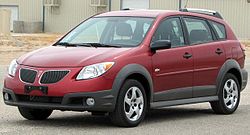 Pontiac Vibe (E130)
 -
 Pontiac Vibe (E140)
 -
 Toyota Matrix (E130)
 -
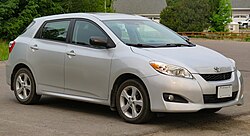 Toyota Matrix (E140)
 -
 Toyota Voltz
 -
 Toyota Opa
 -
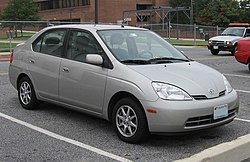 Toyota Prius (XW10)
 -
 Toyota Prius (XW20)
 -
 Toyota RAV4 (XA20)
 -
 Toyota Vista
 -
 Toyota WiLL VS
 -
 Toyota Wish (AE10)
 -
 Toyota Wish (AE20)
 -
 Scion tC (AT10)
 -
 Toyota Noah/Voxy (R60)
 -
 Toyota Noah/Voxy/NAV1 (R70)


.jpg)
_front.JPG)

.jpg)
_Ascent_sedan_(2011-04-28)_01.jpg)

_%E2%80%93_Frontansicht,_31._Juli_2012,_Velbert.jpg)


_(cropped).jpg)


.jpg)
.jpg)
.jpg)
.jpg)


New MC
[edit]Applications
[edit]- Toyota Alphard/Vellfire — AH20 (2008–2015),[2] AH30 (2015–2023)
- Toyota Crown Vellfire — AH30 (2021–2023)
- Lexus LM — AH30 (2019–2023)
- Toyota Avensis — T270 (2008–2018)[2]
- Toyota Auris — E150 (2006–2012)
- Toyota Blade — E150 (2006–2012)
- Toyota Auris — E180 (2012–2018)
- Scion iM/Toyota Corolla iM (2015–2018)
- Toyota Corolla/Corolla Altis — E150 (2006–2013), E170 (2013–2019)
- Toyota Corolla Rumion/Rukus/Scion xB — E150 (2007–2015)[2]
- Toyota Harrier — XU60 (2013–2020)
- Toyota Mark X ZiO — AA10 (2007–2013)[2]
- Toyota Noah/Voxy/Esquire — R80 (2014–2021)
- Toyota Previa/Estima/Tarago — XR50 (2006–2019)[2]
- Toyota Prius — XW30 (2009–2015)[2]
- Toyota Prius v/Prius α/Prius+ — XW40 (2011–2021)[2]
- Daihatsu Mebius — XW40 (2013–2021)
- Toyota RAV4 — XA30 (2005–2013),[2] XA40 (2013–2018)
- Toyota Vanguard — XA30 (2007–2013)
- Toyota Verso/E'Z — AR20 (2009–2018)
- Toyota Sai — AZK10 (2009–2017)[2]
- Scion tC/Toyota Zelas — AT20 (2010–2016)
- Lexus CT — ZWA10 (2011–2022)[2]
- Lexus HS — ANF10 (2009–2017)[2]
- Lexus NX — AZ10 (2014–2021)
-
 Toyota Alphard/Vellfire (AH20)
 -
 Toyota Alphard/Vellfire/Crown Vellfire (AH30)
 -
 Lexus LM
 -
 Toyota Avensis (T270)
 -
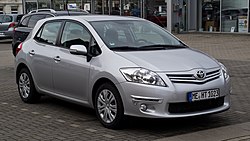 Toyota Auris/Blade (E150)
 -
 Toyota Auris (E180)
 -
 Scion iM/Toyota Corolla iM (E180)
 -
 Toyota Corolla/Corolla Altis (E150)
 -
 Toyota Corolla/Corolla Altis (E170)
 -
 Toyota Corolla Rumion/Rukus
 -
 Scion xB
 -
 Toyota Harrier (XU60)
 -
 Toyota Mark X ZiO
 -
 Toyota Noah/Voxy/Esquire (R80)
 -
 Toyota Previa/Estima/Tarago (XR50)
 -
 Toyota Prius (XW30)
 -
 Toyota Prius v/Prius α/Prius+ (XW40)
 -
 Daihatsu Mebius (XW40)
 -
 Toyota RAV4 (XA30)
 -
 Toyota RAV4 (XA40)
 -
 Toyota Vanguard (XA30)
 -
 Toyota Verso/E'Z (AR20)
 -
 Toyota Sai (AZK10)
 -
 Toyota Zelas (AT20)
 -
 Scion tC (AT20)
 -
 Lexus CT
 -
 Lexus HS
 -
 Lexus NX
_HONG_KONG_(8)_(cropped).jpg)

_(cropped).jpg)

_%E2%80%93_Frontansicht,_18._M%C3%A4rz_2012,_Wuppertal.jpg)


_Ascent_5-door_hatchback_01.jpg)
_Ascent_sedan_(2018-11-02)_01.jpg)

.jpg)

_front.jpg)
.jpg)
_%E2%80%93_f_11032025.jpg)


.jpg)


References
[edit]
- ^ a b 力, 田野倉 (27 December 2005). "Toyota RAV4". Nikkei Technology Online (in Japanese). Retrieved 18 June 2014.
RAV4もトヨタのCDセグメント用「新MC(ミディアム・コンパクト)プラットフォーム」の採用第一号車となっている。
- ^ a b c d e f g h i j k l m n o p q Akita, Masahiro; Shiohara, Kunihiko (11 June 2012). "Observations on TNGA: How will Toyota's plans to make better cars affect suppliers". Credit Suisse. pp. 2, 4. Archived from the original (PDF) on 17 June 2014.
- ^ Akita, Masahiro (11 March 2013). "Opportunities and risks related to parts sourcing for next-gen Prius". Credit Suisse. pp. 1–3. Archived from the original (PDF) on 17 July 2014.
- ^ "トヨタの「オーリス」と「エスティマ」が兄弟車!? プラットフォームの共通化について考える" [Toyota's "Auris" and "Estima" are brother cars!? Considering common platform]. webCG (in Japanese). Retrieved 2023-04-18.
Toyota MC platform
View on GrokipediaIntroduction
Definition and Role
The Toyota MC platform is a front-wheel-drive (FWD) automobile platform, also adaptable to all-wheel-drive (AWD) configurations, developed for compact and mid-size models produced by Toyota and Lexus.[2][5] First introduced in 1997 with the first-generation Prius hybrid vehicle,[1] it serves as the foundational chassis for efficient, versatile vehicle production. In its role, the MC platform facilitates modular component sharing across multiple vehicle lines, allowing for common parts such as suspension, engines, and body structures to be used interchangeably. This design approach significantly reduces development and manufacturing costs while enhancing overall production efficiency and quality consistency.[2] Positioned as a mid-tier architecture within Toyota's lineup, it bridges the gap between smaller platforms like the NBC and B series—intended for subcompacts—and the larger K platform used for midsize vehicles. The platform's initial conceptualization occurred in the mid-1990s, driven by Toyota's cost-cutting strategy amid economic pressures, which emphasized platform consolidation to streamline operations and boost profitability. This effort replaced older, less efficient architectures such as the E and T platforms with a more unified system tailored for modern vehicle needs.Position in Toyota's Platform Lineup
The Toyota MC platform holds a central position in the company's modular architecture, bridging subcompact and mid-size segments. It sits above the NBC and B platforms, which support smaller vehicles such as the Aygo and iQ, while remaining below the larger K platform used for models like the Camry. This hierarchical placement allows the MC platform to serve compact cars, crossovers, and minivans, facilitating economies of scale in production for vehicles in the B- and C-segment classes.[6] Introduced as part of Toyota's late-1990s strategic pivot toward streamlined, versatile platforms, the MC architecture contributed to substantial cost efficiencies by promoting shared components across multiple model lines, reducing development and manufacturing expenses through greater parts commonality. This approach aligned with broader industry trends toward platform consolidation to enhance competitiveness amid economic pressures. The platform emphasizes front-wheel-drive layouts as standard, with optional all-wheel-drive capability provided via viscous-coupling systems like V-Flex II for improved traction in select applications, though it does not support rear-wheel-drive configurations. From its debut, the MC platform incorporated provisions for hybrid powertrains, enabling early adoption in electrified vehicles.[1]Development and History
Origins and Initial Launch
The development of the Toyota MC platform was initiated in the early 1990s amid Japan's economic challenges following the asset price bubble burst, as part of Toyota's broader cost-cutting and efficiency initiatives to reinvent its operations and reduce development expenses.[7][8] These efforts included expanding cost planning teams in 1991, implementing emergency income-improving measures in 1992, and establishing a Value Engineering (VE) Center in 1994 to reinforce unit and component cost management.[8] The platform aimed to create a unified small-car architecture, replacing disparate setups like the E platform (used for the Corolla) and T platform (used for the Corona, Celica, and Carina), while emphasizing shared engineering processes beyond hardware to lower costs, accelerate model development cycles, and enhance global market adaptability.[9] The MC platform's motivations were rooted in Toyota's strategic push for efficiency and innovation during a period of stagnant domestic sales and currency fluctuations, which led to significant profit pressures by the mid-1990s.[10] By standardizing parts and processes, the platform supported mass planning and part commonality, stabilizing quality, minimizing spare parts inventory, and optimizing plant space across models.[8] This approach aligned with Toyota's response to global competition and environmental concerns, enabling flexible adaptations for diverse markets without excessive redesigns. The platform made its debut in December 1997 with the Toyota Prius (XW10), serving as the foundation for Toyota's first mass-produced hybrid vehicle and showcasing its hybrid-ready design from inception.[11][12] Developed under the G21 project started in 1993, the Prius integrated the innovative Toyota Hybrid System (THS), with the MC platform providing a front-wheel-drive base optimized for the system's power split device, electric motor, and planetary gearset.[11][12] This launch not only introduced hybrid technology to mass production but also demonstrated the platform's role in enabling rapid prototyping and commercialization, with the vehicle achieving initial fuel efficiency targets of around 28 km/L in Japan.[11]Evolution to New MC
The original Toyota MC platform, which originated from cost-saving efforts to consolidate multiple vehicle architectures into a single shared structure, underwent a gradual phase-out around 2005 as newer models transitioned away from it. This shift marked the introduction of the New MC platform, a revised iteration designed to build upon the foundational elements of its predecessor while addressing emerging market and regulatory demands. The New MC platform debuted in late 2005 with the third-generation Toyota RAV4 (XA30), unveiled at the Frankfurt Motor Show and initially launched in the Japanese market that year, followed by North American availability in early 2006.[13] This timeline aligned with the broader replacement of the original MC across Toyota's lineup, enabling the company to retire the earlier version by mid-decade while scaling up production of the updated architecture for compact crossovers and related vehicles. Key drivers for this platform evolution included the requirement for increased versatility to accommodate diverse vehicle heights and body styles, particularly in expanding SUV and minivan segments, where the original MC's narrower focus on sedans and hybrids limited adaptability.[13] These factors prompted greater modularity in the New MC, allowing for optimized packaging in taller, more varied applications without compromising core engineering principles. A pivotal milestone occurred with the 2005 redesign of the platform, which integrated refined lessons from the original MC's pioneering hybrid powertrain accommodations—exemplified in the Prius—to support more efficient electrification and overall vehicle dynamics.[3] This update not only prolonged the MC lineage's utility but also sustained its deployment across Toyota's global portfolio until the progressive rollout of the Toyota New Global Architecture (TNGA) platforms beginning in the mid-2010s.[3]Original MC Platform
Design Features
The original MC platform employed a unibody construction utilizing steel for structural integrity and compactness, enabling efficient packaging of components while supporting fuel economy goals in compact and mid-size vehicles. Its core suspension architecture consisted of a MacPherson strut setup at the front for independent wheel control and a torsion beam at the rear, optimized for cost-effective handling in urban applications.[14] A key innovation was the platform's integration of the Toyota Hybrid System (THS), marking the first dedicated architecture for hybrid powertrains with built-in mounting points for the nickel-metal hydride battery pack and electric motors.[11] Developed in collaboration with partners like Matsushita Battery Industrial Co., Ltd., the THS featured a drive motor for propulsion and battery charging during deceleration, alongside a generator motor for electricity production and transmission control via a planetary gear power-split device; these components were aligned on the same plane for minimal space usage in the Prius XW10 application.[11] This design allowed seamless blending of the 1.5-liter gasoline engine and electric elements without a traditional transmission, prioritizing efficiency and low emissions. The platform's dimensions emphasized modularity for compact sedans, hatchbacks, and other body styles, with wheelbases ranging from approximately 2,500 to 2,800 mm to balance interior roominess and maneuverability across applications.[1] Track widths varied by model but were typically tuned around 1,470–1,500 mm front and rear for stable urban handling and a low-floor profile that facilitated easy cabin access without compromising the hybrid components' placement.[1] Adaptable to both front-wheel drive and all-wheel drive configurations, the MC platform supported versatile drivetrain options across its applications.[15]Vehicle Applications
The original MC platform supported a diverse array of compact and mid-size vehicles from 1997 to around 2014, spanning sedans, hatchbacks, SUVs, and MPVs, underpinning Toyota's expansion into hybrid and efficient conventional powertrains. This adaptability enabled configurations for various body styles, including options for different vehicle heights and purposes. Key models built on the original MC platform include the following:| Model | Code | Production Years | Description |
|---|---|---|---|
| Toyota Prius | XW10 | 1997–2003 | The debut hybrid vehicle, a compact liftback emphasizing fuel efficiency and innovative THS integration for urban commuting.[1] |
| Toyota Prius | XW20 | 2003–2009 | Second-generation hybrid hatchback with improved power and packaging, expanding global hybrid adoption.[1] |
| Toyota Corolla | E120/E130 | 2000–2006 | Global compact sedan and hatchback (including Runx/Allex variants) focused on reliability and economy for everyday use.[1] |
| Toyota Corolla | E140 | 2006–2013 | Updated compact models (including Fielder wagon) with refined handling, serving as a bridge to New MC in later years.[1] |
| Toyota RAV4 | XA20 | 2000–2005 | Compact crossover SUV with all-wheel drive options, balancing urban versatility and light off-road capability.[1] |
| Toyota Celica | T230 | 1999–2006 | Sporty compact coupe targeted at enthusiasts, offering dynamic performance in the hot hatch segment.[1] |
| Toyota Matrix/Pontiac Vibe/Scion xA | E130 | 2002–2008 | North American compact hatchback/wagon with versatile cargo space, emphasizing youthful appeal and practicality.[1] |
| Toyota Avensis | T250 | 2003–2008 | European mid-size sedan and estate for family and fleet use, featuring efficient engines.[1] |
| Toyota Allion/Premio | T240 | 2001–2007 | Japan- and Asia-focused mid-size sedans, with Allion for sportier drive and Premio for comfort.[1] |
| Toyota Wish | AE10 | 2003–2009 | Compact MPV for Asian families, prioritizing spacious interiors and smooth performance.[1] |
New MC Platform
Design Enhancements
The New MC platform represented an evolution from the original MC base, incorporating key upgrades to improve versatility and applicability across a wider range of vehicle types. A major enhancement was the introduction of three floor heights—low for sedans such as the Auris E150, medium for SUVs like the RAV4 XA30, and high for minivans like the Previa—allowing the platform to support diverse body styles while maintaining structural integrity.[1] Structural improvements focused on enhanced rigidity and ride quality. Reinforced subframes contributed to better noise, vibration, and harshness (NVH) performance, providing a quieter cabin and more refined driving experience. Additionally, all-wheel-drive (AWD) integration was improved with electronic controls that enabled more precise torque distribution, enhancing traction and stability on varied surfaces.[16] Modularity was expanded to facilitate greater component sharing, supporting engine displacements from 1.5 to 2.5 liters as well as hybrid powertrains. The platform's wheelbase flexibility, ranging from 2,600 to 2,800 mm, allowed for easy adaptation to different model lengths without compromising handling or packaging efficiency. These features collectively enabled cost-effective development and production scalability for Toyota's mid-size lineup.Vehicle Applications
The New MC platform supported a diverse array of compact and mid-size vehicles, spanning sedans, hatchbacks, SUVs, and MPVs. This adaptability enabled configurations for various body styles, including a three-floor-height design to accommodate different vehicle heights and purposes. Key models built on the New MC platform include the following:| Model | Code | Production Years | Description |
|---|---|---|---|
| Toyota RAV4 | XA30 | 2005–2012 | Compact crossover SUV offering all-wheel drive options and versatile cargo space, popular for its rugged yet efficient design in urban and light off-road use. |
| Toyota RAV4 | XA40 | 2012–2018 | Mid-size crossover SUV with improved hybrid options and advanced safety features, emphasizing family utility and fuel economy. |
| Toyota Corolla | E140/E150 | 2006–2013 | Global compact sedan and hatchback (including North American Scion xD/Matrix variants) with hybrid powertrain availability, emphasizing fuel efficiency and reliability for everyday commuting. |
| Toyota Corolla | E170/E180 | 2013–2019 | Compact sedan and hatchback variants, including hybrid models, focused on global markets with enhanced connectivity and safety. |
| Toyota Auris/Blade | E150/E180 | 2006–2018 | European-market compact hatchback and wagon, noted for its agile handling and hybrid variants, serving as a Corolla alternative with strong sales in Europe. |
| Toyota Avensis | T250/T270 | 2003–2018 (partial overlap on New MC from 2008) | Mid-size sedan and estate targeted at European fleets, featuring diesel and petrol engines for business and family use with partial platform evolution. |
| Toyota Allion/Premio | T240/T260 | 2001–2017 (New MC from 2007) | Japan- and Asia-focused mid-size sedans, with the Allion offering a sportier profile and the Premio a more luxurious one, heavily utilized in Asian markets for executive transport. |
| Toyota Mark X ZiO | GRX120/130 | 2007–2013 | Japan-exclusive mid-size MPV with flexible "three-mode" seating for sedan, wagon, or lounge configurations, blending comfort and utility for family buyers. |
| Toyota Wish | AE20 | 2009–2017 | Compact seven-seater MPV for Asian families, prioritizing spacious interiors and smooth CVT transmissions for daily practicality. |
| Toyota Ractis/Rumion | NCP120/NCP125 (Rumion); NSP120 (Ractis second gen partial) | 2005–2017 | Subcompact MPVs with the Rumion (JDM Scion xB equivalent) as a boxy wagon for cargo versatility; Ractis emphasized urban maneuverability in Asia, though shared components only for later variants. |
| Toyota Prius | XW30 | 2009–2015 | Third-generation hybrid hatchback, pioneering advanced Hybrid Synergy Drive for superior fuel efficiency and environmental performance. |
| Toyota Prius | XW40 | 2015–2022 (partial to 2021) | Fourth-generation hybrid with aerodynamic design and improved battery technology, maintaining leadership in the hybrid segment. |
| Lexus HS | ANF10 | 2009–2012 | Compact luxury hybrid sedan, Lexus's first dedicated hybrid model, focusing on premium comfort and efficiency. |
| Lexus CT | ZWA10 | 2010–2017 | Compact luxury hybrid hatchback, offering sporty handling and premium features in the entry-level luxury segment. |
| Lexus NX | AZ10 | 2014–2021 | Compact luxury crossover SUV with hybrid and turbo options, targeting premium urban drivers with versatile styling. |