Hubbry Logo
Toyota bBToyota bBMain
Open search
Toyota bB
Community hub
Toyota bB
logo
8 pages, 0 posts
0 subscribers
Be the first to start a discussion here.
Toyota bB
Toyota bB
from Wikipedia
Toyota bB
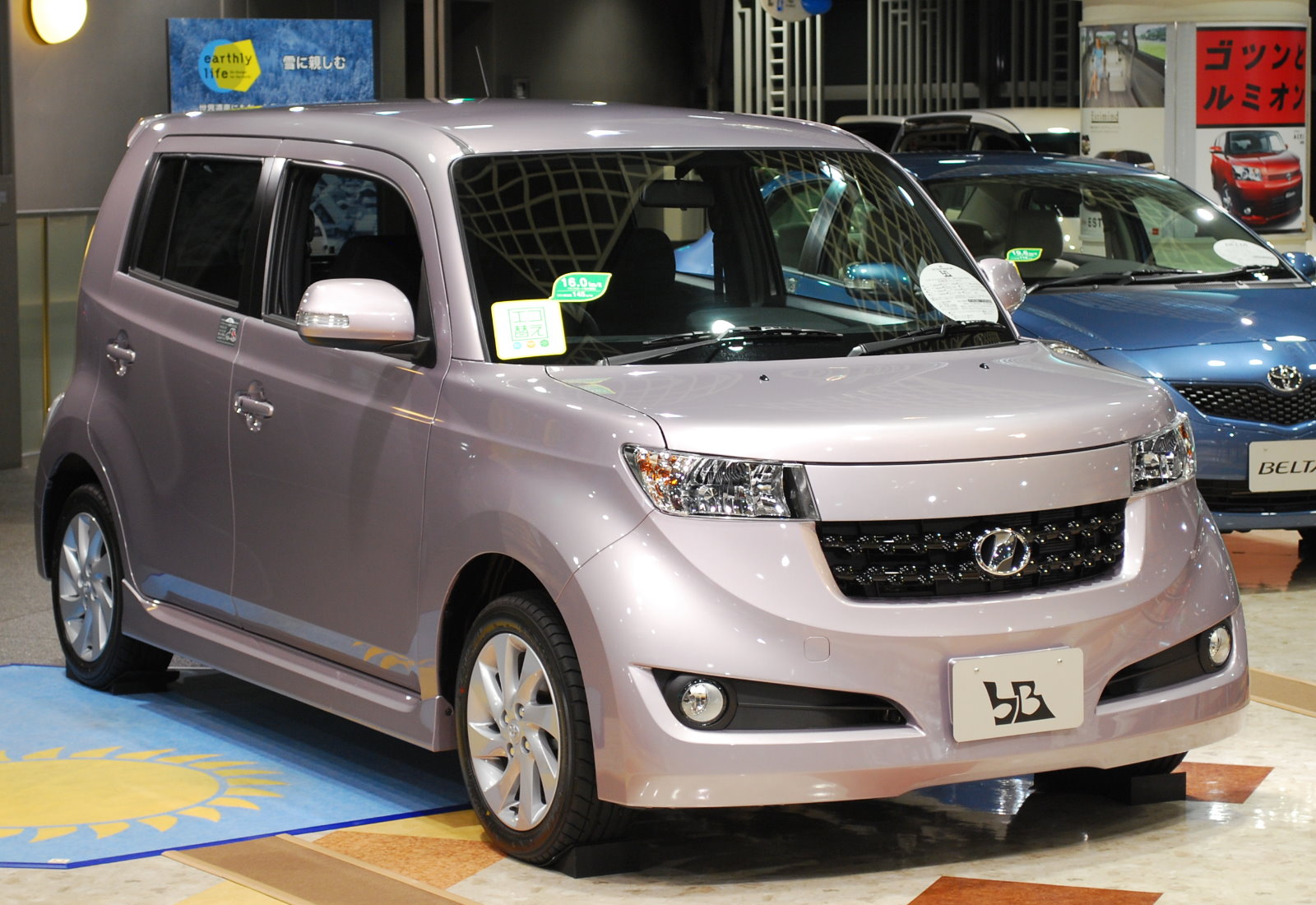
Second generation Toyota bB (2008)
Overview
ManufacturerToyota
Also called
  • Scion xB (2003–2006)
  • Daihatsu Coo/Materia (2006–2012)
  • Subaru Dex (2006–2012)
ProductionJanuary 2000 – May 2016
Body and chassis
ClassMini MPV
Body style
Layout
Chronology
Predecessor
Successor

The Toyota bB is a mini MPV produced by the Japanese car company Toyota. The first generation launched in 2000, and the second generation was jointly developed with Daihatsu from 2005.

The car has been badge engineered and sold as the Daihatsu Materia, Scion xB and Subaru Dex.

First generation (XP30; 2000)

[edit]
First generation (XP30)
Overview
Also calledScion xB (North America)
ProductionJanuary 2000 – December 2005[1][2]
AssemblyJapan: Toyota, Aichi (Takaoka plant)[1]
Body and chassis
Body style
PlatformToyota NBC platform
Related
Powertrain
Engine
Transmission4-speed automatic
Dimensions
Wheelbase2,500 mm (98.4 in)
Length3,825–3,945 mm (150.6–155.3 in)
Width1,690 mm (66.5 in)
Height1,640–1,695 mm (64.6–66.7 in)
Curb weight1,070–1,130 kg (2,359–2,491 lb)

The first generation bB was based on the Toyota Vitz and the development was led by Toyota chief engineer Tetsuya Tada.[3] While the box-shaped mini MPV was initially targeted towards Japanese men in their twenties, it is also popular with women buyers.[citation needed]

Production of the bB occurred between January 2000 and April 2005 at the Takaoka plant in Toyota, Aichi.[1] Production occurred at the former Central Motors between August 2004 and December 2005 for the bB; export Scion xB model continued until December 2006.[2] In more recent years, the first and second-generation bB have been at least privately imported to the United Kingdom, the Republic of Ireland, Australia and New Zealand.

The bB has also been offered in a variant tuned by TRD. It featured the same 1NZ-FE Turbo as the Vitz RS Turbo/TRD Turbo/GRMN Turbo. Unlike those, it is a dealer installed option and not a trim, just like with the ist TRD Turbo. It also has the same other enhancements like the ist, like TRD suspension, air filter, emblems, front brake pads and muffler.[4][5]

Engines

[edit]

Engine choices include 1.3- and 1.5-litre inline-four engines.

The Scion xB (XP30) came standard with the 1.5 litre inline-four engines.

Marketing

[edit]

In the United States, the first generation bB was sold under the Scion brand as the xB from June 2003 to 2007.

For the Scion xB, the front passenger area was also changed significantly with the bB's front bench seat replaced with bucket seats and the column-mounted shifter changed to a floor-mounted shifter.

Open Deck (2000–2001)

[edit]

The bB Open Deck was a coupe utility version of the bB.

[edit]

Second generation (QNC20; 2005)

[edit]
Second generation (QNC20)
Overview
Also called
  • Daihatsu Coo (in Japan and Taiwan)
  • Daihatsu Materia
  • Subaru Dex
Production
  • Toyota:
  • December 2005 – May 2016
  • Daihatsu:
  • May 2006 – January 2013 (Coo)
  • July 2007 – 2015 (Materia)
  • Subaru:
  • November 2008 – November 2012
AssemblyJapan: Ikeda, Osaka (Daihatsu Head Plant)
Designer
  • Jiro Matsueda, Katsumi Kujime and Tastuya Takei (Coo/Materia)[6]
  • Mark Widjaja (2009 minor change)[7][8]
Body and chassis
Body style5-door hatchback
Related
Powertrain
Engine
Transmission
Dimensions
Wheelbase2,540 mm (100.0 in)
Length3,785–3,800 mm (149.0–149.6 in)
Width1,690 mm (66.5 in)
Height1,635 mm (64.4 in)
Curb weight1,040–1,120 kg (2,293–2,469 lb)

The second generation bB was unveiled at the 2005 Tokyo Motor Show. Production version went on sale in Netz dealers. The second generation Scion xB is not based on the bB, but was specifically designed by Toyota to appeal to American buyers, which was sold in Japan as the Toyota Corolla Rumion. Badge engineered Daihatsu and Subaru models were also produced, but production ceased in 2012, leaving just the Toyota model. Production of the Toyota model also ceased in May 2016, with sales ending in Japan in July 2016, and it was replaced by the Toyota Tank and its twin counterpart the Toyota Roomy, which is a rebadged Daihatsu Thor.

Design

[edit]

The vehicle was designed as "A Car-shaped Music Player" to hopefully satisfy the preferences of the younger generation. The Daihatsu version can be identified by a wider and shallower grille and indicator layout.

Body styles

[edit]
Chassis codes (DBA-)QNC21-BHSGK (DBA-)QNC25-BHSGK (DBA-)QNC20-BHSXK (DBA-)QNC25-BHSXK
Model Z 1.5 2WD Z 1.3 4WD S 1.3 2WD S 1.3 4WD
Drive FWD 4WD FWD 4WD
Engine 3SZ-VE K3-VE K3-VE K3-VE

Engines

[edit]
Code Type/code Power, torque/rpm
3SZ-VE 1,495 cc (1.5 L; 91.2 cu in) (72.0 mm x 91.8 mm) I4 109 PS (80 kW; 108 hp) at 6000, 141 N⋅m (104 lb⋅ft) at 4400
"3SZ-VET" (South Africa)[9] 150 PS (110 kW; 148 hp) at 5750, 190 N⋅m (140 lb⋅ft) at 4800
K3-VE 1,297 cc (1.3 L; 79.1 cu in) (72.0 mm x 79.7 mm) I4 92 PS (68 kW; 91 hp) at 6000, 123 N⋅m (91 lb⋅ft) at 4400

Transmissions

[edit]

All Toyota models include Super ECT 4-speed automatic transmission.

Daihatsu Coo/Materia

[edit]
Daihatsu Coo (Japan)

The Daihatsu Materia (Daihatsu Coo in Japan) replaced the Daihatsu YRV and is largely identical to the second generation of the Toyota bB. It came in 1.3-litre and 1.5-litre varieties with a 4WD option that was available in Japan and several European markets. There were manual and automatic gearbox options. 0–97 km/h (0–60 mph) times are 10.8 seconds for the manual and 13.7 seconds for the auto. The maximum speed is 171 km/h (106 mph) for the manual and 164 km/h (102 mph) for the automatic. The vehicles were built in Head (Ikeda) Plant, Daihatsu Motor Co., Ltd.[10]

In the tenth series of Top Gear, Jeremy Clarkson jokingly compared the Materia to the Ascari A10, saying, "Sure the Daihatsu Materia is a good car... but on balance... I'd choose the big, yellow, shouty car instead."[11]

For the UK market, the Daihatsu Materia was only available with a 1.5-litre, 16 valve, fuel injected, petrol engine.[12]

A limited edition Daihatsu Materia Turbo version was available only for the South African market. This version produces 110 kW (150 PS) at 5,750 rpm and 190 N⋅m (140 lb⋅ft) at 4,800 rpm, with a top speed electronically limited to 200 km/h (124 mph).[9] A rear roof spoiler, bonnet scoop, alloy wheels, and a set of lowering springs from Eibach rounded out the package. The initial, October 2009 batch was of only 40 cars.[9]

Sales of the Daihatsu Coo ended in Japan in January 2013.

Subaru Dex

[edit]

The Subaru Dex is a badge engineered version for Subaru with the K3-VE 1.3-litre engine and a choice of FWD or 4WD.

[edit]

See also

[edit]

References

[edit]
[edit]
Revisions and contributorsEdit on WikipediaRead on Wikipedia
from Grokipedia
The Toyota bB is a subcompact tall and mini multi-purpose vehicle (MPV) produced by Motor Corporation primarily for the , introduced in February 2000 as a boxy, customizable model targeted at younger buyers inspired by American van personalization trends. Its name derives from "," symbolizing endless customization possibilities, and it combines a spacious cabin with compact exterior dimensions for urban versatility and ease of handling. The first-generation bB (XP30), manufactured from 2000 to 2005 on the platform shared with the Vitz (Yaris), measured approximately 3,825 mm in length, 1,690 mm in width, 1,640 mm in height, and 2,500 mm in , with a curb weight of 1,030–1,040 kg. It was powered by either a 1.3-liter 2NZ-FE inline-four producing 65 kW (88 PS) or a 1.5-liter 1NZ-FE delivering 81 kW (110 PS), both paired with a four-speed and front- or all-wheel drive. Key features included a rear-hinged left rear door for wide entry, a fully digital design process using virtual models, and a that opened fully to expand cargo space; in June 2001, an Open Deck variant added a removable rear roof section for open-air utility. Production occurred at Toyota's Takaoka and Central Motor plants. The second-generation bB (QNC20), launched nationwide in Japan on December 26, 2005, through Netz dealerships, adopted the platform of the Daihatsu Passo for a slightly shorter overall length of 3,785 mm, the same 1,690 mm width, a reduced height of 1,635 mm, an extended 2,540 mm wheelbase, and curb weights ranging from 1,040–1,100 kg. Jointly developed with and assembled at the Ikeda plant from 2006, it emphasized a "car-shaped music player" concept for youthful appeal, with options for front-wheel or and a Super ECT four-speed . Engine choices included a 1.3-liter K3-VE (68 kW/92 PS) and a newly developed 1.5-liter 3SZ-VE (80 kW/109 PS), achieving compliant with Japan's 2010 standards and emissions 75% below 2005 levels. Standout features comprised a nine-speaker audio system with and portable device input, interior lighting that flashed in sync with music across 11 points in three modes, and "Mattari-mode" front seats that reclined and sank 80 mm for relaxation, all supporting a minimum of 4.9 meters. While exclusively marketed in Japan, the bB's design directly influenced the variant exported to from 2004 to 2015, broadening its global recognition for innovative, youth-oriented packaging in the subcompact segment.

Overview

Development and introduction

The Toyota bB was conceived in the late as a subcompact multi-purpose (MPV) by , specifically targeting young urban drivers in with an emphasis on versatility and personalization. Development focused on maximizing interior space efficiency within a compact exterior footprint, achieved by leveraging the NBC platform shared with the Vitz (also known as Yaris in some markets). This platform enabled a tall body style that offered ample headroom and cargo flexibility despite the vehicle's small dimensions. Positioned as a "lifestyle vehicle" within Toyota's Netz dealership network, the bB aimed to capture the youth market by blending practicality with a distinctive, modifiable aesthetic. Its boxy silhouette and customizable features, such as optional interior themes and accessories, were intended to resonate with emerging trends in urban youth culture. Chief engineer Naoto Kitagawa described it as a vehicle designed to "stand out from the crowd" while providing a spacious cabin in a package under 3.8 meters long. The bB made its public debut through Toyota's announcement on , , marking the start of nationwide sales in via Netz outlets. Production commenced shortly thereafter at the Takaoka plant in Toyota City, , with initial output supporting the model's rollout as an individualistic compact in a new genre for the brand. The first generation ran until 2005, followed by a through 2016, establishing the bB as a long-term fixture in 's compact lineup.

Design philosophy and positioning

The Toyota bB's name derives from "black box," symbolizing endless customization possibilities as a versatile blank canvas that encouraged through modular interior and exterior customization options, such as removable panels and accessory kits tailored for individual expression. This design ethos stemmed from the growing trend in the late among young American urbanites to modify for personal style, reflecting a broader cultural shift toward customizable mobility that blended functionality with self-expression. The bB's boxy, retro-futuristic exterior styling diverged from aerodynamic norms, drawing inspiration from urban culture and the vibrant music scene to evoke a sense of playful versatility and standout presence in city environments. Prioritizing interior volume over streamlined form, the design featured a tall silhouette with minimal body lines and large glass areas, fostering an airy, adaptable space that appealed to creative lifestyles. Built on the shared platform for cost efficiency, it enabled affordable production while maintaining structural integrity. Positioned as an entry-level for singles and small families, the bB targeted Japan's kei-adjacent market segment, where it competed directly with quirky compact rivals like the and by offering urban practicality in a fun, non-traditional package. Despite its compact exterior length under 4 meters (3,825 mm), the cabin emphasized spaciousness with 1,355 mm of headroom and sliding rear seats providing ample legroom for passengers. Safety was integrated from the outset with standard ABS equipped with electronic brake-force distribution (EBD) and brake assist, alongside dual front SRS airbags and a impact-absorbing body structure; optional vehicle stability control became available in subsequent updates.

First generation (XP30; 2000–2005)

Specifications and features

The first-generation Toyota bB (XP30) featured compact dimensions optimized for urban maneuverability, with a of 2,500 mm, overall length ranging from 3,825 mm to 3,945 mm depending on trim and , width of 1,690 mm, of 1,640 mm to 1,695 mm, and curb weight between 1,030 kg and 1,040 kg. Built on the , the bB employed a front suspension and a rear torsion beam setup, contributing to nimble handling suited for city driving. Inside, the high-roof design provided generous vertical space, with interior height measuring up to 1,355 mm; the rear seats adopted a 60/40 split-folding configuration that could slide forward or backward by 150 mm for flexible cargo and passenger accommodation. Optional features in variants like the Open Deck included removable roof panels to integrate the cabin with the rear deck area. Externally, standard equipment included 15-inch wheels with 185/65R15 tires, while optional alloy wheels and body kits allowed for personalization. Fuel economy on the Japanese 10-15 mode cycle ranged from approximately 15 to 18 km/L, varying by engine choice such as the available 1.3 L or 1.5 L options.

Powertrain

The first-generation Toyota bB (XP30) was equipped with two gasoline engines from Toyota's NZ series, both inline-four configurations featuring aluminum blocks and double overhead camshafts with variable valve timing (VVT-i). The base 1.3-liter 2NZ-FE engine delivered 88 PS (65 kW) at 6,000 rpm and 121 Nm of torque at 4,400 rpm, providing adequate performance for urban driving while prioritizing fuel efficiency. The more powerful 1.5-liter 1NZ-FE variant produced 110 PS (81 kW) at 6,000 rpm and 141 Nm of torque at 4,200 rpm, offering improved responsiveness for highway use. Both engines utilized electronic fuel injection systems and were designed to meet Japan's stringent emissions regulations introduced in the early 2000s, such as the Post New Long-Term standards that emphasized reduced hydrocarbon and NOx outputs. The was mated exclusively to a four-speed in the Japanese market, with as the standard layout and available on select 1.5 L models. This setup emphasized smooth shifts and ease of use in city environments. Performance metrics for the 1.5-liter model included acceleration from 0 to 100 km/h in 10.5 seconds and a governed top speed of 170 km/h, balancing everyday usability with modest dynamic capabilities. The integration of these components with the NBC subcompact platform helped achieve lightweight efficiency, reducing overall curb weight to around 1,030–1,040 kg for enhanced economy. For enthusiasts seeking greater performance, Toyota offered a limited-production TRD variant from 2001 to 2002, which modified the 1NZ-FE engine with a to produce approximately 150 PS (110 kW), though availability was restricted to select Japanese markets.

Variants and special editions

The first-generation Toyota bB (XP30) was available in multiple trim levels, including the entry-level X and higher-spec G variants. The base X trim featured cloth seats and basic interior appointments, while the premium G trim included upgrades such as leather-trimmed seats and an enhanced audio system. A notable variant was the Open Deck, introduced in June 2001 and produced until approximately 2002, which adopted a three-door utility body style with an open cargo bed and a removable targa for versatile loading. This model measured 3,895 mm in length and was powered by the 1.5-liter 1NZ-FE engine, offering 110 hp, with only and no four-wheel-drive option available. Production was limited to a brief run, making it a rare configuration built at Toyota's Takaoka plant in Aichi, . Toyota also offered a TRD-tuned version of the bB, equipped with a turbocharged 1NZ-FE producing approximately 150 PS (110 kW) and sport-tuned suspension for enhanced performance, targeted at driving enthusiasts. This variant shared the standard bB's front-wheel-drive layout and was assembled at the Takaoka facility. Special editions included a limited release of the 1.5Z X version in 2000, with around 2,000 units featuring unique styling elements like a Kenstyle , exclusive interior accents, and a special color option. Select first-generation bB variants offered four-wheel-drive capability, while others, including these editions, were only. Overall production of the first generation totaled approximately 200,000 units in from 2000 to 2005 and occurred at Toyota's Takaoka and Central Motor plants.

Marketing and export markets

The first-generation Toyota bB was introduced in Japan on February 3, 2000, exclusively through Netz dealerships as part of 's to appeal to a youthful demographic seeking individuality and lifestyle-oriented mobility. The vehicle's boxy, customizable design was positioned to attract buyers in their 20s and 30s, with marketing emphasizing personalization options like interior themes and accessories to foster a sense of freedom and self-expression. Toyota set an initial monthly sales target of 4,000 units, reflecting expectations for strong uptake among urban young adults drawn to its compact yet spacious tall-wagon format. Sales peaked in the early years following launch, contributing to the model's popularity before the first generation concluded in 2005. In export markets, the bB was rebadged and adapted as the for , debuting in 2004 with a restyled front end featuring distinctive square headlights while retaining the underlying NBC platform and core mechanicals. Scion's no-haggle pricing and extensive customization programs targeted similar young urban buyers, promoting the xB as an affordable, modifiable entry into personalized driving. U.S. sales of the first-generation xB reached 169,292 units from 2004 to 2006, with annual figures climbing from 47,013 in 2004 to a high of 61,306 in 2006. Exports beyond were limited, primarily to and select Asian markets where the original bB configuration found niche appeal among compact urban vehicles, though it saw no official introduction in Europe. (Note: This citation is used only for the Hong Kong export confirmation, as the page documents registered examples without endorsing the encyclopedia.) The bB and its Scion xB counterpart received positive reception for their cavernous interior space—comparable to larger vehicles despite the compact footprint—and engaging, tossable handling that added a fun element to daily driving. However, reviewers often criticized the stiff suspension and ride quality, particularly over rough roads, which could feel jarring in everyday use. Both models earned strong dependability ratings, with Scion outperforming industry averages in J.D. Power initial quality studies during the period. The Open Deck variant further highlighted promotional efforts, advertised as a versatile convertible pickup to underscore the lineup's innovative, lifestyle-focused adaptability.

Second generation (QNC20; 2005–2016)

Design and development

The development of the second-generation bB (QNC20) began as a collaborative effort between and , leveraging Daihatsu's expertise in subcompact vehicles to create a successor to the original model. This partnership shifted the vehicle from the previous NBC platform to the newer NC platform shared with the Passo and , enabling a more rigid structure with a longer (2,540 mm) and wider track for improved stability. Production transitioned to Daihatsu's Ikeda plant starting in January 2006, following initial assembly at Central Motor Co., underscoring the joint development approach that also resulted in the sibling Coo model launched in May 2006. The second-generation bB was unveiled as a at the 2005 Tokyo Motor Show in October, highlighting its innovative "Car-shaped Music Player" theme aimed at young drivers seeking a lifestyle-oriented with integrated audio and lighting features. This emphasized rounded, fluid exterior lines for a more approachable aesthetic, while the production version went on sale in on December 26, 2005, through Toyota's Netz dealerships. The continued the youth-focused customization options from the first , allowing for extensive personalization to appeal to individual tastes. Engineering enhancements addressed feedback from the first-generation model by prioritizing refinement and drivability. The featured improved body rigidity and enhanced noise and vibration insulation, contributing to a quieter cabin and better overall handling. A reduced minimum of 4.9 meters (compared to 5.5 meters in the predecessor) improved maneuverability, while the evolved platform provided a stiffer foundation without sacrificing the compact footprint. These upgrades positioned the bB as a more mature yet playful option in the subcompact segment.

Body styles and specifications

The second-generation Toyota bB (QNC20) was produced exclusively as a 5-door , classified as a tall , without an equivalent to the first-generation Open Deck variant. Its physical dimensions included a of 2,540 mm, overall length of 3,785 mm (extending to 3,800 mm in some configurations), width of 1,690 mm, height of 1,635 mm, and curb weight ranging from 1,040 to 1,100 kg depending on and equipment. The model was offered in three primary trim levels: the base "U" equipped with manual and essential features; the mid-level "G" adding a navigation system and enhanced audio; and the top "Z" trim, which included leather-trimmed seats, a power , and premium interior accents. Standard equipment across trims featured 15-inch , with 16-inch wheels available as an option on higher grades for improved and handling. The cabin provided practical versatility, with rear seats that folded flat to expand cargo space to 1,050 L, supporting the model's positioning as a compact . In response to evolving safety standards, the 2007 model year introduced front side airbags as standard, enhancing occupant protection alongside the existing dual front airbags and ABS.

Powertrain options

The second-generation Toyota bB utilized two inline-four petrol engines developed in collaboration with , emphasizing efficiency and urban drivability. The base 1.3-liter K3-VE engine, with a displacement of 1,297 cc, produced 92 PS (68 kW) at 6,000 rpm and 123 Nm of torque at 4,400 rpm. The optional 1.5-liter 3SZ-VE unit, displacing 1,495 cc, offered 109 PS (80 kW) at 6,000 rpm and 141 Nm of torque at 4,400 rpm. Both featured DOHC design with (VVT-i) for optimized performance across low-to-mid rev ranges. All models came standard with Toyota's Super ECT four-speed , known for its electronic control and lock-up to reduce slippage and improve responsiveness. was the default configuration, but a part-time four-wheel-drive system with a viscous coupling limited-slip center differential was available only on 1.3-liter variants, providing better grip on slippery surfaces without constant all-wheel engagement. The 1.5-liter enabled 0–100 km/h in about 10.5 seconds and a governed top speed of 165 km/h, suitable for use. reached up to 16.4 km/L under Japanese 10-15 mode testing for the 1.3-liter model, with the 1.5-liter variant offering comparable economy of 15–16 km/L, aided by lightweight construction and refined engine mapping. These s met Japan's emissions standards at launch, with no major mechanical changes in the facelift beyond calibration tweaks for smoother operation.

Rebadged models

The second-generation Toyota bB served as the basis for several badge-engineered variants produced under the Toyota Group's alliances, primarily through and Subaru, with adaptations for specific markets. The Coo was introduced in Japan on May 8, 2006, as a mechanically identical counterpart to the bB, sharing the same platform, powertrains, and interior layout but featuring a distinctive front grille design to differentiate it visually. Sold exclusively through dealerships, the Coo targeted urban buyers seeking compact versatility and remained in production until 2012. For export markets, offered the Materia from 2006 to 2013, primarily in , , and select regions like , with a focus on the 1.5-liter engine to comply with regional preferences and emissions standards. The Materia incorporated revised bumpers and structural reinforcements to meet European crash requirements, earning a four-star rating in the 2007 tests for adult occupant protection. In , a turbocharged variant delivering approximately 150 PS was available, enhancing performance for local driving conditions while retaining the core 1.5-liter base. Subaru marketed the Dex in from 2008 to 2012 as a rebadged version built on the same platform, supplied via an OEM agreement with and emphasizing Subaru's all-wheel-drive heritage. The Dex offered optional AWD for improved traction, along with standard roof rails to support its positioning as a practical for outdoor and activities. All variants, including the Coo and Materia, were produced at Daihatsu's Ikeda plant in , leveraging shared second-generation powertrain options such as the 1.3-liter and 1.5-liter inline-four engines for efficiency and reliability across markets.

Discontinuation and successors

The second-generation Toyota bB underwent a minor facelift in 2012, featuring subtle styling updates such as revised front grille accents and updated interior trim options to refresh its appeal amid evolving market demands. Production of the bB concluded in May 2016 at Daihatsu's Ikeda plant in , , marking the end of a 16-year run for the model across both generations. Sales had steadily declined in the years leading up to discontinuation, dropping significantly after due to the model's ineligibility for Japan's eco-car tax reduction incentives, which favored more fuel-efficient vehicles. This shift exacerbated competition from sport utility vehicles (SUVs) and kei cars, as consumer preferences moved toward taller crossovers offering better visibility and versatility, while stricter emissions regulations encouraged adoption of hybrid alternatives. The bB's discontinuation aligned with broader industry trends, where compact MPVs like it struggled against rising demand for more practical, elevated designs. Cumulative sales in exceeded ,000 units over its lifespan, reflecting its initial popularity but underscoring the challenges of sustaining relevance in a diversifying segment. transitioned the bB's lineage to the Roomy and minivans, launched in November 2016 and co-developed with to target young families seeking spacious, maneuverable vehicles. Both successors utilized Daihatsu's New Global Architecture (DNGA) platform, providing a taller stance for improved interior room and efficiency through a 1.0-liter turbocharged three-cylinder paired with a (CVT). The Roomy remains in production as of 2025, while the Tank was discontinued in September 2020, but their boxy, customizable aesthetics echoed the bB's innovative spirit and influenced subsequent designs emphasizing modular family transport, such as elements seen in the larger .

References

Add your contribution
Related Hubs
User Avatar
No comments yet.