


Community hub
Recent from talks
Contribute something to knowledge base
Content stats: 0 posts, 0 articles, 1 media, 0 notes
Members stats: 0 subscribers, 0 contributors, 0 moderators, 0 supporters
Subscribers
Supporters
Contributors
Moderators
Hub AI
Traffic calming AI simulator
(@Traffic calming_simulator)
Hub AI
Traffic calming AI simulator
(@Traffic calming_simulator)
Traffic calming
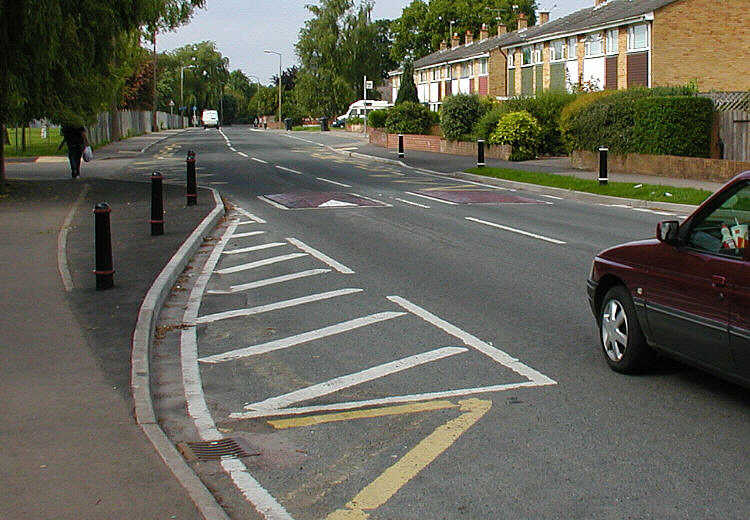
Traffic calming uses physical design, as well as traffic signs, road surface markings, road use rule changes, and other traffic engineering measures to improve road safety for motorists, pedestrians, and cyclists. It has become a tool used by urban planners and road designers to combat speeding and other unsafe behaviours of drivers. It aims to encourage safer, more responsible driving and potentially restrict traffic flow. Urban planners and traffic engineers have many strategies for traffic calming, including narrowed roads and speed humps. Such measures are common in Australia and Europe (especially Northern Europe), but less so in North America, where the focus is often more on facilitating motorized traffic flow. Although they are growing more popular. Traffic calming is a calque (literal translation) of the German word Verkehrsberuhigung – the term's first published use in English was in 1985 by Carmen Hass-Klau.
In its early development in the UK in the 1930s, traffic calming was based on the idea that residential areas should be protected from through-traffic. Subsequently, it became valued for its ability to improve pedestrian safety and reduce noise and air pollution from traffic.[citation needed]
For much of the 20th century, streets were designed by engineers who were charged only with ensuring smooth motor vehicular traffic flow and not with fostering the other functions of streets. Traffic calming initiatives have grown to consider other design functions as well. For example, it has been shown that car traffic severely impairs the social and recreational functions of public streets. The Livable Streets study by Donald Appleyard (1981) found that residents of streets with light traffic had, on average, three more friends and twice as many acquaintances as the people on streets with heavy traffic which were otherwise similar in dimensions, income, etc.[citation needed]
Traffic engineers refer to three "E's" when discussing traffic calming: engineering, (community) education, and (police) enforcement. Because neighborhood traffic management studies have shown that residents often contribute to the perceived speeding problem within their neighborhoods, instructions on traffic calming (for example in Hass-Klau et al., 1992) stress that the most effective traffic calming plans entail all three components—that engineering measures alone will not produce satisfactory results.
Horizontal deflection traffic calming measures cause a lateral shift in the travel pattern of vehicles. This shift forces motorists to slow down in order to comfortably navigate the measure. This is often done by narrowing traffic lanes. Such measures include:
Vertical deflection traffic calming measures cause a vertical upward movement of the vehicle. The change in the height of the roadway forces the motorist to slow down in order to maintain an acceptable level of comfort. Sic measures include:
There are primarily two implementation options for the creation of traffic calming measure: capital reconstruction versus operational changes.[citation needed]
Enforcement and education measures for traffic calming include:
Traffic calming
Traffic calming uses physical design, as well as traffic signs, road surface markings, road use rule changes, and other traffic engineering measures to improve road safety for motorists, pedestrians, and cyclists. It has become a tool used by urban planners and road designers to combat speeding and other unsafe behaviours of drivers. It aims to encourage safer, more responsible driving and potentially restrict traffic flow. Urban planners and traffic engineers have many strategies for traffic calming, including narrowed roads and speed humps. Such measures are common in Australia and Europe (especially Northern Europe), but less so in North America, where the focus is often more on facilitating motorized traffic flow. Although they are growing more popular. Traffic calming is a calque (literal translation) of the German word Verkehrsberuhigung – the term's first published use in English was in 1985 by Carmen Hass-Klau.
In its early development in the UK in the 1930s, traffic calming was based on the idea that residential areas should be protected from through-traffic. Subsequently, it became valued for its ability to improve pedestrian safety and reduce noise and air pollution from traffic.[citation needed]
For much of the 20th century, streets were designed by engineers who were charged only with ensuring smooth motor vehicular traffic flow and not with fostering the other functions of streets. Traffic calming initiatives have grown to consider other design functions as well. For example, it has been shown that car traffic severely impairs the social and recreational functions of public streets. The Livable Streets study by Donald Appleyard (1981) found that residents of streets with light traffic had, on average, three more friends and twice as many acquaintances as the people on streets with heavy traffic which were otherwise similar in dimensions, income, etc.[citation needed]
Traffic engineers refer to three "E's" when discussing traffic calming: engineering, (community) education, and (police) enforcement. Because neighborhood traffic management studies have shown that residents often contribute to the perceived speeding problem within their neighborhoods, instructions on traffic calming (for example in Hass-Klau et al., 1992) stress that the most effective traffic calming plans entail all three components—that engineering measures alone will not produce satisfactory results.
Horizontal deflection traffic calming measures cause a lateral shift in the travel pattern of vehicles. This shift forces motorists to slow down in order to comfortably navigate the measure. This is often done by narrowing traffic lanes. Such measures include:
Vertical deflection traffic calming measures cause a vertical upward movement of the vehicle. The change in the height of the roadway forces the motorist to slow down in order to maintain an acceptable level of comfort. Sic measures include:
There are primarily two implementation options for the creation of traffic calming measure: capital reconstruction versus operational changes.[citation needed]
Enforcement and education measures for traffic calming include:
Recent media
Recent media