



Community hub
Recent from talks
Knowledge base stats:
Talk channels stats:
Members stats:
Traffic collision avoidance system
A traffic alert and collision avoidance system (TCAS), pronounced /ˈtiːkæs/ TEE-kas), also known as an Airborne Collision Avoidance System (ACAS), is an aircraft collision avoidance system designed to reduce the incidence of mid-air collision (MAC) between aircraft. It monitors the airspace around an aircraft for other aircraft equipped with a corresponding active transponder, independent of air traffic control, and warns pilots of the presence of other transponder-equipped aircraft which may present a threat of MAC. It is a type of airborne collision avoidance system mandated by the International Civil Aviation Organization to be fitted to all aircraft with a maximum take-off mass (MTOM) of over 5,700 kg (12,600 lb) or authorized to carry more than 19 passengers. In the United States, CFR 14, Ch I, part 135 requires that TCAS I be installed for aircraft with 10–30 passengers and TCAS II for aircraft with more than 30 passengers. ACAS/TCAS is based on secondary surveillance radar (SSR) transponder signals, but operates independently of ground-based equipment to provide advice to the pilot on potentially conflicting aircraft.
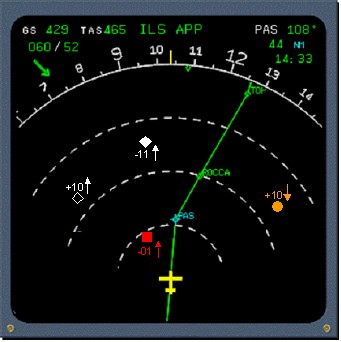
In modern glass cockpit aircraft, the TCAS display may be integrated in the navigation display (ND) or electronic horizontal situation indicator (EHSI).
In older glass cockpit aircraft and those with mechanical instrumentation, an integrated TCAS display including an instantaneous vertical speed indicator (IVSI) may replace the mechanical IVSI, which only indicates the rate at which the aircraft is descending or climbing.
Research into collision avoidance systems has been ongoing since at least the 1950s, and the airline industry has been working with the Air Transport Association of America (ATA) since 1955 toward a collision avoidance system. ICAO and aviation authorities such as the Federal Aviation Administration (FAA) were spurred into action by the 1956 Grand Canyon mid-air collision.
Although ATCRBS airborne transponders were available, it was not until the mid-1970s that research focused on using their signals as the cooperative element for a collision avoidance system. This technical approach enabled an independent collision avoidance capability on the flight deck, separate from the ground system. In 1981, the FAA decided to implement the Traffic Alert and Collision Avoidance System (TCAS), which was developed based on industry and agency efforts in the field of beacon-based collision avoidance systems and air-to-air discrete address communication techniques that used Mode S airborne transponder message formats.
A short time later, prototypes of TCAS II were installed on two Piedmont Airlines Boeing 727 aircraft, and were flown on regularly scheduled flights. Although the displays were located outside the view of the flight crew and seen only by trained observers, these tests did provide valuable information on the frequency and circumstances of alerts and their potential for interaction with the ATC system. On a follow-on phase II program, a later version of TCAS II was installed on a single Piedmont Airlines Boeing 727, and the system was certified in April 1986, then subsequently approved for operational evaluation in early 1987. Since the equipment was not developed to full standards, the system was only operated in visual meteorological conditions (VMC). Although the flight crew operated the system, the evaluation was primarily for the purpose of data collection and its correlation with flight crew and observer observation and response.
Later versions of TCAS II manufactured by Bendix/King Air Transport Avionics Division were installed and approved on United Airlines airplanes in early 1988. Similar units manufactured by Honeywell were installed and approved on Northwest Airlines airplanes in late 1988. This limited installation program operated TCAS II units approved for operation as a full-time system in both visual and instrument meteorological conditions (IMC) on three different aircraft types. The operational evaluation programs continued through 1988 to validate the operational suitability of the systems.
The implementation of TCAS added a safety barrier to help prevent mid-air collisions. However, further study, refinements, training and regulatory measures were still required because the limitations and misuse of the system still resulted in other incidents and fatal accidents, which include:
Hub AI
Traffic collision avoidance system AI simulator
(@Traffic collision avoidance system_simulator)
Traffic collision avoidance system
A traffic alert and collision avoidance system (TCAS), pronounced /ˈtiːkæs/ TEE-kas), also known as an Airborne Collision Avoidance System (ACAS), is an aircraft collision avoidance system designed to reduce the incidence of mid-air collision (MAC) between aircraft. It monitors the airspace around an aircraft for other aircraft equipped with a corresponding active transponder, independent of air traffic control, and warns pilots of the presence of other transponder-equipped aircraft which may present a threat of MAC. It is a type of airborne collision avoidance system mandated by the International Civil Aviation Organization to be fitted to all aircraft with a maximum take-off mass (MTOM) of over 5,700 kg (12,600 lb) or authorized to carry more than 19 passengers. In the United States, CFR 14, Ch I, part 135 requires that TCAS I be installed for aircraft with 10–30 passengers and TCAS II for aircraft with more than 30 passengers. ACAS/TCAS is based on secondary surveillance radar (SSR) transponder signals, but operates independently of ground-based equipment to provide advice to the pilot on potentially conflicting aircraft.
In modern glass cockpit aircraft, the TCAS display may be integrated in the navigation display (ND) or electronic horizontal situation indicator (EHSI).
In older glass cockpit aircraft and those with mechanical instrumentation, an integrated TCAS display including an instantaneous vertical speed indicator (IVSI) may replace the mechanical IVSI, which only indicates the rate at which the aircraft is descending or climbing.
Research into collision avoidance systems has been ongoing since at least the 1950s, and the airline industry has been working with the Air Transport Association of America (ATA) since 1955 toward a collision avoidance system. ICAO and aviation authorities such as the Federal Aviation Administration (FAA) were spurred into action by the 1956 Grand Canyon mid-air collision.
Although ATCRBS airborne transponders were available, it was not until the mid-1970s that research focused on using their signals as the cooperative element for a collision avoidance system. This technical approach enabled an independent collision avoidance capability on the flight deck, separate from the ground system. In 1981, the FAA decided to implement the Traffic Alert and Collision Avoidance System (TCAS), which was developed based on industry and agency efforts in the field of beacon-based collision avoidance systems and air-to-air discrete address communication techniques that used Mode S airborne transponder message formats.
A short time later, prototypes of TCAS II were installed on two Piedmont Airlines Boeing 727 aircraft, and were flown on regularly scheduled flights. Although the displays were located outside the view of the flight crew and seen only by trained observers, these tests did provide valuable information on the frequency and circumstances of alerts and their potential for interaction with the ATC system. On a follow-on phase II program, a later version of TCAS II was installed on a single Piedmont Airlines Boeing 727, and the system was certified in April 1986, then subsequently approved for operational evaluation in early 1987. Since the equipment was not developed to full standards, the system was only operated in visual meteorological conditions (VMC). Although the flight crew operated the system, the evaluation was primarily for the purpose of data collection and its correlation with flight crew and observer observation and response.
Later versions of TCAS II manufactured by Bendix/King Air Transport Avionics Division were installed and approved on United Airlines airplanes in early 1988. Similar units manufactured by Honeywell were installed and approved on Northwest Airlines airplanes in late 1988. This limited installation program operated TCAS II units approved for operation as a full-time system in both visual and instrument meteorological conditions (IMC) on three different aircraft types. The operational evaluation programs continued through 1988 to validate the operational suitability of the systems.
The implementation of TCAS added a safety barrier to help prevent mid-air collisions. However, further study, refinements, training and regulatory measures were still required because the limitations and misuse of the system still resulted in other incidents and fatal accidents, which include: