



Community hub
Recent from talks
Knowledge base stats:
Talk channels stats:
Members stats:
Trail braking
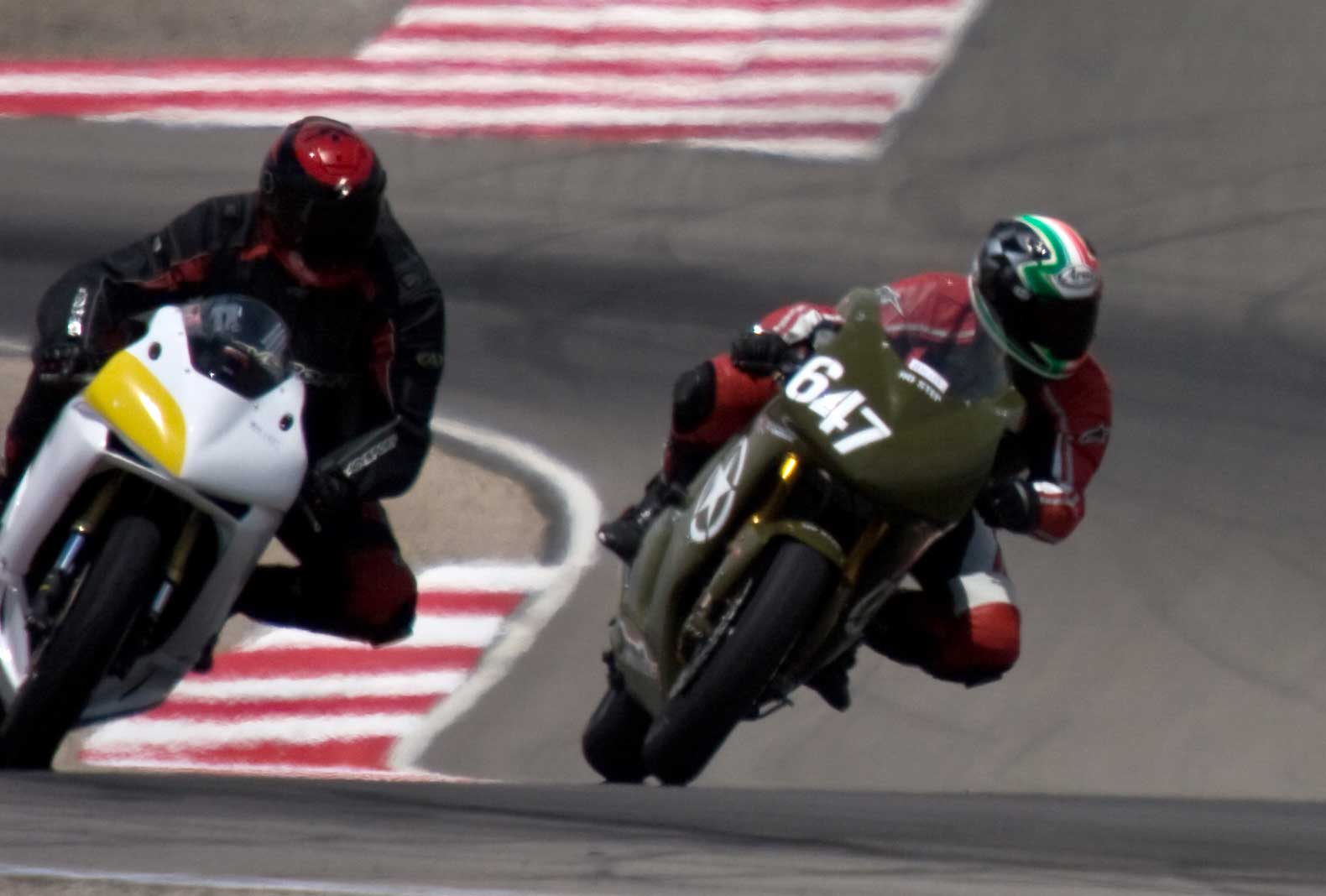
Trail braking is a driving and motorcycle riding technique where the brakes are used beyond the entrance to a turn (turn-in), and then gradually released (trailed off). Depending on a number of factors, the driver fully releases brake pressure at any point between turn-in and the apex of the turn.
In applying this technique, motorcycle riders approach turns applying front brakes to reduce speed. As they enter the turn, they slowly ease off the brakes, gradually decreasing or trailing off the brakes as motorcycle lean increases. This is done for several reasons.
First, it gives more traction because the downward force on the front tire is increased by load transfer. Second, as the brakes are applied and the weight shifts forward, the forks are compressed. The compression of the forks changes the motorcycle's steering geometry, decreasing stability in a way that makes the motorcycle more apt to lean and more quickly change direction. Third, decreasing speed decreases the motorcycle's cornering radius. Conversely, accelerating while turning increases the motorcycle's cornering radius.
Fourth, trailing off the brakes while entering blind or tight corners allows the rider to slow if something unexpected blocks the rider's path. Because the motorcycle is already on the brakes and the front tire is getting additional traction from already slowing, the rider can slow even more with very little risk, depending on surface conditions. However, applying the brakes after the motorcycle is already leaned over can be risky, depending on surface conditions and lean angle.
Traditionally, trail braking is done exclusively with the front brake, even though trailing the rear brake will also effectively slow the motorcycle and decrease the turning radius.
The rider's ability to correctly choose their turn in, apex, and exit points reduces or eliminates the need for prolonged trailing of the brakes into turns. This technique is commonly used when racing, but can enhance control, increase sight distance through the turn, and add evasive options for street riders.
There is risk with trail braking because excessive use of the front brake can result in a loss of grip as the tire's adhesion is split between braking and cornering forces. Effective trail braking requires finesse from the rider, which can be difficult to learn.
Motorcycle training curriculums vary in whether they introduce trail braking to beginning street riders, or focus on other skills at first and introduce the topic to intermediate riders later.
Hub AI
Trail braking AI simulator
(@Trail braking_simulator)
Trail braking
Trail braking is a driving and motorcycle riding technique where the brakes are used beyond the entrance to a turn (turn-in), and then gradually released (trailed off). Depending on a number of factors, the driver fully releases brake pressure at any point between turn-in and the apex of the turn.
In applying this technique, motorcycle riders approach turns applying front brakes to reduce speed. As they enter the turn, they slowly ease off the brakes, gradually decreasing or trailing off the brakes as motorcycle lean increases. This is done for several reasons.
First, it gives more traction because the downward force on the front tire is increased by load transfer. Second, as the brakes are applied and the weight shifts forward, the forks are compressed. The compression of the forks changes the motorcycle's steering geometry, decreasing stability in a way that makes the motorcycle more apt to lean and more quickly change direction. Third, decreasing speed decreases the motorcycle's cornering radius. Conversely, accelerating while turning increases the motorcycle's cornering radius.
Fourth, trailing off the brakes while entering blind or tight corners allows the rider to slow if something unexpected blocks the rider's path. Because the motorcycle is already on the brakes and the front tire is getting additional traction from already slowing, the rider can slow even more with very little risk, depending on surface conditions. However, applying the brakes after the motorcycle is already leaned over can be risky, depending on surface conditions and lean angle.
Traditionally, trail braking is done exclusively with the front brake, even though trailing the rear brake will also effectively slow the motorcycle and decrease the turning radius.
The rider's ability to correctly choose their turn in, apex, and exit points reduces or eliminates the need for prolonged trailing of the brakes into turns. This technique is commonly used when racing, but can enhance control, increase sight distance through the turn, and add evasive options for street riders.
There is risk with trail braking because excessive use of the front brake can result in a loss of grip as the tire's adhesion is split between braking and cornering forces. Effective trail braking requires finesse from the rider, which can be difficult to learn.
Motorcycle training curriculums vary in whether they introduce trail braking to beginning street riders, or focus on other skills at first and introduce the topic to intermediate riders later.