
Recent from talks
Train horn
Knowledge base stats:
Talk channels stats:
Members stats:
Train horn
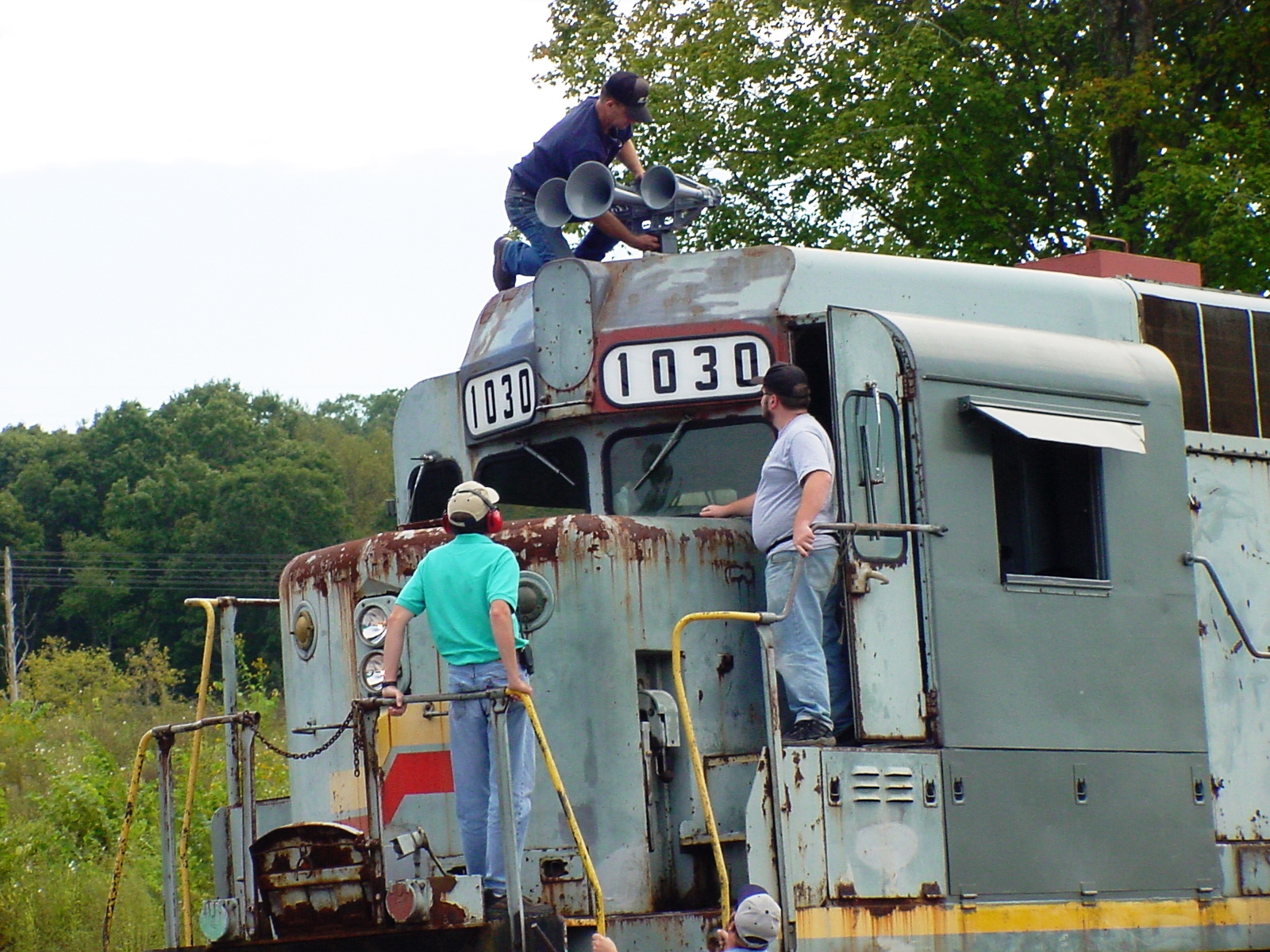
A train horn is an air horn used as an audible warning device on diesel and electric-powered trains. Its primary purpose is to alert persons and animals to an oncoming train, especially when approaching a level crossing. They are often extremely loud, allowing them to be heard from great distances. They are also used for acknowledging signals given by railroad employees, such as during switching operations. For steam locomotives, the equivalent device is a train whistle.
Since trains move on fixed rails, they are uniquely susceptible to collision. This is exacerbated by the train's enormous weight and inertia, which make it difficult to quickly stop when encountering an obstacle. Also, trains generally do not stop at level crossings, instead relying on pedestrians and vehicles to clear the tracks when they pass. Therefore, from their beginnings, locomotives have been equipped with loud horns or bells to warn vehicles and pedestrians that they are coming. Steam locomotives had steam whistles, operated from steam produced by their boilers.
As diesel locomotives began to replace steam on most railroads during the mid-20th century, it was realized that the new locomotives were unable to utilize the steam whistles then in use. Early internal combustion locomotives were initially fitted with small truck horns or exhaust-powered whistles, but these were found to be unsuitable and hence the air horn design was scaled up and modified for railroad use. Early train horns often were tonally similar to the air horns still heard on road-going trucks today. It was found that this caused some confusion among people who were accustomed to steam locomotives and the sound of their whistles; when approaching a grade crossing, when some people heard an air horn they expected to see a truck, not a locomotive, and accidents happened. So, locomotive air horns were created that had a much higher, more musical note, tonally much more like a steam whistle. This is why most train horns have a unique sound, different from that of road going trucks, although many switcher locomotives, which didn't see road service (service on the main lines), retained the deeper truck-like horns.
Strict regulations specific to each country specify how loud horns must be, and how far in advance of grade crossings and other locations locomotive engineers are required to sound their horns to give adequate time to clear the tracks. Standard signals consisting of different sequences of horn blasts must be given in different circumstances.
Due to the encroachment of development, some suburban dwellers have opposed railroad use of the air horn as a trackside warning device. Residents in some communities have attempted to establish quiet zones, in which train crews are instructed not to sound their horns, except in case of emergency.
Recent years have seen an increase of horn theft from railroad property.
Train horns are operated by compressed air, typically 125–140 psi (8.6–9.7 bar), and fed from a locomotive main air reservoir. When the engineer opens the horn valve, air flows through a supply line into the power chamber at the horn's base (diagram, right). It passes through a narrow opening between a nozzle and a circular diaphragm in the power chamber, then out through the flaring horn bell. The flow of air past the diaphragm causes it to vibrate or oscillate against the nozzle, producing sound.
When an air horn is not operating and has no fluid pressure flowing through it, the interior of the power chamber housing is completely airtight, as the diaphragm disc creates a full airtight seal against the nozzle surface. As this diagram illustrates, when a constant stream of pressurized fluid enters through the small bottom inlet, the pressure in the airtight power chamber increases. The pressure continues rising in Chamber 'A' until the pressure overcomes the diaphragm's spring tension. Once this occurs, the diaphragm is deflected back and is no longer sealed against the nozzle, causing the power chamber to lose its airtightness. The pressurized fluid then escapes out of the horn bell, at a much faster rate than it enters the power chamber, causing the pressure in the power chamber to drop rapidly and the diaphragm to re-seat itself against the nozzle surface. This entire process is one cycle of the diaphragm operating. In reality, it occurs much faster, in accordance to the frequency produced by the horn. The diaphragm's constant back-and-forth oscillation creates sound waves, which are amplified by the large flared horn bell. The horn bell's length, thickness and diameter contribute to the frequency of the note the horn produces.
Hub AI
Train horn AI simulator
(@Train horn_simulator)
Train horn
A train horn is an air horn used as an audible warning device on diesel and electric-powered trains. Its primary purpose is to alert persons and animals to an oncoming train, especially when approaching a level crossing. They are often extremely loud, allowing them to be heard from great distances. They are also used for acknowledging signals given by railroad employees, such as during switching operations. For steam locomotives, the equivalent device is a train whistle.
Since trains move on fixed rails, they are uniquely susceptible to collision. This is exacerbated by the train's enormous weight and inertia, which make it difficult to quickly stop when encountering an obstacle. Also, trains generally do not stop at level crossings, instead relying on pedestrians and vehicles to clear the tracks when they pass. Therefore, from their beginnings, locomotives have been equipped with loud horns or bells to warn vehicles and pedestrians that they are coming. Steam locomotives had steam whistles, operated from steam produced by their boilers.
As diesel locomotives began to replace steam on most railroads during the mid-20th century, it was realized that the new locomotives were unable to utilize the steam whistles then in use. Early internal combustion locomotives were initially fitted with small truck horns or exhaust-powered whistles, but these were found to be unsuitable and hence the air horn design was scaled up and modified for railroad use. Early train horns often were tonally similar to the air horns still heard on road-going trucks today. It was found that this caused some confusion among people who were accustomed to steam locomotives and the sound of their whistles; when approaching a grade crossing, when some people heard an air horn they expected to see a truck, not a locomotive, and accidents happened. So, locomotive air horns were created that had a much higher, more musical note, tonally much more like a steam whistle. This is why most train horns have a unique sound, different from that of road going trucks, although many switcher locomotives, which didn't see road service (service on the main lines), retained the deeper truck-like horns.
Strict regulations specific to each country specify how loud horns must be, and how far in advance of grade crossings and other locations locomotive engineers are required to sound their horns to give adequate time to clear the tracks. Standard signals consisting of different sequences of horn blasts must be given in different circumstances.
Due to the encroachment of development, some suburban dwellers have opposed railroad use of the air horn as a trackside warning device. Residents in some communities have attempted to establish quiet zones, in which train crews are instructed not to sound their horns, except in case of emergency.
Recent years have seen an increase of horn theft from railroad property.
Train horns are operated by compressed air, typically 125–140 psi (8.6–9.7 bar), and fed from a locomotive main air reservoir. When the engineer opens the horn valve, air flows through a supply line into the power chamber at the horn's base (diagram, right). It passes through a narrow opening between a nozzle and a circular diaphragm in the power chamber, then out through the flaring horn bell. The flow of air past the diaphragm causes it to vibrate or oscillate against the nozzle, producing sound.
When an air horn is not operating and has no fluid pressure flowing through it, the interior of the power chamber housing is completely airtight, as the diaphragm disc creates a full airtight seal against the nozzle surface. As this diagram illustrates, when a constant stream of pressurized fluid enters through the small bottom inlet, the pressure in the airtight power chamber increases. The pressure continues rising in Chamber 'A' until the pressure overcomes the diaphragm's spring tension. Once this occurs, the diaphragm is deflected back and is no longer sealed against the nozzle, causing the power chamber to lose its airtightness. The pressurized fluid then escapes out of the horn bell, at a much faster rate than it enters the power chamber, causing the pressure in the power chamber to drop rapidly and the diaphragm to re-seat itself against the nozzle surface. This entire process is one cycle of the diaphragm operating. In reality, it occurs much faster, in accordance to the frequency produced by the horn. The diaphragm's constant back-and-forth oscillation creates sound waves, which are amplified by the large flared horn bell. The horn bell's length, thickness and diameter contribute to the frequency of the note the horn produces.
Recent media