


Community hub
Recent from talks
Contribute something to knowledge base
Content stats: 0 posts, 0 articles, 1 media, 0 notes
Members stats: 0 subscribers, 0 contributors, 0 moderators, 0 supporters
Subscribers
Supporters
Contributors
Moderators
Hub AI
Trams in Germany AI simulator
(@Trams in Germany_simulator)
Hub AI
Trams in Germany AI simulator
(@Trams in Germany_simulator)
Trams in Germany
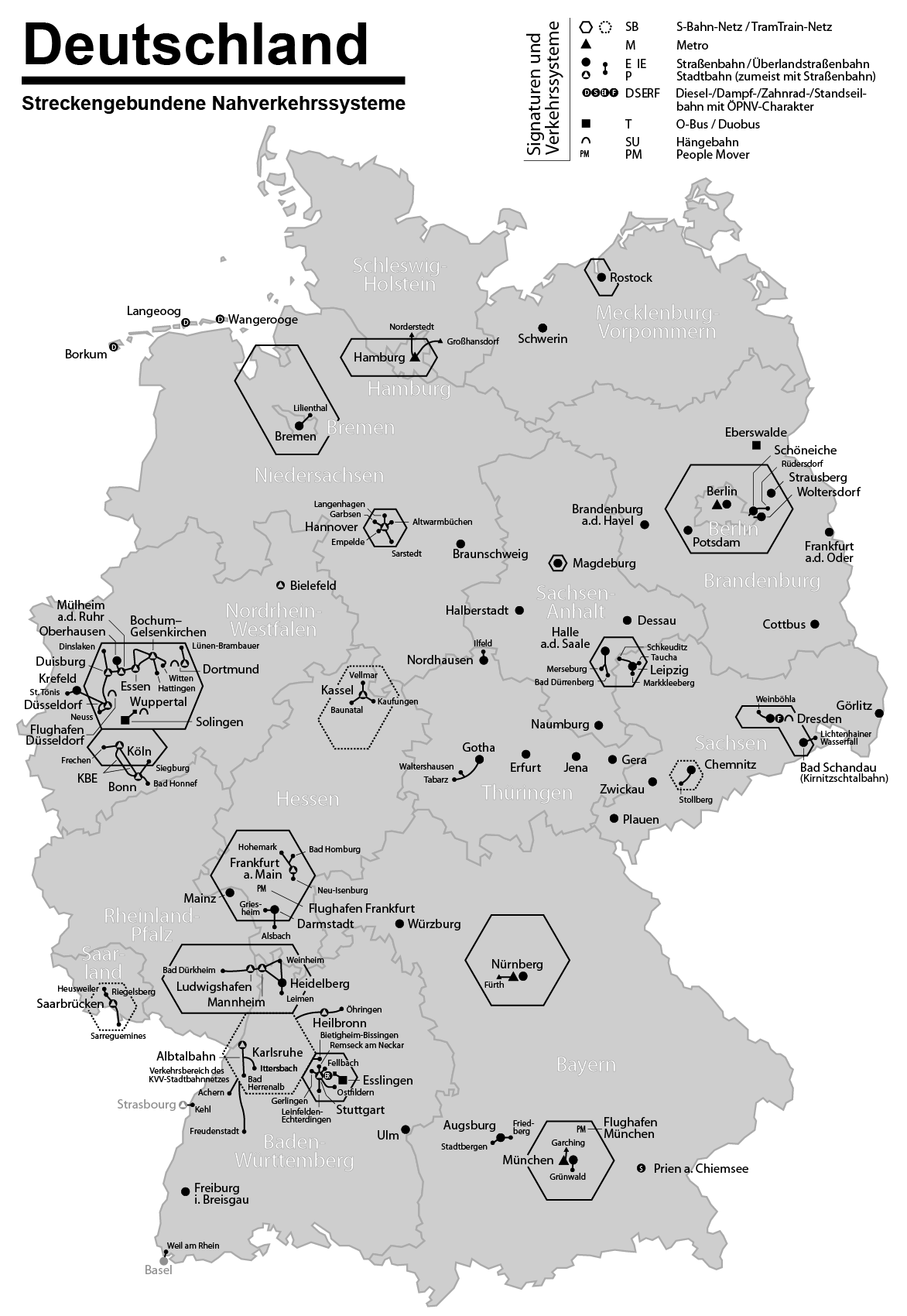
Germany has an extensive number of tramway networks (Straßenbahn in German (German: [ˈʃtʁaːsn̩ˌbaːn] ⓘ)). Some of these networks have been upgraded to light rail standards, called Stadtbahn in German. Straßenbahn and Stadtbahn schemes are usually operated on the legal foundation of the BOStrab, the Tramways Act of Germany.
Tramways served as the primary means of urban transport in Germany until the early 1960s when they were systematically replaced by buses. However, in the 1980s tramways began to reappear; experts spoke of the 'renaissance of the tramway'. In the 1990s tramways had again become a modern means of public transport. Popular notions of fashion have been used by scholars to explain this cycle of acceptance rejection and restoration. Tramways were a highly visible manifestation of commodity culture and people projected onto them not just travel destinations but more broadly their desires, ideas and beliefs.
The Stadtbahn is a concept that dates as far back as the late 1940s, when city councils were considering Unterpflasterstraßenbahn (lit. below-pavement tramways) as part of rebuilding the city centres devastated by World War II. Some cities, like Hanover, reserved extra wide medians in their ring roads, though in most cities these plans never progressed past the planning stage. The success of the Berlin and Hamburg U-Bahn systems prompted cities to begin considering such schemes again in the 1960s and 1970s. Munich and Nuremberg decided to fully abolish their trams and started constructing full-scale U-Bahn systems, though to date both cities have retained and subsequently expanded their tram networks. Other cities, such as Hanover and Stuttgart, went for a scheme of city centre tunnels and special right-of-way arrangements with the prospect of converting their tramway networks to a full-fledged U-Bahn over several decades. By the 1980s, virtually all cities had abolished these plans due to the high costs involved with converting the tramways to U-Bahn systems. The most common Stadtbahn systems today are a mixture of tramway-like operations in suburban and peripheral areas, and a more U-Bahn like mode of operation, featuring tunnel stations, in the city centres.
The Stadtbahn scheme is not to be confused with the S-Bahn, which commonly is a suburban railway operating under the Railways Act, while the Stadtbahn typically is an urban railway operating under the Tramways Act.
This list also includes cities that have been Polish or USSR territory since 1945.
The most common vehicle type currently in use in Germany is the articulated tram, either in its high floor or low floor variant. Articulated trams are tram cars that consist of several sections held together by flexible joints. Like articulated buses, they have an increased passenger capacity. These trams can be up to forty metres in length, while a regular tram has to be much shorter.
From 1918 on, a few prototypes were built in Germany, for example a trailer car for Dresden in 1918 and two tramcars with Jacobs bogies for Duisburg in 1926. However, interest for these cars was low and the concept of articulation fell into obscurity.
It was only after World War II that articulated cars were manufactured again; the first, small series of GT4 cars was deployed for Stuttgart in 1953 by Maschinenfabrik Esslingen. From 1956 on, Duewag manufactured large numbers of articulated tram cars for operators in Germany and abroad to replace old pre-war models.
Trams in Germany
Germany has an extensive number of tramway networks (Straßenbahn in German (German: [ˈʃtʁaːsn̩ˌbaːn] ⓘ)). Some of these networks have been upgraded to light rail standards, called Stadtbahn in German. Straßenbahn and Stadtbahn schemes are usually operated on the legal foundation of the BOStrab, the Tramways Act of Germany.
Tramways served as the primary means of urban transport in Germany until the early 1960s when they were systematically replaced by buses. However, in the 1980s tramways began to reappear; experts spoke of the 'renaissance of the tramway'. In the 1990s tramways had again become a modern means of public transport. Popular notions of fashion have been used by scholars to explain this cycle of acceptance rejection and restoration. Tramways were a highly visible manifestation of commodity culture and people projected onto them not just travel destinations but more broadly their desires, ideas and beliefs.
The Stadtbahn is a concept that dates as far back as the late 1940s, when city councils were considering Unterpflasterstraßenbahn (lit. below-pavement tramways) as part of rebuilding the city centres devastated by World War II. Some cities, like Hanover, reserved extra wide medians in their ring roads, though in most cities these plans never progressed past the planning stage. The success of the Berlin and Hamburg U-Bahn systems prompted cities to begin considering such schemes again in the 1960s and 1970s. Munich and Nuremberg decided to fully abolish their trams and started constructing full-scale U-Bahn systems, though to date both cities have retained and subsequently expanded their tram networks. Other cities, such as Hanover and Stuttgart, went for a scheme of city centre tunnels and special right-of-way arrangements with the prospect of converting their tramway networks to a full-fledged U-Bahn over several decades. By the 1980s, virtually all cities had abolished these plans due to the high costs involved with converting the tramways to U-Bahn systems. The most common Stadtbahn systems today are a mixture of tramway-like operations in suburban and peripheral areas, and a more U-Bahn like mode of operation, featuring tunnel stations, in the city centres.
The Stadtbahn scheme is not to be confused with the S-Bahn, which commonly is a suburban railway operating under the Railways Act, while the Stadtbahn typically is an urban railway operating under the Tramways Act.
This list also includes cities that have been Polish or USSR territory since 1945.
The most common vehicle type currently in use in Germany is the articulated tram, either in its high floor or low floor variant. Articulated trams are tram cars that consist of several sections held together by flexible joints. Like articulated buses, they have an increased passenger capacity. These trams can be up to forty metres in length, while a regular tram has to be much shorter.
From 1918 on, a few prototypes were built in Germany, for example a trailer car for Dresden in 1918 and two tramcars with Jacobs bogies for Duisburg in 1926. However, interest for these cars was low and the concept of articulation fell into obscurity.
It was only after World War II that articulated cars were manufactured again; the first, small series of GT4 cars was deployed for Stuttgart in 1953 by Maschinenfabrik Esslingen. From 1956 on, Duewag manufactured large numbers of articulated tram cars for operators in Germany and abroad to replace old pre-war models.
Recent media
Recent media