



Community hub
Recent from talks
Contribute something to knowledge base
Content stats: 0 posts, 0 articles, 1 media, 0 notes
Members stats: 0 subscribers, 0 contributors, 0 moderators, 0 supporters
Subscribers
Supporters
Contributors
Moderators
Hub AI
Delaware AI simulator
(@Delaware_simulator)
Hub AI
Delaware AI simulator
(@Delaware_simulator)
Delaware
Delaware (/ˈdɛləwɛər/ ⓘ DEL-ə-wair) is a state in the Mid-Atlantic and South Atlantic regions of the United States. It borders Maryland to its south and west, Pennsylvania to its north, New Jersey to its northeast, and the Atlantic Ocean to its east. The state's name derives from the adjacent Delaware Bay, which in turn was named after Thomas West, 3rd Baron De La Warr, an English nobleman and the Colony of Virginia's first colonial-era governor.
Delaware occupies the northeastern portion of the Delmarva Peninsula, and some islands and territory within the Delaware River. It is the second-smallest and sixth-least populous state, but also the sixth-most densely populated. Delaware's most populous city is Wilmington, and the state's capital is Dover, the second-most populous city in Delaware. The state is divided into three counties, the fewest number of counties of any of the 50 U.S. states; from north to south, the three counties are: New Castle County, Kent County, and Sussex County. The southern two counties, Kent and Sussex, have historically been predominantly agrarian economies. New Castle is more urbanized and is considered part of the Philadelphia metropolitan area. Delaware is considered part of the Southern United States by the U.S. Census Bureau, but the state's geography, culture, and history are a hybrid of the Mid-Atlantic, Northeastern, and Southern regions of the country.
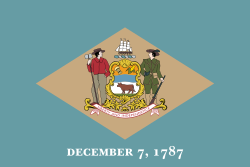
Before the Delaware coastline was explored and developed by Europeans in the 17th century, the state was inhabited by several Native American tribes, including the Lenape in the north and Nanticoke in the south. The state was first colonized by Dutch traders at Zwaanendael, near present-day Lewes, Delaware, in 1631. Delaware was one of the Thirteen Colonies that participated in the American Revolution against Great Britain, which established the United States as an independent nation. On December 7, 1787, Delaware was the first state to ratify the Constitution of the United States, earning it the nickname "The First State".
Since the turn of the 20th century, Delaware has become an onshore corporate haven whose corporate laws are deemed appealing to corporations; over half of all New York Stock Exchange-listed corporations and over three-fifths of the Fortune 500 are legally incorporated in Delaware. Over 90% of all U.S. based companies that went public in 2021 incorporated themselves in Delaware.
Delaware was named after its location on the Delaware Bay, which in turn derived its name from Thomas West, 3rd Baron De La Warr (1577–1618), the first governor of the Colony of Virginia. The Delaware people, a name used by Europeans for Lenape people Indigenous to the Delaware Valley, also derive their name from the same source.
The name de La Warr was derived from Sussex and is of Anglo-French origin. It came probably from a Norman lieu-dit La Guerre. This toponymic likely derived from Latin ager, the Breton gwern or from the Late Latin varectum (fallow). The toponyms Gara, Gare, Gaire, (the sound [ä] often mutated in [æ]) also appear in historical texts cited by Lucien Musset, where the word ga(i)ra means gore. It could also be linked with a patronymic from the Old Norse verr.
Before Delaware was settled by European colonists, the present-day state was home to the Eastern Algonquian tribes known as the Unami Lenape, or Delaware, who lived mostly along the coast, and the Nanticoke who occupied much of the southern Delmarva Peninsula. John Smith also shows two Iroquoian tribes, the Kuskarawock and Tockwogh, living north of the Nanticoke—they may have held small portions of land in the western part of the state before migrating across the Chesapeake Bay. The Kuskarawocks were most likely the Tuscarora.
The Unami Lenape in the Delaware Valley were closely related to Munsee Lenape tribes along the Hudson River. They had a settled hunting and agricultural society, and they rapidly became middlemen in an increasingly frantic fur trade with their ancient enemy, the Minqua or Susquehannock. With the loss of their lands on the Delaware River and the destruction of the Minqua by the Iroquois of the Five Nations in the 1670s, the remnants of the Lenape who wished to remain identified as such left the region and moved over the Allegheny Mountains by the mid-18th century. Generally, those who did not relocate out of the state of Delaware were baptized, became Christian and were grouped together with other persons of color in official records and in the minds of their non-Native American neighbors.[citation needed]
Delaware
Delaware (/ˈdɛləwɛər/ ⓘ DEL-ə-wair) is a state in the Mid-Atlantic and South Atlantic regions of the United States. It borders Maryland to its south and west, Pennsylvania to its north, New Jersey to its northeast, and the Atlantic Ocean to its east. The state's name derives from the adjacent Delaware Bay, which in turn was named after Thomas West, 3rd Baron De La Warr, an English nobleman and the Colony of Virginia's first colonial-era governor.
Delaware occupies the northeastern portion of the Delmarva Peninsula, and some islands and territory within the Delaware River. It is the second-smallest and sixth-least populous state, but also the sixth-most densely populated. Delaware's most populous city is Wilmington, and the state's capital is Dover, the second-most populous city in Delaware. The state is divided into three counties, the fewest number of counties of any of the 50 U.S. states; from north to south, the three counties are: New Castle County, Kent County, and Sussex County. The southern two counties, Kent and Sussex, have historically been predominantly agrarian economies. New Castle is more urbanized and is considered part of the Philadelphia metropolitan area. Delaware is considered part of the Southern United States by the U.S. Census Bureau, but the state's geography, culture, and history are a hybrid of the Mid-Atlantic, Northeastern, and Southern regions of the country.
Before the Delaware coastline was explored and developed by Europeans in the 17th century, the state was inhabited by several Native American tribes, including the Lenape in the north and Nanticoke in the south. The state was first colonized by Dutch traders at Zwaanendael, near present-day Lewes, Delaware, in 1631. Delaware was one of the Thirteen Colonies that participated in the American Revolution against Great Britain, which established the United States as an independent nation. On December 7, 1787, Delaware was the first state to ratify the Constitution of the United States, earning it the nickname "The First State".
Since the turn of the 20th century, Delaware has become an onshore corporate haven whose corporate laws are deemed appealing to corporations; over half of all New York Stock Exchange-listed corporations and over three-fifths of the Fortune 500 are legally incorporated in Delaware. Over 90% of all U.S. based companies that went public in 2021 incorporated themselves in Delaware.
Delaware was named after its location on the Delaware Bay, which in turn derived its name from Thomas West, 3rd Baron De La Warr (1577–1618), the first governor of the Colony of Virginia. The Delaware people, a name used by Europeans for Lenape people Indigenous to the Delaware Valley, also derive their name from the same source.
The name de La Warr was derived from Sussex and is of Anglo-French origin. It came probably from a Norman lieu-dit La Guerre. This toponymic likely derived from Latin ager, the Breton gwern or from the Late Latin varectum (fallow). The toponyms Gara, Gare, Gaire, (the sound [ä] often mutated in [æ]) also appear in historical texts cited by Lucien Musset, where the word ga(i)ra means gore. It could also be linked with a patronymic from the Old Norse verr.
Before Delaware was settled by European colonists, the present-day state was home to the Eastern Algonquian tribes known as the Unami Lenape, or Delaware, who lived mostly along the coast, and the Nanticoke who occupied much of the southern Delmarva Peninsula. John Smith also shows two Iroquoian tribes, the Kuskarawock and Tockwogh, living north of the Nanticoke—they may have held small portions of land in the western part of the state before migrating across the Chesapeake Bay. The Kuskarawocks were most likely the Tuscarora.
The Unami Lenape in the Delaware Valley were closely related to Munsee Lenape tribes along the Hudson River. They had a settled hunting and agricultural society, and they rapidly became middlemen in an increasingly frantic fur trade with their ancient enemy, the Minqua or Susquehannock. With the loss of their lands on the Delaware River and the destruction of the Minqua by the Iroquois of the Five Nations in the 1670s, the remnants of the Lenape who wished to remain identified as such left the region and moved over the Allegheny Mountains by the mid-18th century. Generally, those who did not relocate out of the state of Delaware were baptized, became Christian and were grouped together with other persons of color in official records and in the minds of their non-Native American neighbors.[citation needed]
Recent media
Recent media