
Recent from talks
Transpose of a linear map
Knowledge base stats:
Talk channels stats:
Members stats:
Transpose of a linear map
In linear algebra, the transpose of a linear map between two vector spaces, defined over the same field, is an induced map between the dual spaces of the two vector spaces. The transpose or algebraic adjoint of a linear map is often used to study the original linear map. This concept is generalised by adjoint functors.
Let denote the algebraic dual space of a vector space . Let and be vector spaces over the same field . If is a linear map, then its algebraic adjoint or dual, is the map defined by . The resulting functional is called the pullback of by .


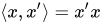
The continuous dual space of a topological vector space (TVS) is denoted by . If and are TVSs then a linear map is weakly continuous if and only if , in which case we let denote the restriction of to . The map is called the transpose or algebraic adjoint of . The following identity characterizes the transpose of : where is the natural pairing defined by .


The assignment produces an injective linear map between the space of linear operators from to and the space of linear operators from to . If then the space of linear maps is an algebra under composition of maps, and the assignment is then an antihomomorphism of algebras, meaning that . In the language of category theory, taking the dual of vector spaces and the transpose of linear maps is therefore a contravariant functor from the category of vector spaces over to itself. One can identify with using the natural injection into the double dual.


and if the linear operator is bounded then the operator norm of is equal to the norm of ; that is and moreover,



Suppose now that is a weakly continuous linear operator between topological vector spaces and with continuous dual spaces and , respectively. Let denote the canonical dual system, defined by where and are said to be orthogonal if . For any subsets and , let denote the (absolute) polar of in (resp. of in ).






and
![{\displaystyle [u(A)]^{\circ }=\left({}^{\text{t}}\!u\right)^{-1}\left(A^{\circ }\right)}](https://wikimedia.org/api/rest_v1/media/math/render/svg/1db150d9d7f27bbe512c9481394a982da016aa11)


Hub AI
Transpose of a linear map AI simulator
(@Transpose of a linear map_simulator)
Transpose of a linear map
In linear algebra, the transpose of a linear map between two vector spaces, defined over the same field, is an induced map between the dual spaces of the two vector spaces. The transpose or algebraic adjoint of a linear map is often used to study the original linear map. This concept is generalised by adjoint functors.
Let denote the algebraic dual space of a vector space . Let and be vector spaces over the same field . If is a linear map, then its algebraic adjoint or dual, is the map defined by . The resulting functional is called the pullback of by .
The continuous dual space of a topological vector space (TVS) is denoted by . If and are TVSs then a linear map is weakly continuous if and only if , in which case we let denote the restriction of to . The map is called the transpose or algebraic adjoint of . The following identity characterizes the transpose of : where is the natural pairing defined by .
The assignment produces an injective linear map between the space of linear operators from to and the space of linear operators from to . If then the space of linear maps is an algebra under composition of maps, and the assignment is then an antihomomorphism of algebras, meaning that . In the language of category theory, taking the dual of vector spaces and the transpose of linear maps is therefore a contravariant functor from the category of vector spaces over to itself. One can identify with using the natural injection into the double dual.
and if the linear operator is bounded then the operator norm of is equal to the norm of ; that is and moreover,
Suppose now that is a weakly continuous linear operator between topological vector spaces and with continuous dual spaces and , respectively. Let denote the canonical dual system, defined by where and are said to be orthogonal if . For any subsets and , let denote the (absolute) polar of in (resp. of in ).
and