



Community hub
Recent from talks
Contribute something
Nothing was collected or created yet.
Operator norm
View on WikipediaIn mathematics, the operator norm measures the "size" of certain linear operators by assigning each a real number called its operator norm. Formally, it is a norm defined on the space of bounded linear operators between two given normed vector spaces. Informally, the operator norm of a linear map is the maximum factor by which it "lengthens" vectors. It is also called the bound norm.[1]


Introduction and definition
[edit]Given two normed vector spaces and (over the same base field, either the real numbers or the complex numbers ), a linear map is continuous if and only if there exists a real number such that[2]



The norm on the left is the one in and the norm on the right is the one in . Intuitively, the continuous operator never increases the length of any vector by more than a factor of Thus the image of a bounded set under a continuous operator is also bounded. Because of this property, the continuous linear operators are also known as bounded operators. In order to "measure the size" of one can take the infimum of the numbers such that the above inequality holds for all This number represents the maximum scalar factor by which "lengthens" vectors. In other words, the "size" of is measured by how much it "lengthens" vectors in the "biggest" case. So we define the operator norm of as



The infimum is attained as the set of all such is closed, nonempty, and bounded from below.[3]
It is important to bear in mind that this operator norm depends on the choice of norms for the normed vector spaces and .
Examples
[edit]Every real -by- matrix corresponds to a linear map from to Each pair of the plethora of (vector) norms applicable to real vector spaces induces an operator norm for all -by- matrices of real numbers; these induced norms form a subset of matrix norms.


If we specifically choose the Euclidean norm on both and then the matrix norm given to a matrix is the square root of the largest eigenvalue of the matrix (where denotes the conjugate transpose of ).[4] This is equivalent to assigning the largest singular value of


Passing to a typical infinite-dimensional example, consider the sequence space which is an Lp space, defined by


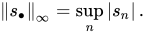
This can be viewed as an infinite-dimensional analogue of the Euclidean space Now consider a bounded sequence The sequence is an element of the space with a norm given by


Define an operator by pointwise multiplication:


The operator is bounded with operator norm

This discussion extends directly to the case where is replaced by a general space with and replaced by


Equivalent definitions
[edit]Let be a linear operator between normed spaces. The first four definitions are always equivalent, and if in addition then they are all equivalent:

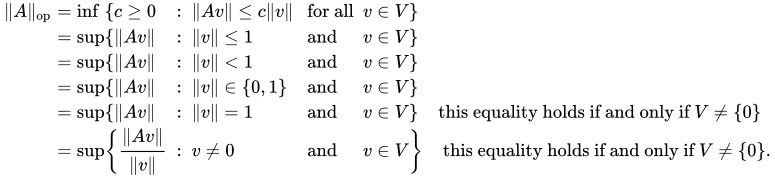
If then the sets in the last two rows will be empty, and consequently their supremums over the set will equal instead of the correct value of If the supremum is taken over the set instead, then the supremum of the empty set is and the formulas hold for any

![{\displaystyle [-\infty ,\infty ]}](https://wikimedia.org/api/rest_v1/media/math/render/svg/e13233867b861889693a36843d98e51d90d38f9f)


![{\displaystyle [0,\infty ]}](https://wikimedia.org/api/rest_v1/media/math/render/svg/52088d5605716e18068a460dec118214954a68e9)


Importantly, a linear operator is not, in general, guaranteed to achieve its norm on the closed unit ball meaning that there might not exist any vector of norm such that (if such a vector does exist and if then would necessarily have unit norm ). R.C. James proved James's theorem in 1964, which states that a Banach space is reflexive if and only if every bounded linear functional achieves its norm on the closed unit ball.[5] It follows, in particular, that every non-reflexive Banach space has some bounded linear functional (a type of bounded linear operator) that does not achieve its norm on the closed unit ball.




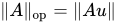


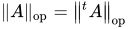
If is bounded then[6] and[6] where is the transpose of which is the linear operator defined by




Properties
[edit]The operator norm is indeed a norm on the space of all bounded operators between and . This means



The following inequality is an immediate consequence of the definition:

The operator norm is also compatible with the composition, or multiplication, of operators: if , and are three normed spaces over the same base field, and and are two bounded operators, then it is a sub-multiplicative norm, that is:



For bounded operators on , this implies that operator multiplication is jointly continuous.
It follows from the definition that if a sequence of operators converges in operator norm, it converges uniformly on bounded sets.
Table of common operator norms
[edit]By choosing different norms for the codomain, used in computing , and the domain, used in computing , we obtain different values for the operator norm. Some common operator norms are easy to calculate, and others are NP-hard. Except for the NP-hard norms, all these norms can be calculated in operations (for an matrix), with the exception of the norm (which requires operations for the exact answer, or fewer if you approximate it with the power method or Lanczos iterations).


| Co-domain | ||||
|---|---|---|---|---|
| Domain | Maximum norm of a column | Maximum norm of a column | Maximum norm of a column | |
| NP-hard | Maximum singular value | Maximum norm of a row | ||
| NP-hard | NP-hard | Maximum norm of a row | ||


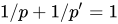
The norm of the adjoint or transpose can be computed as follows. We have that for any then where are Hölder conjugate to that is, and




Operators on a Hilbert space
[edit]Suppose is a real or complex Hilbert space. If is a bounded linear operator, then we have and where denotes the adjoint operator of (which in Euclidean spaces with the standard inner product corresponds to the conjugate transpose of the matrix ).




In general, the spectral radius of is bounded above by the operator norm of :
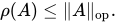
To see why equality may not always hold, consider the Jordan canonical form of a matrix in the finite-dimensional case. Because there are non-zero entries on the superdiagonal, equality may be violated. The quasinilpotent operators is one class of such examples. A nonzero quasinilpotent operator has spectrum So while


However, when a matrix is normal, its Jordan canonical form is diagonal (up to unitary equivalence); this is the spectral theorem. In that case it is easy to see that


This formula can sometimes be used to compute the operator norm of a given bounded operator : define the Hermitian operator determine its spectral radius, and take the square root to obtain the operator norm of

The space of bounded operators on with the topology induced by operator norm, is not separable. For example, consider the Lp space which is a Hilbert space. For let be the characteristic function of and be the multiplication operator given by that is,

![{\displaystyle L^{2}[0,1],}](https://wikimedia.org/api/rest_v1/media/math/render/svg/db69c0180e1e8e1a7b4a0cb48c8fbd304d10beb2)


![{\displaystyle [0,t],}](https://wikimedia.org/api/rest_v1/media/math/render/svg/7ecd690ae41479e5cf026f27d8d994554cefa8b8)



Then each is a bounded operator with operator norm 1 and

But is an uncountable set. This implies the space of bounded operators on is not separable, in operator norm. One can compare this with the fact that the sequence space is not separable.

![{\displaystyle L^{2}([0,1])}](https://wikimedia.org/api/rest_v1/media/math/render/svg/13c2586b254365ca72d662d9e6485fdee8026912)
The associative algebra of all bounded operators on a Hilbert space, together with the operator norm and the adjoint operation, yields a C*-algebra.
See also
[edit]- Banach–Mazur compactum – Concept in functional analysis
- Continuous linear operator – Function between topological vector spaces
- Contraction (operator theory) – Bounded operators with sub-unit norm
- Discontinuous linear map
- Dual norm – Measurement on a normed vector space
- Matrix norm – Norm on a vector space of matrices
- Norm (mathematics) – Length in a vector space
- Normed space – Vector space on which a distance is defined
- Operator algebra – Branch of functional analysis
- Operator theory – Mathematical field of study
- Topologies on the set of operators on a Hilbert space
- Unbounded operator – Linear operator defined on a dense linear subspace
Notes
[edit]- ^ (Bhatia 1997, p. 7)
- ^ Kreyszig, Erwin (1978), Introductory functional analysis with applications, John Wiley & Sons, p. 97, ISBN 9971-51-381-1
- ^ See e.g. Lemma 6.2 of Aliprantis & Border (2007).
- ^ Weisstein, Eric W. "Operator Norm". mathworld.wolfram.com. Retrieved 2020-03-14.
- ^ Diestel 1984, p. 6.
- ^ a b Rudin 1991, pp. 92–115.
- ^ section 4.3.1, Joel Tropp's PhD thesis, [1]
References
[edit]- Aliprantis, Charalambos D.; Border, Kim C. (2007), Infinite Dimensional Analysis: A Hitchhiker's Guide, Springer, p. 229, ISBN 9783540326960.
- Conway, John B. (1990), "III.2 Linear Operators on Normed Spaces", A Course in Functional Analysis, New York: Springer-Verlag, pp. 67–69, ISBN 0-387-97245-5
- Diestel, Joe (1984). Sequences and series in Banach spaces. New York: Springer-Verlag. ISBN 0-387-90859-5. OCLC 9556781.
- Rudin, Walter (1991). Functional Analysis. International Series in Pure and Applied Mathematics. Vol. 8 (Second ed.). New York, NY: McGraw-Hill Science/Engineering/Math. ISBN 978-0-07-054236-5. OCLC 21163277.
- Bhatia, Rajendra (1997). Matrix Analysis. Graduate Texts in Mathematics. Vol. 169. New York, NY: Springer New York. doi:10.1007/978-1-4612-0653-8. ISBN 978-1-4612-6857-4. ISSN 0072-5285.
Banach space topics | |
|---|---|
| Types of Banach spaces | |
| Banach spaces are: | |
| Function space Topologies | |
| Linear operators | |
| Operator theory | |
| Theorems |
|
| Analysis | |
| Types of sets |
|
| Subsets / set operations | |
| Examples | |
| Applications | |


| Spaces |
| ||||
|---|---|---|---|---|---|
| Theorems | |||||
| Operators | |||||
| Algebras | |||||
| Open problems | |||||
| Applications | |||||
| Advanced topics | |||||
