
Recent from talks
Traverse des Sioux
Knowledge base stats:
Talk channels stats:
Members stats:
Traverse des Sioux
Traverse des Sioux is a historic site in the U.S. state of Minnesota. Once part of a pre-industrial trade route, it is preserved to commemorate that route, a busy river crossing on it, and a nineteenth-century settlement, trading post, and mission at that crossing place. It was a transshipment point for pelts in fur trading days, and the namesake for an important United States treaty that forced the Dakota people to cede part of their homeland and opened up much of southern Minnesota to European-American settlement.
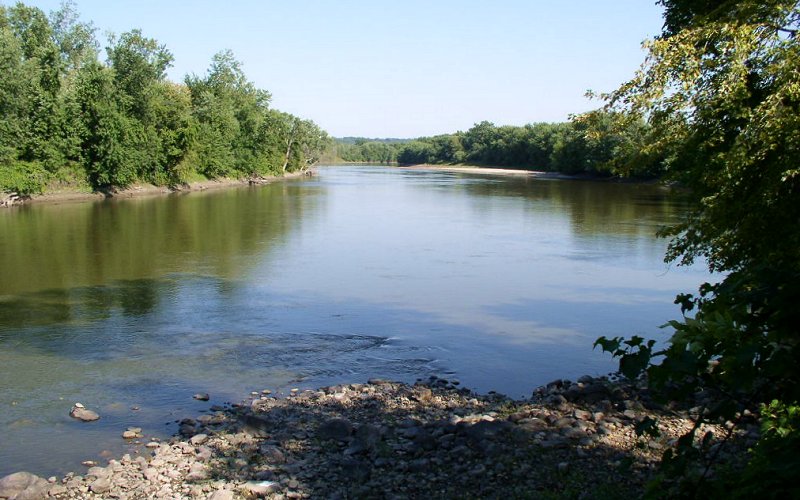
Formerly a Minnesota state park, the site of the old settlement and river ford is now a State Historic Site and a Minnesota State Monument. It is listed on the National Register of Historic Places. Traverse des Sioux is located on the Minnesota River, once a major transportation route, in Nicollet County just north of the city of St. Peter. The site of the crossing was rediscovered in the early 2000s; its north and south ends were marked by PVC pipe, as the river has changed its route and the crossing is not obvious.
Traverse is a French word that means crossing. The term Traverse des Sioux has been applied both to the crossing of the Minnesota River at this location, and the transit of the prairie from the west.
As used by the French Canadian voyageurs and their Métis relatives and descendants, a traverse was a crossing from a safe resting place across an open area to another point of shelter, such as a voyageurs’ crossing of hazardous waters from point to point rather than along a sheltered shore, or its correlate on land, a crossing by Métis ox cart brigades of open prairie from one secure resting place to another. The settlement at Traverse des Sioux was a destination of Métis carters during the days of the Red River Trails, and was also home of a voyageur community during the same time.
Nineteenth-century explorer John C. Frémont used the term Traverse des Sioux to refer to the crossing of the plain west of the river. Westbound travelers left the Minnesota River at the settlement of Traverse des Sioux and went directly west across the open prairie, leaving the shelter of the wooded riverbank in order to shortcut the right-angle elbow of the river at Mankato. They returned to the river near the mouth of the Cottonwood River at modern New Ulm.
Native Americans had historically used a ford of the Minnesota River here from pre-contact times. A trading post at the site of the crossing likely existed by the last half of the eighteenth century, and a number of fur traders had establishments there in the first half of the nineteenth century. An Indian mission was established there in 1843.
By the 1840s it was used as a transshipment point in the fur trade. Pelts from upstream fur posts and from collection points as far away as Pembina and Fort Garry, Canada, were brought by ox cart trains traveling on the West Plains Trail, the westernmost of the Red River Trails. At Traverse des Sioux, the furs were transferred to flatboats bound for Mendota, Minnesota and eastern markets. In the later part of that period, some cart trains traveled all the way to Mendota or Saint Paul, Minnesota, whence the furs were taken by Mississippi riverboat to markets downriver. By 1851 the settlement had two missionaries and their families, a school, several fur trading establishments, a few cabins of French voyageurs, and twenty to thirty Indian lodges.
In 1851 the Treaty of Traverse des Sioux was signed at the post, by which tribes of the Sioux people were induced to cede 24 million acres (97,000 km2) of land to the United States for promises of reservations and annuities at a rate of seven cents per acre. This concession opened up vast areas of Minnesota Territory to non-native settlement. The lands surrendered included Minnesota west of the Mississippi and south of the lands of the Ojibwe, all of what later became South Dakota east of the Big Sioux River, and much of northern Iowa.
Hub AI
Traverse des Sioux AI simulator
(@Traverse des Sioux_simulator)
Traverse des Sioux
Traverse des Sioux is a historic site in the U.S. state of Minnesota. Once part of a pre-industrial trade route, it is preserved to commemorate that route, a busy river crossing on it, and a nineteenth-century settlement, trading post, and mission at that crossing place. It was a transshipment point for pelts in fur trading days, and the namesake for an important United States treaty that forced the Dakota people to cede part of their homeland and opened up much of southern Minnesota to European-American settlement.
Formerly a Minnesota state park, the site of the old settlement and river ford is now a State Historic Site and a Minnesota State Monument. It is listed on the National Register of Historic Places. Traverse des Sioux is located on the Minnesota River, once a major transportation route, in Nicollet County just north of the city of St. Peter. The site of the crossing was rediscovered in the early 2000s; its north and south ends were marked by PVC pipe, as the river has changed its route and the crossing is not obvious.
Traverse is a French word that means crossing. The term Traverse des Sioux has been applied both to the crossing of the Minnesota River at this location, and the transit of the prairie from the west.
As used by the French Canadian voyageurs and their Métis relatives and descendants, a traverse was a crossing from a safe resting place across an open area to another point of shelter, such as a voyageurs’ crossing of hazardous waters from point to point rather than along a sheltered shore, or its correlate on land, a crossing by Métis ox cart brigades of open prairie from one secure resting place to another. The settlement at Traverse des Sioux was a destination of Métis carters during the days of the Red River Trails, and was also home of a voyageur community during the same time.
Nineteenth-century explorer John C. Frémont used the term Traverse des Sioux to refer to the crossing of the plain west of the river. Westbound travelers left the Minnesota River at the settlement of Traverse des Sioux and went directly west across the open prairie, leaving the shelter of the wooded riverbank in order to shortcut the right-angle elbow of the river at Mankato. They returned to the river near the mouth of the Cottonwood River at modern New Ulm.
Native Americans had historically used a ford of the Minnesota River here from pre-contact times. A trading post at the site of the crossing likely existed by the last half of the eighteenth century, and a number of fur traders had establishments there in the first half of the nineteenth century. An Indian mission was established there in 1843.
By the 1840s it was used as a transshipment point in the fur trade. Pelts from upstream fur posts and from collection points as far away as Pembina and Fort Garry, Canada, were brought by ox cart trains traveling on the West Plains Trail, the westernmost of the Red River Trails. At Traverse des Sioux, the furs were transferred to flatboats bound for Mendota, Minnesota and eastern markets. In the later part of that period, some cart trains traveled all the way to Mendota or Saint Paul, Minnesota, whence the furs were taken by Mississippi riverboat to markets downriver. By 1851 the settlement had two missionaries and their families, a school, several fur trading establishments, a few cabins of French voyageurs, and twenty to thirty Indian lodges.
In 1851 the Treaty of Traverse des Sioux was signed at the post, by which tribes of the Sioux people were induced to cede 24 million acres (97,000 km2) of land to the United States for promises of reservations and annuities at a rate of seven cents per acre. This concession opened up vast areas of Minnesota Territory to non-native settlement. The lands surrendered included Minnesota west of the Mississippi and south of the lands of the Ojibwe, all of what later became South Dakota east of the Big Sioux River, and much of northern Iowa.
Recent media