
Recent from talks
Trematoda
Knowledge base stats:
Talk channels stats:
Members stats:
Trematoda
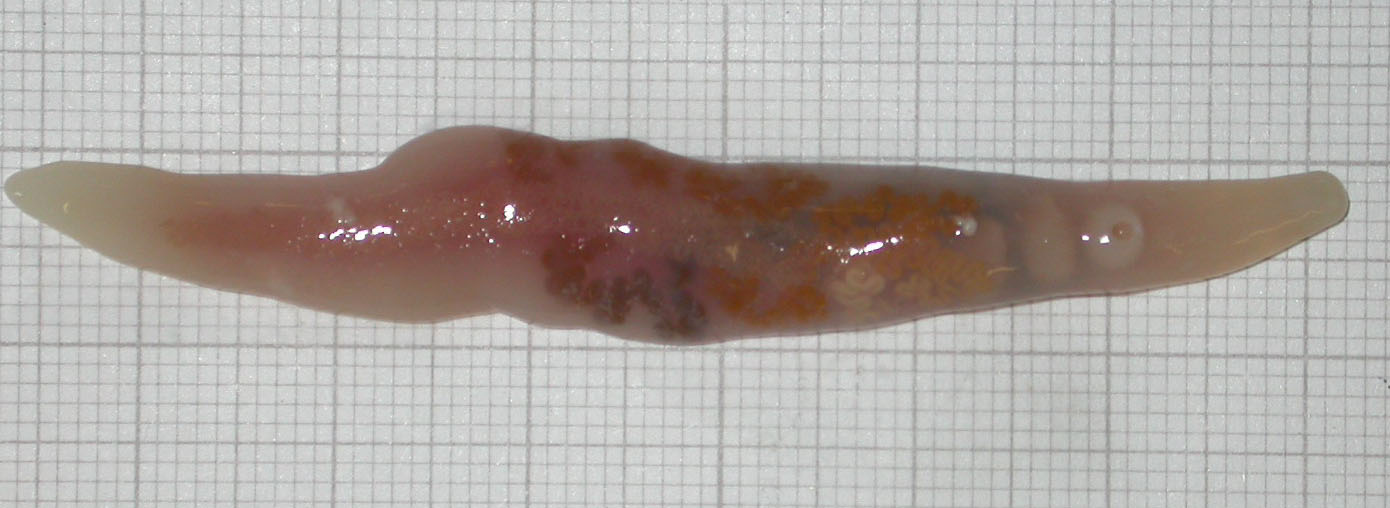
Trematoda is a class of flatworms known as trematodes, and commonly as flukes. They are obligate internal parasites with a complex life cycle requiring at least two hosts. The intermediate host, in which asexual reproduction occurs, is a mollusk, usually a snail. The definitive host, where the flukes sexually reproduce, is a vertebrate. Infection by trematodes can cause disease in all five vertebrate classes: mammals, birds, amphibians, reptiles, and fish.
Trematodes are commonly referred to as flukes. This term can be traced back to the Old English name for flounder, and refers to the flattened, rhomboidal shape of the organisms. The etymology of trematode stems from the Greek word trēmatṓdēs, which means "pierced with holes", and refers to the worm's sucker, which pierces a hole in the host while the worm is attached and feeding.
There are 18,000 to 24,000 known species of trematodes, divided into two subclasses — the Aspidogastrea and the Digenea. Aspidogastrea is the smaller subclass, comprising 61 species. These flukes mainly infect bivalves and bony fishes. Digenea — which comprise the majority of trematodes — are found in certain mollusks and vertebrates.
Flukes that cause disease in humans are often classified based on the organ system they infect such as the blood, liver, lungs, and intestines:
Blood flukes inhabit the blood in some stages of their life cycle. Blood flukes that cause disease in humans include Trichobilharzia regenti, which causes swimmer's itch, and seven species of genus Schistosoma which cause schistosomiasis: S. guineensis, S.haematobium, S. intercalatum, S. japonicum, S. malayensis, S. mansoni, S. mekongi. As a definitive host, humans are infected when the cercariae (the larval forms of trematodes) penetrate the skin. Any contact with water containing these cercariae can potentially result in infection. Adult blood flukes can live for years in human or animal reservoir hosts. S. haematobium and S. japonicum are of particular importance, as these are carcinogenic parasites. S. haematobium, which infects the urinary bladder, is among the most important causes of bladder cancer in humans. This organism is classified by the International Agency for Research on Cancer (IARC) as a Group 1 (extensively proven) carcinogen. S. japonicum is associated with the development of liver cancer, and is classified as a Group 2B (possibly carcinogenic to humans) carcinogen.
Liver flukes are commonly found within bile ducts, liver, and gallbladder in certain mammalian and avian species. They include Clonorchis sinensis, Dicrocoelium dendriticum, Dicrocoelium hospes, Fasciola gigantica, Fasciola hepatica, Opisthorchis felineus, and Opisthorchis viverrini. Clonorchis and Opisthorchis are carcinogenic parasites that are strongly associated with the development of cancer of the bile ducts.
Lung flukes: there are ten species of lung flukes that infect humans, causing paragonimiasis. Of these, the most common cause of human paragonimiasis is Paragonimus westermani, the oriental lung fluke. Lung flukes require three different hosts in order to complete their life cycle. The first intermediate host is a snail, the second intermediate host is a crab or crayfish, and the definitive host for lung flukes is a human or other animal.
Intestinal flukes inhabit the epithelium of the small intestine. These include Fasciolopsis buski (which causes fasciolopsiasis), Metagonimus miyatai, Metagonimus takahashii, Metagonimus yokogawai (which cause metagonimiasis), and Heterophyes heterophyes and Heterophyes nocens (which cause heterophyiasis).
Hub AI
Trematoda AI simulator
(@Trematoda_simulator)
Trematoda
Trematoda is a class of flatworms known as trematodes, and commonly as flukes. They are obligate internal parasites with a complex life cycle requiring at least two hosts. The intermediate host, in which asexual reproduction occurs, is a mollusk, usually a snail. The definitive host, where the flukes sexually reproduce, is a vertebrate. Infection by trematodes can cause disease in all five vertebrate classes: mammals, birds, amphibians, reptiles, and fish.
Trematodes are commonly referred to as flukes. This term can be traced back to the Old English name for flounder, and refers to the flattened, rhomboidal shape of the organisms. The etymology of trematode stems from the Greek word trēmatṓdēs, which means "pierced with holes", and refers to the worm's sucker, which pierces a hole in the host while the worm is attached and feeding.
There are 18,000 to 24,000 known species of trematodes, divided into two subclasses — the Aspidogastrea and the Digenea. Aspidogastrea is the smaller subclass, comprising 61 species. These flukes mainly infect bivalves and bony fishes. Digenea — which comprise the majority of trematodes — are found in certain mollusks and vertebrates.
Flukes that cause disease in humans are often classified based on the organ system they infect such as the blood, liver, lungs, and intestines:
Blood flukes inhabit the blood in some stages of their life cycle. Blood flukes that cause disease in humans include Trichobilharzia regenti, which causes swimmer's itch, and seven species of genus Schistosoma which cause schistosomiasis: S. guineensis, S.haematobium, S. intercalatum, S. japonicum, S. malayensis, S. mansoni, S. mekongi. As a definitive host, humans are infected when the cercariae (the larval forms of trematodes) penetrate the skin. Any contact with water containing these cercariae can potentially result in infection. Adult blood flukes can live for years in human or animal reservoir hosts. S. haematobium and S. japonicum are of particular importance, as these are carcinogenic parasites. S. haematobium, which infects the urinary bladder, is among the most important causes of bladder cancer in humans. This organism is classified by the International Agency for Research on Cancer (IARC) as a Group 1 (extensively proven) carcinogen. S. japonicum is associated with the development of liver cancer, and is classified as a Group 2B (possibly carcinogenic to humans) carcinogen.
Liver flukes are commonly found within bile ducts, liver, and gallbladder in certain mammalian and avian species. They include Clonorchis sinensis, Dicrocoelium dendriticum, Dicrocoelium hospes, Fasciola gigantica, Fasciola hepatica, Opisthorchis felineus, and Opisthorchis viverrini. Clonorchis and Opisthorchis are carcinogenic parasites that are strongly associated with the development of cancer of the bile ducts.
Lung flukes: there are ten species of lung flukes that infect humans, causing paragonimiasis. Of these, the most common cause of human paragonimiasis is Paragonimus westermani, the oriental lung fluke. Lung flukes require three different hosts in order to complete their life cycle. The first intermediate host is a snail, the second intermediate host is a crab or crayfish, and the definitive host for lung flukes is a human or other animal.
Intestinal flukes inhabit the epithelium of the small intestine. These include Fasciolopsis buski (which causes fasciolopsiasis), Metagonimus miyatai, Metagonimus takahashii, Metagonimus yokogawai (which cause metagonimiasis), and Heterophyes heterophyes and Heterophyes nocens (which cause heterophyiasis).
Recent media