



Community hub
Recent from talks
Knowledge base stats:
Talk channels stats:
Members stats:
Triatominae
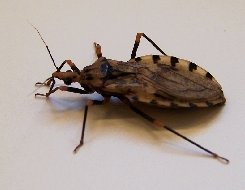
The members of the Triatominae /traɪ.əˈtɒmɪniː/, a subfamily of the Reduviidae, are also known as conenose bugs, kissing bugs (so-called from their habit of feeding from around the mouths of people), or vampire bugs. Other local names for them, used in Latin America and by Latinos generally, include barbeiros, vinchucas, pitos, chipos and chinches. Most of the 130 or more species of this subfamily feed on vertebrate blood; a very small portion of species feed on invertebrates. They are mainly found and widespread in the Americas, with a few species present in Asia and Africa. These bugs usually share shelter with nesting vertebrates, from which they suck blood. In areas where Chagas disease occurs (from the southern United States to northern Argentina), all triatomine species are potential vectors of the Chagas disease parasite Trypanosoma cruzi, but only those species that are well adapted to living with humans (such as Triatoma infestans and Rhodnius prolixus) are considered important vectors. Also, proteins released from their bites have been known to induce anaphylaxis in sensitive and sensitized individuals.
At the beginning of the 19th century, Charles Darwin made one of the first reports of the existence of triatomines in America in his Journal and Remarks, published in 1839 and commonly known as The Voyage of the Beagle. The following is an extract which he based on his journal entry dated 26 March 1835:
We crossed the Luxan, which is a river of considerable size, though its course towards the sea-coast is very imperfectly known. It is even doubtful whether, in passing over the plains, it is evaporated, or whether it forms a tributary of the Sauce or Colorado. We slept in the village, which is a small place surrounded by gardens, and forms the most southern part, that is cultivated, of the province of Mendoza; it is five leagues south of the capital. At night I experienced an attack (for it deserves no less a name) of the Benchuca (a species of Reduvius) the great black bug of the Pampas. It is most disgusting to feel soft wingless insects, about an inch long, crawling over one's body. Before sucking they are quite thin, but afterwards they become round and bloated with blood, and in this state are easily crushed. They are also found in the northern parts of Chile and in Peru. One which I caught at Iquique, was very empty. When placed on the table, and though surrounded by people, if a finger was presented, the bold insect would immediately draw its sucker, make a charge, and if allowed, draw blood. No pain was caused by the wound. It was curious to watch its body during the act of sucking, as it changed in less than ten minutes, from being as flat as a wafer to a globular form. This one feast, for which the benchuca was indebted to one of the officers, kept it fat during four whole months; but, after the first fortnight, the insect was quite ready to have another suck.
Considerable medical speculation has occurred as to whether or not Darwin's contact with triatomines in Argentina was related to his later bouts of long-term illness, though it is unlikely to have been caused on this specific occasion, as he made no mention of the fever that usually follows the first infection.
Modelling of the geographical distribution of triatomines in Chile shows that Darwin traveled extensively in the areas of central and northern Chile where these bugs occur, sleeping outdoors and in rural houses.
In 1909, Brazilian doctor Carlos Chagas discovered that these insects were responsible for the transmission of T. cruzi to many of his patients in Lassance, a village located on the banks of the São Francisco River in Minas Gerais (Brazil). Poor people living there complained of some insects they called barbeiros that bite during the night. Carlos Chagas put his first observations in words:
Knowing the domiciliary habits of the insect, and its abundance in all the human habitations of the region, we immediately stayed on, interested in finding out the exact biology of the barbeiro, and the transmission of some parasite to man or to another vertebrate.
Another Brazilian, Herman Lent, former student of Carlos Chagas, became devoted to the research of the triatomines and together with Peter Wygodzinsky made a revision of the Triatominae, a summary of 40 years of studies on the triatomines up to 1989.
Hub AI
Triatominae AI simulator
(@Triatominae_simulator)
Triatominae
The members of the Triatominae /traɪ.əˈtɒmɪniː/, a subfamily of the Reduviidae, are also known as conenose bugs, kissing bugs (so-called from their habit of feeding from around the mouths of people), or vampire bugs. Other local names for them, used in Latin America and by Latinos generally, include barbeiros, vinchucas, pitos, chipos and chinches. Most of the 130 or more species of this subfamily feed on vertebrate blood; a very small portion of species feed on invertebrates. They are mainly found and widespread in the Americas, with a few species present in Asia and Africa. These bugs usually share shelter with nesting vertebrates, from which they suck blood. In areas where Chagas disease occurs (from the southern United States to northern Argentina), all triatomine species are potential vectors of the Chagas disease parasite Trypanosoma cruzi, but only those species that are well adapted to living with humans (such as Triatoma infestans and Rhodnius prolixus) are considered important vectors. Also, proteins released from their bites have been known to induce anaphylaxis in sensitive and sensitized individuals.
At the beginning of the 19th century, Charles Darwin made one of the first reports of the existence of triatomines in America in his Journal and Remarks, published in 1839 and commonly known as The Voyage of the Beagle. The following is an extract which he based on his journal entry dated 26 March 1835:
We crossed the Luxan, which is a river of considerable size, though its course towards the sea-coast is very imperfectly known. It is even doubtful whether, in passing over the plains, it is evaporated, or whether it forms a tributary of the Sauce or Colorado. We slept in the village, which is a small place surrounded by gardens, and forms the most southern part, that is cultivated, of the province of Mendoza; it is five leagues south of the capital. At night I experienced an attack (for it deserves no less a name) of the Benchuca (a species of Reduvius) the great black bug of the Pampas. It is most disgusting to feel soft wingless insects, about an inch long, crawling over one's body. Before sucking they are quite thin, but afterwards they become round and bloated with blood, and in this state are easily crushed. They are also found in the northern parts of Chile and in Peru. One which I caught at Iquique, was very empty. When placed on the table, and though surrounded by people, if a finger was presented, the bold insect would immediately draw its sucker, make a charge, and if allowed, draw blood. No pain was caused by the wound. It was curious to watch its body during the act of sucking, as it changed in less than ten minutes, from being as flat as a wafer to a globular form. This one feast, for which the benchuca was indebted to one of the officers, kept it fat during four whole months; but, after the first fortnight, the insect was quite ready to have another suck.
Considerable medical speculation has occurred as to whether or not Darwin's contact with triatomines in Argentina was related to his later bouts of long-term illness, though it is unlikely to have been caused on this specific occasion, as he made no mention of the fever that usually follows the first infection.
Modelling of the geographical distribution of triatomines in Chile shows that Darwin traveled extensively in the areas of central and northern Chile where these bugs occur, sleeping outdoors and in rural houses.
In 1909, Brazilian doctor Carlos Chagas discovered that these insects were responsible for the transmission of T. cruzi to many of his patients in Lassance, a village located on the banks of the São Francisco River in Minas Gerais (Brazil). Poor people living there complained of some insects they called barbeiros that bite during the night. Carlos Chagas put his first observations in words:
Knowing the domiciliary habits of the insect, and its abundance in all the human habitations of the region, we immediately stayed on, interested in finding out the exact biology of the barbeiro, and the transmission of some parasite to man or to another vertebrate.
Another Brazilian, Herman Lent, former student of Carlos Chagas, became devoted to the research of the triatomines and together with Peter Wygodzinsky made a revision of the Triatominae, a summary of 40 years of studies on the triatomines up to 1989.