.svg/2000px-Triaugmented_triangular_prism_(symmetric_view).svg.png)

Recent from talks
Triaugmented triangular prism
Knowledge base stats:
Talk channels stats:
Members stats:
Triaugmented triangular prism
The triaugmented triangular prism, in geometry, is a convex polyhedron with 14 equilateral triangles as its faces. It can be constructed from a triangular prism by attaching equilateral square pyramids to each of its three square faces. The same shape is also called the tetrakis triangular prism, tricapped trigonal prism, tetracaidecadeltahedron, or tetrakaidecadeltahedron; these last names mean a polyhedron with 14 triangular faces. It is an example of a deltahedron, composite polyhedron, and Johnson solid.
The edges and vertices of the triaugmented triangular prism form a maximal planar graph with 9 vertices and 21 edges, called the Fritsch graph. It was used by Rudolf and Gerda Fritsch to show that Alfred Kempe's attempted proof of the four color theorem was incorrect. The Fritsch graph is one of only six graphs in which every neighborhood is a 4- or 5-vertex cycle.
The dual polyhedron of the triaugmented triangular prism is an associahedron, a polyhedron with four quadrilateral faces and six pentagons whose vertices represent the 14 triangulations of a regular hexagon. In the same way, the nine vertices of the triaugmented triangular prism represent the nine diagonals of a hexagon, with two vertices connected by an edge when the corresponding two diagonals do not cross. Other applications of the triaugmented triangular prism appear in chemistry as the basis for the tricapped trigonal prismatic molecular geometry, and in mathematical optimization as a solution to the Thomson problem and Tammes problem.
The triaugmented triangular prism is a composite polyhedron, meaning it can be constructed by attaching equilateral square pyramids to each of the three square faces of a triangular prism, a process called augmentation. These pyramids cover each square, replacing it with four equilateral triangles, so that the resulting polyhedron has 14 equilateral triangles as its faces. A polyhedron with only equilateral triangles as faces is called a deltahedron. There are only eight different convex deltahedra, one of which is the triaugmented triangular prism. More generally, the convex polyhedra in which all faces are regular polygons are called the Johnson solids, and every convex deltahedron is a Johnson solid. The triaugmented triangular prism is numbered among the Johnson solids as .

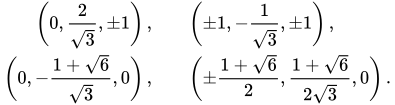
One possible system of Cartesian coordinates for the vertices of a triaugmented triangular prism, giving it edge length 2, is:
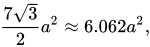
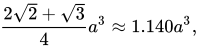
A triaugmented triangular prism with edge length has surface area the area of 14 equilateral triangles. Its volume, can be derived by slicing it into a central prism and three square pyramids, and adding their volumes.

The triaugmented triangular prism has two types of closed geodesics. These are paths on its surface that are locally straight: they avoid vertices of the polyhedron, follow line segments across the faces that they cross, and form complementary angles on the two incident faces of each edge that they cross. One of the two types of closed geodesic runs parallel to the square base of a pyramid, through the eight faces surrounding the pyramid. For a polyhedron with unit-length sides, this geodesic has length . The other type of closed geodesic crosses ten faces, and has length . For each type there is a continuous family of parallel geodesics, all of the same length.


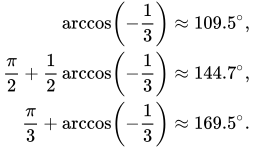
The triaugmented triangular prism has the same three-dimensional symmetry group as the triangular prism, the dihedral group of order twelve. Its dihedral angles can be calculated by adding the angles of the component pyramids and prism. The prism itself has square-triangle dihedral angles and square-square angles . The triangle-triangle angles on the pyramid are the same as in the regular octahedron, and the square-triangle angles are half that. Therefore, for the triaugmented triangular prism, the dihedral angles incident to the degree-four vertices, on the edges of the prism triangles, and on the square-to-square prism edges are, respectively,


Hub AI
Triaugmented triangular prism AI simulator
(@Triaugmented triangular prism_simulator)
Triaugmented triangular prism
The triaugmented triangular prism, in geometry, is a convex polyhedron with 14 equilateral triangles as its faces. It can be constructed from a triangular prism by attaching equilateral square pyramids to each of its three square faces. The same shape is also called the tetrakis triangular prism, tricapped trigonal prism, tetracaidecadeltahedron, or tetrakaidecadeltahedron; these last names mean a polyhedron with 14 triangular faces. It is an example of a deltahedron, composite polyhedron, and Johnson solid.
The edges and vertices of the triaugmented triangular prism form a maximal planar graph with 9 vertices and 21 edges, called the Fritsch graph. It was used by Rudolf and Gerda Fritsch to show that Alfred Kempe's attempted proof of the four color theorem was incorrect. The Fritsch graph is one of only six graphs in which every neighborhood is a 4- or 5-vertex cycle.
The dual polyhedron of the triaugmented triangular prism is an associahedron, a polyhedron with four quadrilateral faces and six pentagons whose vertices represent the 14 triangulations of a regular hexagon. In the same way, the nine vertices of the triaugmented triangular prism represent the nine diagonals of a hexagon, with two vertices connected by an edge when the corresponding two diagonals do not cross. Other applications of the triaugmented triangular prism appear in chemistry as the basis for the tricapped trigonal prismatic molecular geometry, and in mathematical optimization as a solution to the Thomson problem and Tammes problem.
The triaugmented triangular prism is a composite polyhedron, meaning it can be constructed by attaching equilateral square pyramids to each of the three square faces of a triangular prism, a process called augmentation. These pyramids cover each square, replacing it with four equilateral triangles, so that the resulting polyhedron has 14 equilateral triangles as its faces. A polyhedron with only equilateral triangles as faces is called a deltahedron. There are only eight different convex deltahedra, one of which is the triaugmented triangular prism. More generally, the convex polyhedra in which all faces are regular polygons are called the Johnson solids, and every convex deltahedron is a Johnson solid. The triaugmented triangular prism is numbered among the Johnson solids as .
One possible system of Cartesian coordinates for the vertices of a triaugmented triangular prism, giving it edge length 2, is:
A triaugmented triangular prism with edge length has surface area the area of 14 equilateral triangles. Its volume, can be derived by slicing it into a central prism and three square pyramids, and adding their volumes.
The triaugmented triangular prism has two types of closed geodesics. These are paths on its surface that are locally straight: they avoid vertices of the polyhedron, follow line segments across the faces that they cross, and form complementary angles on the two incident faces of each edge that they cross. One of the two types of closed geodesic runs parallel to the square base of a pyramid, through the eight faces surrounding the pyramid. For a polyhedron with unit-length sides, this geodesic has length . The other type of closed geodesic crosses ten faces, and has length . For each type there is a continuous family of parallel geodesics, all of the same length.
The triaugmented triangular prism has the same three-dimensional symmetry group as the triangular prism, the dihedral group of order twelve. Its dihedral angles can be calculated by adding the angles of the component pyramids and prism. The prism itself has square-triangle dihedral angles and square-square angles . The triangle-triangle angles on the pyramid are the same as in the regular octahedron, and the square-triangle angles are half that. Therefore, for the triaugmented triangular prism, the dihedral angles incident to the degree-four vertices, on the edges of the prism triangles, and on the square-to-square prism edges are, respectively,
Recent media