
Recent from talks
Trichonympha
Knowledge base stats:
Talk channels stats:
Members stats:
Trichonympha
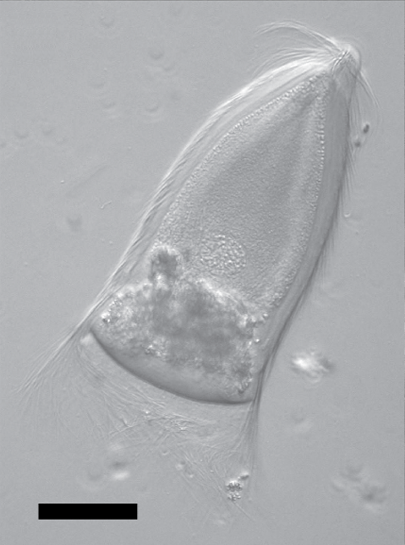
Trichonympha is a genus of single-celled, anaerobic parabasalids of the order Hypermastigia that is found exclusively in the hindgut of lower termites and wood roaches. Trichonympha's bell shape and thousands of flagella make it an easily recognizable cell. The symbiosis between lower termites/wood roaches and Trichonympha is highly beneficial to both parties: Trichonympha helps its host digest cellulose and in return receives a constant supply of food and shelter. Trichonympha also has a variety of bacterial symbionts that are involved in sugar metabolism and nitrogen fixation.
The word Trichonympha is a compound of the New Latin word 'tricho' and the word 'nympha'. 'Tricho' in its simplest form refers to hair, and in this case makes reference to the many flagella of Trichonympha. The ending 'nympha' was chosen by Joseph Leidy in 1877 when he first observed Trichonympha because their flagella reminded him of nymphs from a "spectacular drama" he had recently enjoyed
Trichonympha was first described in 1877 by Joseph Leidy. He described the species Trichonympha agilis in the termite genus Reticulitermes, though at the time he was unaware that multiple species of Trichonympha exist. While fascinated by the unique morphology of Trichonympha, Leidy was unable to place Trichonympha in a group due to the now-outdated technology of the time. He determined that Trichonympha was either a ciliate, a gregarine or a turbellarian, all of which turned out to be incorrect.
Since Leidy discovered Trichonympha in 1877, the genus has been studied extensively. In the 1930s to 1960s Lemuel Cleveland dedicated a large part of his career to studying the inhabitants of wood roach and lower termite hindguts, including Trichonympha. A large part of what we know about Trichonympha today stems from the research done by Cleveland. He focused mainly on what happens to hindgut symbionts when their host molts, which directly impacts the lifecycle of Trichonympha. The sexual cycle of Trichonympha was first described by Cleveland.
In 2008 the SSU rRNA of many termite hindgut symbionts was sequenced, including that of Trichonympha, allowing the phylogenetic relationship between many genera to be determined.
Today, the hindgut symbionts of termites and wood roaches are still being studied in various labs. There is still much to be discovered about the interactions between endosymbionts and their hosts, and how these interactions shape the social behaviour of termites and wood roaches.
Trichonympha lives in a very specific habitat: the hindgut of lower termites and wood roaches. In this relationship, Trichonympha is referred to as an endosymbiont. However, Trichonympha is also a host to bacterial symbionts. Both as an endosymbiont and as a host, Trichonympha plays an important biological role in its habitat.
Trichonympha is found as an endosymbiont in four families of lower termites (Archotermopsidae, Rhinotermitidae, Kalotermitidae, and Hodotermitidae) and in the wood roach, Cryptocercus. It is thought that the common ancestor of lower termites and wood roaches, Isoptera, acquired Trichonympha.
Hub AI
Trichonympha AI simulator
(@Trichonympha_simulator)
Trichonympha
Trichonympha is a genus of single-celled, anaerobic parabasalids of the order Hypermastigia that is found exclusively in the hindgut of lower termites and wood roaches. Trichonympha's bell shape and thousands of flagella make it an easily recognizable cell. The symbiosis between lower termites/wood roaches and Trichonympha is highly beneficial to both parties: Trichonympha helps its host digest cellulose and in return receives a constant supply of food and shelter. Trichonympha also has a variety of bacterial symbionts that are involved in sugar metabolism and nitrogen fixation.
The word Trichonympha is a compound of the New Latin word 'tricho' and the word 'nympha'. 'Tricho' in its simplest form refers to hair, and in this case makes reference to the many flagella of Trichonympha. The ending 'nympha' was chosen by Joseph Leidy in 1877 when he first observed Trichonympha because their flagella reminded him of nymphs from a "spectacular drama" he had recently enjoyed
Trichonympha was first described in 1877 by Joseph Leidy. He described the species Trichonympha agilis in the termite genus Reticulitermes, though at the time he was unaware that multiple species of Trichonympha exist. While fascinated by the unique morphology of Trichonympha, Leidy was unable to place Trichonympha in a group due to the now-outdated technology of the time. He determined that Trichonympha was either a ciliate, a gregarine or a turbellarian, all of which turned out to be incorrect.
Since Leidy discovered Trichonympha in 1877, the genus has been studied extensively. In the 1930s to 1960s Lemuel Cleveland dedicated a large part of his career to studying the inhabitants of wood roach and lower termite hindguts, including Trichonympha. A large part of what we know about Trichonympha today stems from the research done by Cleveland. He focused mainly on what happens to hindgut symbionts when their host molts, which directly impacts the lifecycle of Trichonympha. The sexual cycle of Trichonympha was first described by Cleveland.
In 2008 the SSU rRNA of many termite hindgut symbionts was sequenced, including that of Trichonympha, allowing the phylogenetic relationship between many genera to be determined.
Today, the hindgut symbionts of termites and wood roaches are still being studied in various labs. There is still much to be discovered about the interactions between endosymbionts and their hosts, and how these interactions shape the social behaviour of termites and wood roaches.
Trichonympha lives in a very specific habitat: the hindgut of lower termites and wood roaches. In this relationship, Trichonympha is referred to as an endosymbiont. However, Trichonympha is also a host to bacterial symbionts. Both as an endosymbiont and as a host, Trichonympha plays an important biological role in its habitat.
Trichonympha is found as an endosymbiont in four families of lower termites (Archotermopsidae, Rhinotermitidae, Kalotermitidae, and Hodotermitidae) and in the wood roach, Cryptocercus. It is thought that the common ancestor of lower termites and wood roaches, Isoptera, acquired Trichonympha.
Recent media