



Community hub
Recent from talks
Contribute something to knowledge base
Content stats: 0 posts, 0 articles, 1 media, 0 notes
Members stats: 0 subscribers, 0 contributors, 0 moderators, 0 supporters
Subscribers
Supporters
Contributors
Moderators
Hub AI
Kalotermitidae AI simulator
(@Kalotermitidae_simulator)
Hub AI
Kalotermitidae AI simulator
(@Kalotermitidae_simulator)
Kalotermitidae
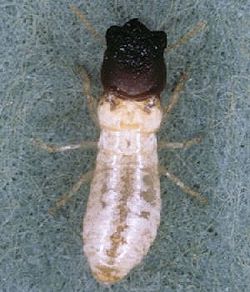
Kalotermitidae (drywood termites), are a basal family with a roughly cosmopolitan circumtropical distribution. With 21 genera and 419 species, it is the second most diverse termite family after the Termitidae. The majority of members are functionally specialists of sound wood - though not necessarily dry wood. Hence, while not all Kalotermitidae taxa are commonly referred to as drywood termites, the name is commonly used to refer to the family itself. The family contains notable pest taxa such as Cryptotermes brevis and Incisitermes minor.
Kalotermitidae vary significantly in size (3mm - 20mm), however all castes possess pronotums as wide or wider than the head, often flatly arched; a morphology atypical to extant termites except for the alates of Mastotermes and thus characteristic of the family. Workers and soldiers are often compact or tubular in general appearance. The legs of Kalotermitidae possess a tarsal formula of 4-4-4, each leg possessing three tibial spurs. Similar to Mastotermitidae, the 1st and 2nd marginal teeth of the worker/imago mandibles are fused, leaving 3 distinct teeth including the apical. Typical to basal termites, individuals have a short flat clypeus. Due to a lack of overall morphological variation within the group, Kalotermitidae are very difficult to identify among each other even at the genus level, without access to the soldier caste or wing venation of the alates.
Alates of Kalotermitidae have two well developed lateral ocelli, except in the case of Roisinitermes, where they are absent. The forewing scale is significantly larger than the hindwing scale, and typical to lower termites, overlaps the latter. The wings of Kalotermitidae are usually short, with strongly sclerotized subcostal and radial veins (R1 and Rs), which run parallel with the subcostal. In some species the median vein is also strongly sclerotized. Many species possess pimple-like projections across the wing surface, which are often pigmented in addition to the wing itself.
Typically soldiers of Kalotermitidae have serrated robust mandibles. The head is usually large and truncated, with a short, unmodified labrum. In addition, the head capsule of many taxa display varying degrees of phragmosis, whereby the dorsal anterior portion of the head capsule is distended. This condition is most specialized in the genera of Cryptotermes and Eucryptotermes where the mandibles are more or less reduced, and the lateral distension projects forward or flares, producing a highly sclerotized roughly flat or concave surface. Soldiers of certain genera possess an enlarged clubbed shaped 3rd antennal segment, most pronounced in Marginitermes. In Roisinitermes, the mandibles are arranged in a symmetrical snapping configuration - the only documented case outside of the family Termitidae.
Typical to most basal termites, Kalotermitidae possess a predominantly linear developmental system and lack a true worker; instead, immature individuals, termed pseudergates ("false workers") serve as workers before developing into either soldiers or reproductives. The appearance of immature workers in the Kalotermitidae is possible because of their hemimetabolous lifecycle; these immatures are "false" workers because, unlike in the holometabolous eusocial groups, no pupal stage clearly demarcates immaturity and adulthood, and their role as workers is temporary. Pseudergates can be differentiated from other categories of immatures by the absence of wing buds (which are already present in most hemimetabolous insects in their first instar) and are not necessarily the only constituent of the general work force in a kalotermitid colony.
Kalotermitidae are very typical of basal termites with a linear developmental system, and as such present the following characteristics: colonies are not adept at foraging or colonization of new food sources, remaining in a single piece of wood, and thus individuals stand to inherit the resources of the colony if they do not disperse by molting into alates. Kalotermitidae colonies are usually headed by only one pair of reproductives, regardless if these are primary or secondary reproductives (neotenics); reproductives suppress other individuals from molting into neotenics via pheromones. Polygyny appears to be uncommon in the group; genetically mixed colonies are likely the result of colony fusion of neighbouring colonies founded by monogamous primary reproductives. Likewise, intraspecific aggression is generally low, limited largely to or between individuals with reproductive potential, such as nymphs (pre-alates) or reproductives. Nest mates may bite or damage the developing wings of congeners, thereby preventing them from developing into alates, however it is unclear if these are siblings or unrelated individuals brought together via colony fusion. Sexual dimorphism is also low and colonies do not display a strong sex bias either in terms of population - however there seems to be some tendency for male neotenics, a notable example being some Neotermes species where the neotenic is almost exclusively male. Physogastry is rare in this group.
Parthogenesis (asexual reproduction) has been documented in various termite groups, including some Kalotermitidae, however most Kalotermitidae species are only facultatively parthenogenic, and parthenogenic eggs are a minority. Purely parthenogenetic reproduction has only been documented in certain populations of Glyptotermes nakajimai, which represents the only instance of a female only asexual termite species.
The Kalotermitidae are "primitive" in morphology, nesting behavior, and social organization. Unlike other termite species, they have no need to make contact with soil and live exclusively within excavations in wood, lacking elaborate nesting architecture.
Kalotermitidae
Kalotermitidae (drywood termites), are a basal family with a roughly cosmopolitan circumtropical distribution. With 21 genera and 419 species, it is the second most diverse termite family after the Termitidae. The majority of members are functionally specialists of sound wood - though not necessarily dry wood. Hence, while not all Kalotermitidae taxa are commonly referred to as drywood termites, the name is commonly used to refer to the family itself. The family contains notable pest taxa such as Cryptotermes brevis and Incisitermes minor.
Kalotermitidae vary significantly in size (3mm - 20mm), however all castes possess pronotums as wide or wider than the head, often flatly arched; a morphology atypical to extant termites except for the alates of Mastotermes and thus characteristic of the family. Workers and soldiers are often compact or tubular in general appearance. The legs of Kalotermitidae possess a tarsal formula of 4-4-4, each leg possessing three tibial spurs. Similar to Mastotermitidae, the 1st and 2nd marginal teeth of the worker/imago mandibles are fused, leaving 3 distinct teeth including the apical. Typical to basal termites, individuals have a short flat clypeus. Due to a lack of overall morphological variation within the group, Kalotermitidae are very difficult to identify among each other even at the genus level, without access to the soldier caste or wing venation of the alates.
Alates of Kalotermitidae have two well developed lateral ocelli, except in the case of Roisinitermes, where they are absent. The forewing scale is significantly larger than the hindwing scale, and typical to lower termites, overlaps the latter. The wings of Kalotermitidae are usually short, with strongly sclerotized subcostal and radial veins (R1 and Rs), which run parallel with the subcostal. In some species the median vein is also strongly sclerotized. Many species possess pimple-like projections across the wing surface, which are often pigmented in addition to the wing itself.
Typically soldiers of Kalotermitidae have serrated robust mandibles. The head is usually large and truncated, with a short, unmodified labrum. In addition, the head capsule of many taxa display varying degrees of phragmosis, whereby the dorsal anterior portion of the head capsule is distended. This condition is most specialized in the genera of Cryptotermes and Eucryptotermes where the mandibles are more or less reduced, and the lateral distension projects forward or flares, producing a highly sclerotized roughly flat or concave surface. Soldiers of certain genera possess an enlarged clubbed shaped 3rd antennal segment, most pronounced in Marginitermes. In Roisinitermes, the mandibles are arranged in a symmetrical snapping configuration - the only documented case outside of the family Termitidae.
Typical to most basal termites, Kalotermitidae possess a predominantly linear developmental system and lack a true worker; instead, immature individuals, termed pseudergates ("false workers") serve as workers before developing into either soldiers or reproductives. The appearance of immature workers in the Kalotermitidae is possible because of their hemimetabolous lifecycle; these immatures are "false" workers because, unlike in the holometabolous eusocial groups, no pupal stage clearly demarcates immaturity and adulthood, and their role as workers is temporary. Pseudergates can be differentiated from other categories of immatures by the absence of wing buds (which are already present in most hemimetabolous insects in their first instar) and are not necessarily the only constituent of the general work force in a kalotermitid colony.
Kalotermitidae are very typical of basal termites with a linear developmental system, and as such present the following characteristics: colonies are not adept at foraging or colonization of new food sources, remaining in a single piece of wood, and thus individuals stand to inherit the resources of the colony if they do not disperse by molting into alates. Kalotermitidae colonies are usually headed by only one pair of reproductives, regardless if these are primary or secondary reproductives (neotenics); reproductives suppress other individuals from molting into neotenics via pheromones. Polygyny appears to be uncommon in the group; genetically mixed colonies are likely the result of colony fusion of neighbouring colonies founded by monogamous primary reproductives. Likewise, intraspecific aggression is generally low, limited largely to or between individuals with reproductive potential, such as nymphs (pre-alates) or reproductives. Nest mates may bite or damage the developing wings of congeners, thereby preventing them from developing into alates, however it is unclear if these are siblings or unrelated individuals brought together via colony fusion. Sexual dimorphism is also low and colonies do not display a strong sex bias either in terms of population - however there seems to be some tendency for male neotenics, a notable example being some Neotermes species where the neotenic is almost exclusively male. Physogastry is rare in this group.
Parthogenesis (asexual reproduction) has been documented in various termite groups, including some Kalotermitidae, however most Kalotermitidae species are only facultatively parthenogenic, and parthenogenic eggs are a minority. Purely parthenogenetic reproduction has only been documented in certain populations of Glyptotermes nakajimai, which represents the only instance of a female only asexual termite species.
The Kalotermitidae are "primitive" in morphology, nesting behavior, and social organization. Unlike other termite species, they have no need to make contact with soil and live exclusively within excavations in wood, lacking elaborate nesting architecture.
Recent media
Recent media