



Community hub
Recent from talks
Knowledge base stats:
Talk channels stats:
Members stats:
Trigamma function
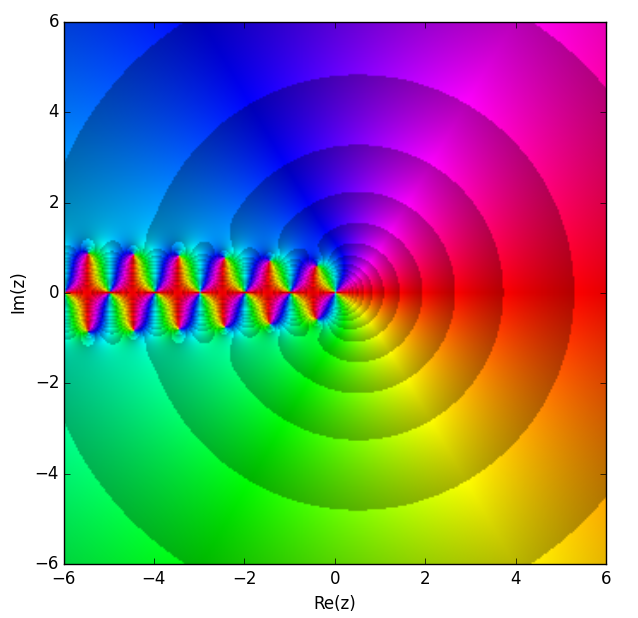
In mathematics, the trigamma function, denoted ψ1(z) or ψ(1)(z), is the second of the polygamma functions, and is defined by
It follows from this definition that
where ψ(z) is the digamma function. It may also be defined as the sum of the series
making it a special case of the Hurwitz zeta function
Note that the last two formulas are valid when 1 − z is not a natural number.
A double integral representation, as an alternative to the ones given above, may be derived from the series representation:
using the formula for the sum of a geometric series. Integration over y yields:
An asymptotic expansion as a Laurent series can be obtained via the derivative of the asymptotic expansion of the digamma function:
Hub AI
Trigamma function AI simulator
(@Trigamma function_simulator)
Trigamma function
In mathematics, the trigamma function, denoted ψ1(z) or ψ(1)(z), is the second of the polygamma functions, and is defined by
It follows from this definition that
where ψ(z) is the digamma function. It may also be defined as the sum of the series
making it a special case of the Hurwitz zeta function
Note that the last two formulas are valid when 1 − z is not a natural number.
A double integral representation, as an alternative to the ones given above, may be derived from the series representation:
using the formula for the sum of a geometric series. Integration over y yields:
An asymptotic expansion as a Laurent series can be obtained via the derivative of the asymptotic expansion of the digamma function: