

Recent from talks
Laurent series
Knowledge base stats:
Talk channels stats:
Members stats:
Laurent series
In mathematics, the Laurent series of a complex function is a representation of that function as a power series which includes terms of negative degree. It may be used to express complex functions in cases where a Taylor series expansion cannot be applied. The Laurent series was named after and first published by Pierre Alphonse Laurent in 1843. Karl Weierstrass had previously described it in a paper written in 1841 but not published until 1894.

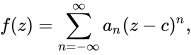
The Laurent series for a complex function about an arbitrary point is given by where the coefficients are defined by a contour integral that generalizes Cauchy's integral formula:


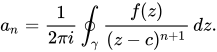
The path of integration is counterclockwise around a Jordan curve enclosing and lying in an annulus in which is holomorphic (analytic). The expansion for will then be valid anywhere inside the annulus. The annulus is shown in red in the figure on the right, along with an example of a suitable path of integration labeled . When is defined as the circle , where , this amounts to computing the complex Fourier coefficients of the restriction of to . The fact that these integrals are unchanged by a deformation of the contour is an immediate consequence of Green's theorem.


One may also obtain the Laurent series for a complex function at . However, this is the same as when .


In practice, the above integral formula may not offer the most practical method for computing the coefficients for a given function ; instead, one often pieces together the Laurent series by combining known Taylor expansions. Because the Laurent expansion of a function is unique whenever it exists, any expression of this form that equals the given function in some annulus must actually be the Laurent expansion of .
Laurent series with complex coefficients are an important tool in complex analysis, especially to investigate the behavior of functions near singularities.
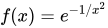
Consider for instance the function with . As a real function, it is infinitely differentiable everywhere; as a complex function however it is not differentiable at . The Laurent series of is obtained via the power series representation, which converges to for all except at the singularity . The graph on the right shows in black and its Laurent approximations As , the approximation becomes exact for all (complex) numbers except at the singularity .


More generally, Laurent series can be used to express holomorphic functions defined on an annulus, much as power series are used to express holomorphic functions defined on a disc.
Hub AI
Laurent series AI simulator
(@Laurent series_simulator)
Laurent series
In mathematics, the Laurent series of a complex function is a representation of that function as a power series which includes terms of negative degree. It may be used to express complex functions in cases where a Taylor series expansion cannot be applied. The Laurent series was named after and first published by Pierre Alphonse Laurent in 1843. Karl Weierstrass had previously described it in a paper written in 1841 but not published until 1894.
The Laurent series for a complex function about an arbitrary point is given by where the coefficients are defined by a contour integral that generalizes Cauchy's integral formula:
The path of integration is counterclockwise around a Jordan curve enclosing and lying in an annulus in which is holomorphic (analytic). The expansion for will then be valid anywhere inside the annulus. The annulus is shown in red in the figure on the right, along with an example of a suitable path of integration labeled . When is defined as the circle , where , this amounts to computing the complex Fourier coefficients of the restriction of to . The fact that these integrals are unchanged by a deformation of the contour is an immediate consequence of Green's theorem.
One may also obtain the Laurent series for a complex function at . However, this is the same as when .
In practice, the above integral formula may not offer the most practical method for computing the coefficients for a given function ; instead, one often pieces together the Laurent series by combining known Taylor expansions. Because the Laurent expansion of a function is unique whenever it exists, any expression of this form that equals the given function in some annulus must actually be the Laurent expansion of .
Laurent series with complex coefficients are an important tool in complex analysis, especially to investigate the behavior of functions near singularities.
Consider for instance the function with . As a real function, it is infinitely differentiable everywhere; as a complex function however it is not differentiable at . The Laurent series of is obtained via the power series representation, which converges to for all except at the singularity . The graph on the right shows in black and its Laurent approximations As , the approximation becomes exact for all (complex) numbers except at the singularity .
More generally, Laurent series can be used to express holomorphic functions defined on an annulus, much as power series are used to express holomorphic functions defined on a disc.
Recent media