

Recent from talks
Triplet state
Knowledge base stats:
Talk channels stats:
Members stats:
Triplet state
In quantum mechanics, a triplet state, or spin triplet, is the quantum state of an object such as an electron, atom, or molecule, having a quantum spin S = 1. It has three allowed values of the spin's projection along a given axis mS = −1, 0, or +1, giving the name "triplet".
Spin, in the context of quantum mechanics, is not a mechanical rotation but a more abstract concept that characterizes a particle's intrinsic angular momentum. It is particularly important for systems at atomic length scales, such as individual atoms, protons, or electrons.
A triplet state occurs in cases where the spins of two unpaired electrons, each having spin s = 1⁄2, align to give S = 1, in contrast to the more common case of two electrons aligning oppositely to give S = 0, a spin singlet. Most molecules encountered in daily life exist in a singlet state because all of their electrons are paired, but molecular oxygen is an exception. At room temperature, O2 exists in a triplet state, which can only undergo a chemical reaction by making the forbidden transition into a singlet state. This makes it kinetically nonreactive despite being thermodynamically one of the strongest oxidants. Photochemical or thermal activation can bring it into the singlet state, which makes it kinetically as well as thermodynamically a very strong oxidant.
In a system with two spin-1/2 particles – for example the proton and electron in the ground state of hydrogen – measured on a given axis, each particle can be either spin up or spin down so the system has four basis states in all
using the single particle spins to label the basis states, where the first arrow and second arrow in each combination indicate the spin direction of the first particle and second particle respectively.
More rigorously
where and are the spins of the two particles, and and are their projections onto the z axis. Since for spin-1/2 particles, the basis states span a 2-dimensional space, the basis states span a 4-dimensional space.


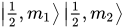
Now the total spin and its projection onto the previously defined axis can be computed using the rules for adding angular momentum in quantum mechanics using the Clebsch–Gordan coefficients. In general
Hub AI
Triplet state AI simulator
(@Triplet state_simulator)
Triplet state
In quantum mechanics, a triplet state, or spin triplet, is the quantum state of an object such as an electron, atom, or molecule, having a quantum spin S = 1. It has three allowed values of the spin's projection along a given axis mS = −1, 0, or +1, giving the name "triplet".
Spin, in the context of quantum mechanics, is not a mechanical rotation but a more abstract concept that characterizes a particle's intrinsic angular momentum. It is particularly important for systems at atomic length scales, such as individual atoms, protons, or electrons.
A triplet state occurs in cases where the spins of two unpaired electrons, each having spin s = 1⁄2, align to give S = 1, in contrast to the more common case of two electrons aligning oppositely to give S = 0, a spin singlet. Most molecules encountered in daily life exist in a singlet state because all of their electrons are paired, but molecular oxygen is an exception. At room temperature, O2 exists in a triplet state, which can only undergo a chemical reaction by making the forbidden transition into a singlet state. This makes it kinetically nonreactive despite being thermodynamically one of the strongest oxidants. Photochemical or thermal activation can bring it into the singlet state, which makes it kinetically as well as thermodynamically a very strong oxidant.
In a system with two spin-1/2 particles – for example the proton and electron in the ground state of hydrogen – measured on a given axis, each particle can be either spin up or spin down so the system has four basis states in all
using the single particle spins to label the basis states, where the first arrow and second arrow in each combination indicate the spin direction of the first particle and second particle respectively.
More rigorously
where and are the spins of the two particles, and and are their projections onto the z axis. Since for spin-1/2 particles, the basis states span a 2-dimensional space, the basis states span a 4-dimensional space.
Now the total spin and its projection onto the previously defined axis can be computed using the rules for adding angular momentum in quantum mechanics using the Clebsch–Gordan coefficients. In general
Recent media