


Community hub
Recent from talks
Contribute something to knowledge base
Content stats: 0 posts, 0 articles, 1 media, 0 notes
Members stats: 0 subscribers, 0 contributors, 0 moderators, 0 supporters
Subscribers
Supporters
Contributors
Moderators
Hub AI
Trisodium phosphate AI simulator
(@Trisodium phosphate_simulator)
Hub AI
Trisodium phosphate AI simulator
(@Trisodium phosphate_simulator)
Trisodium phosphate
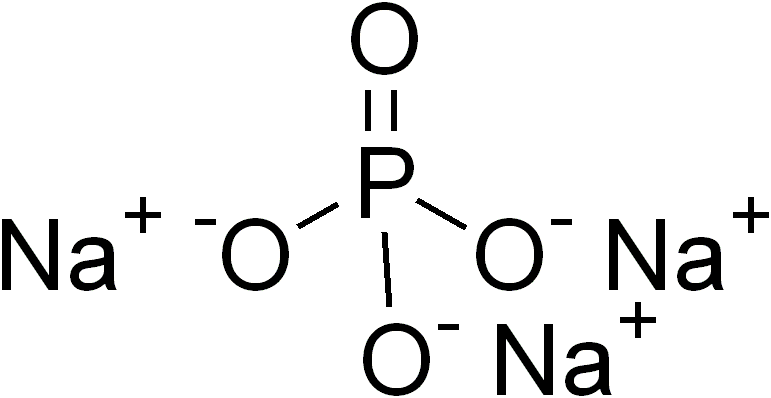
Trisodium phosphate (TSP) is an inorganic compound with the chemical formula Na3PO4. It is a white, granular or crystalline solid, highly soluble in water, producing an alkaline solution. TSP is used as a cleaning agent, builder, lubricant, food additive, stain remover, and degreaser.
As an item of commerce TSP is often partially hydrated and may range from anhydrous Na3PO4 to the dodecahydrate Na3PO4·12H2O. Most often it is found in white powder form. It can also be called trisodium orthophosphate or simply sodium phosphate.
Trisodium phosphate is produced by neutralization of phosphoric acid using sodium carbonate, which produces disodium hydrogen phosphate. The disodium hydrogen phosphate is reacted with sodium hydroxide to form trisodium phosphate and water.
Trisodium phosphate was at one time extensively used in formulations for a variety of consumer-grade soaps and detergents, and the most common use for trisodium phosphate has been in cleaning agents. The pH of a 1% solution is 12 (i.e., very basic), and the solution is sufficiently alkaline to saponify grease and oils. In combination with surfactants, TSP is an excellent agent for cleaning everything from laundry to concrete driveways. This versatility and low manufacturing price made TSP the basis for a plethora of cleaning products sold in the mid-20th century.
TSP is still sold and used as a cleaning agent. Its use has diminished in the United States and many other parts of the world because, like many phosphate-based cleaners, it is known to cause extensive eutrophication of lakes and rivers once it enters a water system.
Although it is still the active ingredient in some toilet bowl-cleaning tablets, TSP is generally not recommended for cleaning bathrooms because it can stain metal fixtures and can damage grout.
With the formula 4Na3PO4·NaOCl·44H2O the material called chlorinated trisodium phosphate is used as a disinfectant and bleach, like sodium hypochlorite. It is prepared using NaOCl in place of some of the base to neutralize phosphoric acid.
In the U.S., trisodium phosphate is an approved flux for use in hard soldering joints in medical-grade copper plumbing. The flux is applied as a concentrated water solution and dissolves copper oxides at the temperature used in copper brazing. Residues are water-soluble and can be rinsed out before plumbing is put into service.
Trisodium phosphate
Trisodium phosphate (TSP) is an inorganic compound with the chemical formula Na3PO4. It is a white, granular or crystalline solid, highly soluble in water, producing an alkaline solution. TSP is used as a cleaning agent, builder, lubricant, food additive, stain remover, and degreaser.
As an item of commerce TSP is often partially hydrated and may range from anhydrous Na3PO4 to the dodecahydrate Na3PO4·12H2O. Most often it is found in white powder form. It can also be called trisodium orthophosphate or simply sodium phosphate.
Trisodium phosphate is produced by neutralization of phosphoric acid using sodium carbonate, which produces disodium hydrogen phosphate. The disodium hydrogen phosphate is reacted with sodium hydroxide to form trisodium phosphate and water.
Trisodium phosphate was at one time extensively used in formulations for a variety of consumer-grade soaps and detergents, and the most common use for trisodium phosphate has been in cleaning agents. The pH of a 1% solution is 12 (i.e., very basic), and the solution is sufficiently alkaline to saponify grease and oils. In combination with surfactants, TSP is an excellent agent for cleaning everything from laundry to concrete driveways. This versatility and low manufacturing price made TSP the basis for a plethora of cleaning products sold in the mid-20th century.
TSP is still sold and used as a cleaning agent. Its use has diminished in the United States and many other parts of the world because, like many phosphate-based cleaners, it is known to cause extensive eutrophication of lakes and rivers once it enters a water system.
Although it is still the active ingredient in some toilet bowl-cleaning tablets, TSP is generally not recommended for cleaning bathrooms because it can stain metal fixtures and can damage grout.
With the formula 4Na3PO4·NaOCl·44H2O the material called chlorinated trisodium phosphate is used as a disinfectant and bleach, like sodium hypochlorite. It is prepared using NaOCl in place of some of the base to neutralize phosphoric acid.
In the U.S., trisodium phosphate is an approved flux for use in hard soldering joints in medical-grade copper plumbing. The flux is applied as a concentrated water solution and dissolves copper oxides at the temperature used in copper brazing. Residues are water-soluble and can be rinsed out before plumbing is put into service.
Recent media
Recent media