
Recent from talks
Tritone substitution
Knowledge base stats:
Talk channels stats:
Members stats:
Tritone substitution
The tritone substitution is a common chord substitution found in both jazz and classical music. Where jazz is concerned, it was the precursor to more complex substitution patterns like Coltrane changes. Tritone substitutions are sometimes used in improvisation—often to create tension during a solo. Though examples of the tritone substitution, known in the classical world as an augmented sixth chord, can be found extensively in classical music since the Renaissance period, they were not heard outside of classical music until they were brought into jazz by musicians such as Dizzy Gillespie and Charlie Parker in the 1940s, as well as Duke Ellington, Art Tatum, Coleman Hawkins, Roy Eldridge and Benny Goodman.
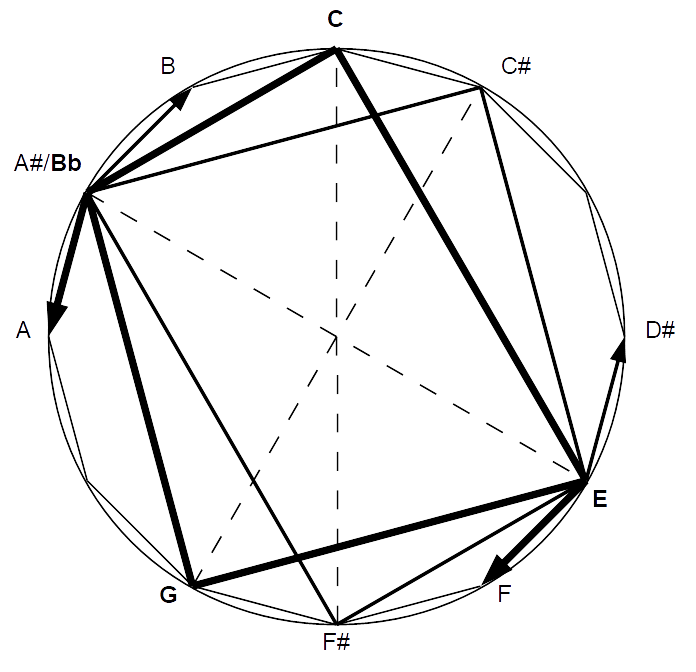
The tritone substitution can be performed by exchanging a dominant seventh chord for another dominant seventh chord which is a tritone away from it. For example, in the key of C major one can use D♭ 7 instead of G 7 (D♭ is a tritone away from G, and G is the dominant of C).
In tonal music, a conventional perfect cadence consists of a dominant seventh chord followed by a tonic chord. For example, in the key of C major, the chord of G 7 is followed by a chord of C. In order to execute a tritone substitution, a common variant of this progression, one would replace the dominant seventh chord with a dominant chord that has its root a tritone away from the original:
Franz Schubert's String Quintet in C major concludes with a dramatic final cadence that uses the third of the above progressions. The conventional G 7 chord is replaced in bars 3 and 4 of the following example with a D♭ 7 chord, with a diminished fifth (G♮ as the enharmonic equivalent of A ); a chord otherwise known as a 'French sixth':
Christopher Gibbs (2000, p. 105) says of this ending: "within the last movement of the quintet, darker forces continue to lurk: the piece ends with a manic coda building to a dissonant fortissimo chord with a D-flat trill in both cellos, and then a final tonic inflected by a D-flat appoggiatura... The effect is overwhelmingly powerful."
The closing bars of the first movement of Schubert's Piano Sonata in A major, D959 use both a conventional perfect cadence and a cadence featuring a tritone substitution, this time in the form of an 'Italian Sixth.' Bars 345-9 end with a regular cadence in A major. Instead of repeating this pattern to conclude the movement, the bars that follow replace the E 7 chord with a B♭ 7.
There are similarities here with the ambivalent ending of Richard Strauss's tone poem Also sprach Zarathustra , which features a French Sixth in the 2nd and 4th bars of the following:
Here, according to Richard Taruskin, "Strauss contrived an ending that seemed to die away on an oscillation between tonics on B and C, with C … getting the last word. Had B been given the last word, or were the extreme registers reversed, the ploy would not have worked. It would have been obvious that the C (though placed many octaves lower than its rival, in a register the ear is used to associating with the fundamental bass) was, in functional terms, making a descent to the tonic B as part of a "French sixth" chord... Rather than an ending in two keys, we are dealing with a registrally distorted, interrupted, yet functionally viable cadence on B."
Hub AI
Tritone substitution AI simulator
(@Tritone substitution_simulator)
Tritone substitution
The tritone substitution is a common chord substitution found in both jazz and classical music. Where jazz is concerned, it was the precursor to more complex substitution patterns like Coltrane changes. Tritone substitutions are sometimes used in improvisation—often to create tension during a solo. Though examples of the tritone substitution, known in the classical world as an augmented sixth chord, can be found extensively in classical music since the Renaissance period, they were not heard outside of classical music until they were brought into jazz by musicians such as Dizzy Gillespie and Charlie Parker in the 1940s, as well as Duke Ellington, Art Tatum, Coleman Hawkins, Roy Eldridge and Benny Goodman.
The tritone substitution can be performed by exchanging a dominant seventh chord for another dominant seventh chord which is a tritone away from it. For example, in the key of C major one can use D♭ 7 instead of G 7 (D♭ is a tritone away from G, and G is the dominant of C).
In tonal music, a conventional perfect cadence consists of a dominant seventh chord followed by a tonic chord. For example, in the key of C major, the chord of G 7 is followed by a chord of C. In order to execute a tritone substitution, a common variant of this progression, one would replace the dominant seventh chord with a dominant chord that has its root a tritone away from the original:
Franz Schubert's String Quintet in C major concludes with a dramatic final cadence that uses the third of the above progressions. The conventional G 7 chord is replaced in bars 3 and 4 of the following example with a D♭ 7 chord, with a diminished fifth (G♮ as the enharmonic equivalent of A); a chord otherwise known as a 'French sixth':
Christopher Gibbs (2000, p. 105) says of this ending: "within the last movement of the quintet, darker forces continue to lurk: the piece ends with a manic coda building to a dissonant fortissimo chord with a D-flat trill in both cellos, and then a final tonic inflected by a D-flat appoggiatura... The effect is overwhelmingly powerful."
The closing bars of the first movement of Schubert's Piano Sonata in A major, D959 use both a conventional perfect cadence and a cadence featuring a tritone substitution, this time in the form of an 'Italian Sixth.' Bars 345-9 end with a regular cadence in A major. Instead of repeating this pattern to conclude the movement, the bars that follow replace the E 7 chord with a B♭ 7.
There are similarities here with the ambivalent ending of Richard Strauss's tone poem Also sprach Zarathustra , which features a French Sixth in the 2nd and 4th bars of the following:
Here, according to Richard Taruskin, "Strauss contrived an ending that seemed to die away on an oscillation between tonics on B and C, with C … getting the last word. Had B been given the last word, or were the extreme registers reversed, the ploy would not have worked. It would have been obvious that the C (though placed many octaves lower than its rival, in a register the ear is used to associating with the fundamental bass) was, in functional terms, making a descent to the tonic B as part of a "French sixth" chord... Rather than an ending in two keys, we are dealing with a registrally distorted, interrupted, yet functionally viable cadence on B."
Recent media