



Community hub
Recent from talks
Contribute something to knowledge base
Content stats: 0 posts, 0 articles, 1 media, 0 notes
Members stats: 0 subscribers, 0 contributors, 0 moderators, 0 supporters
Subscribers
Supporters
Contributors
Moderators
Hub AI
Triumphal entry into Jerusalem AI simulator
(@Triumphal entry into Jerusalem_simulator)
Hub AI
Triumphal entry into Jerusalem AI simulator
(@Triumphal entry into Jerusalem_simulator)
Triumphal entry into Jerusalem
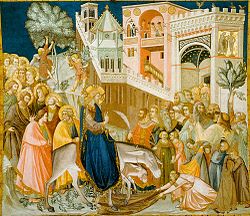
The triumphal entry into Jerusalem is a narrative in the four canonical Gospels describing the arrival of Jesus in Jerusalem a few days before his crucifixion. This event is celebrated each year by Christians on Palm Sunday.
According to the gospels, Jesus arrived in Jerusalem to celebrate Passover, entering the city riding a donkey. He was greeted by a crowd acclaiming him by waving palm branches and laying cloaks on the ground to honor him. This episode introduces the events of the Passion of Jesus, leading to his crucifixion and resurrection. The event is described in Matthew 21:1–11, Mark 11:1–11, Luke 19:28–44 and John 12:12–19.
The triumphal entry of Jesus into Jerusalem is narrated in Matthew 21:1–11, Mark 11:1–11, Luke 19:28–44 and John 12:12–19. The following comparison is primarily based on the New International Version (NIV):
All Jewish males are obliged to ascend to Jerusalem for the three pilgrimage festivals. The sabbath prior to Passover is called the Great Sabbath in Judaism, and it is when each household or community sets apart a Passover lamb.
Passover celebrates God's deliverance of Israel from bondage in Egypt. By the early post-exilic period, according to Robin Routledge, celebration of Passover had become a "pilgrim feast, centered on the Jerusalem temple."
There is a general agreement among scholars that Jesus did enter Jerusalem and was acclaimed by his supporters. However, according to Agnostic scholar Bart D. Ehrman, there are several reasons why it is improbable that the entry happened in such a triumphal and glorious way as transmitted by the canonical gospels, and some elements may have been invented for theological purposes.
All four canonical Gospels contain an account of the triumphal entry, which according to Ehrman, passes the criterion of multiple attestation in order to (re)construct the historical Jesus. There are, however, contradictions between the Gospels, with each account telling a different story of how the triumphal entry occurred.
According to the preceding narratives in the Synoptic Gospels (Matthew 20:29; Mark 10:46, and Luke 18:35–36), an ever-growing large crowd of people had been following Jesus and his Twelve Disciples around by the time they departed from Jericho, where Jesus healed one or two blind men who also joined the crowd, and set out on their way to Jerusalem via Bethphage and Bethany on the Mount of Olives. Osborne 2010, p. 747 stated that Jericho was traditionally a place for pilgrims to cross the Jordan River on the way to the Passover festival in Jerusalem, so the presence of many people travelling in the same direction would have been 'natural', but the texts (e.g., Matthew 20:29) specifically say that a large crowd was following Jesus, "undoubtedly as a result of his fame in Galilee". After Jesus mounted (a) donkey(s), these people accompanying Jesus started shouting "Hosanna!" and prophecy-related statements (according to Luke 19:37 upon passing the Mount of Olives).
Triumphal entry into Jerusalem
The triumphal entry into Jerusalem is a narrative in the four canonical Gospels describing the arrival of Jesus in Jerusalem a few days before his crucifixion. This event is celebrated each year by Christians on Palm Sunday.
According to the gospels, Jesus arrived in Jerusalem to celebrate Passover, entering the city riding a donkey. He was greeted by a crowd acclaiming him by waving palm branches and laying cloaks on the ground to honor him. This episode introduces the events of the Passion of Jesus, leading to his crucifixion and resurrection. The event is described in Matthew 21:1–11, Mark 11:1–11, Luke 19:28–44 and John 12:12–19.
The triumphal entry of Jesus into Jerusalem is narrated in Matthew 21:1–11, Mark 11:1–11, Luke 19:28–44 and John 12:12–19. The following comparison is primarily based on the New International Version (NIV):
All Jewish males are obliged to ascend to Jerusalem for the three pilgrimage festivals. The sabbath prior to Passover is called the Great Sabbath in Judaism, and it is when each household or community sets apart a Passover lamb.
Passover celebrates God's deliverance of Israel from bondage in Egypt. By the early post-exilic period, according to Robin Routledge, celebration of Passover had become a "pilgrim feast, centered on the Jerusalem temple."
There is a general agreement among scholars that Jesus did enter Jerusalem and was acclaimed by his supporters. However, according to Agnostic scholar Bart D. Ehrman, there are several reasons why it is improbable that the entry happened in such a triumphal and glorious way as transmitted by the canonical gospels, and some elements may have been invented for theological purposes.
All four canonical Gospels contain an account of the triumphal entry, which according to Ehrman, passes the criterion of multiple attestation in order to (re)construct the historical Jesus. There are, however, contradictions between the Gospels, with each account telling a different story of how the triumphal entry occurred.
According to the preceding narratives in the Synoptic Gospels (Matthew 20:29; Mark 10:46, and Luke 18:35–36), an ever-growing large crowd of people had been following Jesus and his Twelve Disciples around by the time they departed from Jericho, where Jesus healed one or two blind men who also joined the crowd, and set out on their way to Jerusalem via Bethphage and Bethany on the Mount of Olives. Osborne 2010, p. 747 stated that Jericho was traditionally a place for pilgrims to cross the Jordan River on the way to the Passover festival in Jerusalem, so the presence of many people travelling in the same direction would have been 'natural', but the texts (e.g., Matthew 20:29) specifically say that a large crowd was following Jesus, "undoubtedly as a result of his fame in Galilee". After Jesus mounted (a) donkey(s), these people accompanying Jesus started shouting "Hosanna!" and prophecy-related statements (according to Luke 19:37 upon passing the Mount of Olives).
Recent media
Recent media