



Community hub
Recent from talks
Contribute something to knowledge base
Content stats: 0 posts, 0 articles, 1 media, 0 notes
Members stats: 0 subscribers, 0 contributors, 0 moderators, 0 supporters
Subscribers
Supporters
Contributors
Moderators
Hub AI
Riverside South, Manhattan AI simulator
(@Riverside South, Manhattan_simulator)
Hub AI
Riverside South, Manhattan AI simulator
(@Riverside South, Manhattan_simulator)
Riverside South, Manhattan
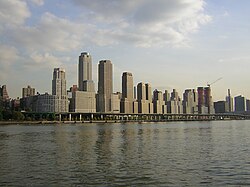
Riverside South is an urban development project in the Lincoln Square neighborhood of the Upper West Side of Manhattan, New York City, United States. Developed by the businessman and later U.S. president Donald Trump in collaboration with a group of Asian investors, the largely residential complex is on 57 acres (23 ha) of land along the Hudson River between 59th Street and 72nd Street. The $3 billion project, which replaced a New York Central Railroad yard known as the 60th Street Yard, includes multiple residential towers and an extension of Riverside Park.
There were several proposals for the site in the late 20th century. These included the Litho City plan in the 1960s, Trump's 1970s plan, and the Lincoln West plan of the early 1980s. The current proposal stems from Trump's late-1980s proposal for Television City. Television City was originally designed to include 16 apartment buildings, 1.8 million square feet (170,000 m2) of studio space, 300,000 square feet (30,000 m2) of office space, ancillary retail space, and a 75-acre (30 ha) waterfront park. The plans were revised following consultations with local civic groups. Trump sold Riverside South to investors from Hong Kong and mainland China, which built seven structures starting in 1997. In 2005, the investors sold the remaining unfinished portions to the Carlyle Group and the Extell Development Company, which developed three more buildings. In turn, Extell sold off some of the southernmost plots in the 2010s; these sites became Waterline Square.
Before Riverside South was developed, the site was a rail freight yard owned by the New York Central Railroad, located between 59th and 72nd streets. By 1849 an embankment near West End Avenue, with a span over a tidal lagoon, carried the Hudson River Railroad, later part of New York Central. At the time, much of the current site of Riverside South was still under water. By 1880, what had been river was transformed by landfill into the New York Central Railroad's vast 60th Street Yard. Within the 60th Street Yard, a set of 400-foot-long (120 m) piers extended into the Hudson River, where barges carried railcars across the river to New Jersey. The piers protruded at a 55-degree angle and each contained tracks.
In the 1930s, New York City parks commissioner Robert Moses covered New York Central's rail track north of 72nd Street as part of the West Side Improvement, which also moved rail lines below grade south of 60th Street. The Moses project was bigger than Hoover Dam and created the Henry Hudson Parkway. The adjacent Riverside Park was expanded to the Hudson River.
Until the 1970s, the rail yard area was generally industrial. The area was home to a printing plant for The New York Times between 1959 and 1975, as well as ABC television studios. At the same time, public housing extended to West End Avenue (across the street from the printing plant and the TV studios), and the Lincoln Towers redevelopment project extended to the rail yard boundary along Freedom Place. New York Central merged with the Pennsylvania Railroad to form Penn Central in 1968 as the rail lines were suffering severe financial difficulties. The railroad went bankrupt in 1970, and its assets were sold off in federal court.
In the late 20th century, there had been several proposals to develop structures over the rail yard. These included the Litho City plan in the 1960s; the businessman Donald Trump's 1970s plan; the Lincoln West plan of the early 1980s; and Trump's Television City plan of the late 1980s. In his book New York 2000, Robert A. M. Stern described the site as "one of the city's most coveted and contested parcels of open land". The site was hard to develop in part because it did not have roads or utilities, and because any potential redevelopment would have had to be built over the train yard.
In 1961, the railroad proposed a partnership with the Amalgamated Lithographers Union to build Litho City, a mixed-use development over the tracks. There would be six 47-story buildings and three 41-story buildings, all designed by Kelly & Gruzen. The development would have included 200 artists' studios that faced north; the rest of the units would be structured as rental apartments or housing cooperatives. Sources variously cited Litho City as being built to accommodate 12,500 or 25,000 people. The New York City Planning Commission (CPC) deferred action on the Litho City proposal for a year while it reviewed Litho City's effects on traffic in the neighborhood, and the consulting firm of Day & Zimmerman warned that the development might worsen traffic. Nonetheless, the union's president Edward Swayduck and the city's traffic commissioner Henry A. Barnes both endorsed the Litho City plan.
The CPC designated the West Side rail yard as an urban renewal site in October 1962, allowing the plans for Litho City to proceed. Shortly afterward, the Amalgamated Lithographers Union announced plans for a $15 million dormitory in the development, which would house 1,000 foreign students. Plans also called for a promenade linking to Lincoln Center, in addition to a park on the Hudson River shoreline. A scale model of Litho City was unveiled at Grand Central Terminal in 1963. By then, the project was being planned as a high-income development, rather than a middle-income development; the cost of Litho City was estimated at $175 million. There were to be 6,000 apartments, and a new street, running parallel to the yard between 66th and 70th streets, was also proposed. Moses also planned to build an exit from the West Side Highway to Litho City, prompting objections that the street grid could not handle the additional traffic.
Riverside South, Manhattan
Riverside South is an urban development project in the Lincoln Square neighborhood of the Upper West Side of Manhattan, New York City, United States. Developed by the businessman and later U.S. president Donald Trump in collaboration with a group of Asian investors, the largely residential complex is on 57 acres (23 ha) of land along the Hudson River between 59th Street and 72nd Street. The $3 billion project, which replaced a New York Central Railroad yard known as the 60th Street Yard, includes multiple residential towers and an extension of Riverside Park.
There were several proposals for the site in the late 20th century. These included the Litho City plan in the 1960s, Trump's 1970s plan, and the Lincoln West plan of the early 1980s. The current proposal stems from Trump's late-1980s proposal for Television City. Television City was originally designed to include 16 apartment buildings, 1.8 million square feet (170,000 m2) of studio space, 300,000 square feet (30,000 m2) of office space, ancillary retail space, and a 75-acre (30 ha) waterfront park. The plans were revised following consultations with local civic groups. Trump sold Riverside South to investors from Hong Kong and mainland China, which built seven structures starting in 1997. In 2005, the investors sold the remaining unfinished portions to the Carlyle Group and the Extell Development Company, which developed three more buildings. In turn, Extell sold off some of the southernmost plots in the 2010s; these sites became Waterline Square.
Before Riverside South was developed, the site was a rail freight yard owned by the New York Central Railroad, located between 59th and 72nd streets. By 1849 an embankment near West End Avenue, with a span over a tidal lagoon, carried the Hudson River Railroad, later part of New York Central. At the time, much of the current site of Riverside South was still under water. By 1880, what had been river was transformed by landfill into the New York Central Railroad's vast 60th Street Yard. Within the 60th Street Yard, a set of 400-foot-long (120 m) piers extended into the Hudson River, where barges carried railcars across the river to New Jersey. The piers protruded at a 55-degree angle and each contained tracks.
In the 1930s, New York City parks commissioner Robert Moses covered New York Central's rail track north of 72nd Street as part of the West Side Improvement, which also moved rail lines below grade south of 60th Street. The Moses project was bigger than Hoover Dam and created the Henry Hudson Parkway. The adjacent Riverside Park was expanded to the Hudson River.
Until the 1970s, the rail yard area was generally industrial. The area was home to a printing plant for The New York Times between 1959 and 1975, as well as ABC television studios. At the same time, public housing extended to West End Avenue (across the street from the printing plant and the TV studios), and the Lincoln Towers redevelopment project extended to the rail yard boundary along Freedom Place. New York Central merged with the Pennsylvania Railroad to form Penn Central in 1968 as the rail lines were suffering severe financial difficulties. The railroad went bankrupt in 1970, and its assets were sold off in federal court.
In the late 20th century, there had been several proposals to develop structures over the rail yard. These included the Litho City plan in the 1960s; the businessman Donald Trump's 1970s plan; the Lincoln West plan of the early 1980s; and Trump's Television City plan of the late 1980s. In his book New York 2000, Robert A. M. Stern described the site as "one of the city's most coveted and contested parcels of open land". The site was hard to develop in part because it did not have roads or utilities, and because any potential redevelopment would have had to be built over the train yard.
In 1961, the railroad proposed a partnership with the Amalgamated Lithographers Union to build Litho City, a mixed-use development over the tracks. There would be six 47-story buildings and three 41-story buildings, all designed by Kelly & Gruzen. The development would have included 200 artists' studios that faced north; the rest of the units would be structured as rental apartments or housing cooperatives. Sources variously cited Litho City as being built to accommodate 12,500 or 25,000 people. The New York City Planning Commission (CPC) deferred action on the Litho City proposal for a year while it reviewed Litho City's effects on traffic in the neighborhood, and the consulting firm of Day & Zimmerman warned that the development might worsen traffic. Nonetheless, the union's president Edward Swayduck and the city's traffic commissioner Henry A. Barnes both endorsed the Litho City plan.
The CPC designated the West Side rail yard as an urban renewal site in October 1962, allowing the plans for Litho City to proceed. Shortly afterward, the Amalgamated Lithographers Union announced plans for a $15 million dormitory in the development, which would house 1,000 foreign students. Plans also called for a promenade linking to Lincoln Center, in addition to a park on the Hudson River shoreline. A scale model of Litho City was unveiled at Grand Central Terminal in 1963. By then, the project was being planned as a high-income development, rather than a middle-income development; the cost of Litho City was estimated at $175 million. There were to be 6,000 apartments, and a new street, running parallel to the yard between 66th and 70th streets, was also proposed. Moses also planned to build an exit from the West Side Highway to Litho City, prompting objections that the street grid could not handle the additional traffic.
Recent media
Recent media