
Truncation error
View on WikipediaIn numerical analysis and scientific computing, truncation error is an error caused by approximating a mathematical process.[1][2] The term truncation comes from the fact that these simplifications often involve the truncation of an infinite series expansion so as to make the computation possible and practical.
Examples
[edit]Infinite series
[edit]A summation series for is given by an infinite series such as


In reality, we can only use a finite number of these terms as it would take an infinite amount of computational time to make use of all of them. So let's suppose we use only three terms of the series, then
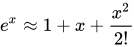
In this case, the truncation error is
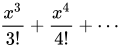
Example A:
Given the following infinite series, find the truncation error for x = 0.75 if only the first three terms of the series are used.

Solution
Using only first three terms of the series gives
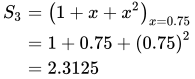
The sum of an infinite geometrical series is given by


For our series, a = 1 and r = 0.75, to give
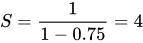
The truncation error hence is

Differentiation
[edit]The definition of the exact first derivative of the function is given by
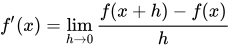
However, if we are calculating the derivative numerically, has to be finite. The error caused by choosing to be finite is a truncation error in the mathematical process of differentiation.

Example A:
Find the truncation in calculating the first derivative of at using a step size of


Solution:
The first derivative of is and at ,
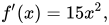

The approximate value is given by

The truncation error hence is

Integration
[edit]The definition of the exact integral of a function from to is given as follows.


Let be a function defined on a closed interval of the real numbers, , and be a partition of I, where where and .
![{\displaystyle f:[a,b]\to \mathbb {R} }](https://wikimedia.org/api/rest_v1/media/math/render/svg/b592d102ccd1ba134d401c5b3ea177baaba3ffac)
![{\displaystyle [a,b]}](https://wikimedia.org/api/rest_v1/media/math/render/svg/9c4b788fc5c637e26ee98b45f89a5c08c85f7935)

![{\displaystyle P=\left\{[x_{0},x_{1}],[x_{1},x_{2}],\dots ,[x_{n-1},x_{n}]\right\},}](https://wikimedia.org/api/rest_v1/media/math/render/svg/e154f451e776e58ef356670f49b866ea897bda1b)

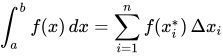

![{\displaystyle x_{i}^{*}\in [x_{i-1},x_{i}]}](https://wikimedia.org/api/rest_v1/media/math/render/svg/dafeab86f1179399f11208ee27a15c76434aed3d)
This implies that we are finding the area under the curve using infinite rectangles. However, if we are calculating the integral numerically, we can only use a finite number of rectangles. The error caused by choosing a finite number of rectangles as opposed to an infinite number of them is a truncation error in the mathematical process of integration.
Example A.
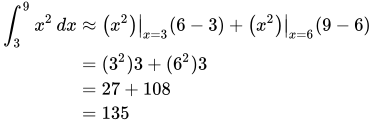
For the integral find the truncation error if a two-segment left-hand Riemann sum is used with equal width of segments.

Solution
We have the exact value as
![{\displaystyle {\begin{aligned}\int _{3}^{9}{x^{2}{dx}}&=\left[{\frac {x^{3}}{3}}\right]_{3}^{9}\\&=\left[{\frac {9^{3}-3^{3}}{3}}\right]\\&=234\end{aligned}}}](https://wikimedia.org/api/rest_v1/media/math/render/svg/a5709298d239080a0090b20171fa298364ac5e16)
Using two rectangles of equal width to approximate the area (see Figure 2) under the curve, the approximate value of the integral

Occasionally, by mistake, round-off error (the consequence of using finite precision floating point numbers on computers), is also called truncation error, especially if the number is rounded by chopping. That is not the correct use of "truncation error"; however calling it truncating a number may be acceptable.
Addition
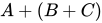
[edit]Truncation error can cause within a computer when because (like it should), while . Here, has a truncation error equal to 1. This truncation error occurs because computers do not store the least significant digits of an extremely large integer.




See also
[edit]References
[edit]- Atkinson, Kendall E. (1989), An Introduction to Numerical Analysis (2nd ed.), New York: John Wiley & Sons, p. 20, ISBN 978-0-471-50023-0
- Stoer, Josef; Bulirsch, Roland (2002), Introduction to Numerical Analysis (3rd ed.), Berlin, New York: Springer-Verlag, p. 1, ISBN 978-0-387-95452-3.
Truncation error
View on GrokipediaDefinition and Fundamentals
Core Definition
Truncation error refers to the discrepancy between an exact mathematical value and its finite approximation resulting from terminating an infinite process, such as truncating an infinite series or discretizing a continuous function in numerical methods.[4] This error arises inherently from the approximation of infinite or continuous phenomena by finite representations, which is a fundamental aspect of numerical analysis. The concept gained prominence in numerical analysis during the mid-20th century, coinciding with the rise of digital computing, though early discussions on related approximation errors appeared in Lewis Fry Richardson's 1910 work on finite difference solutions to differential equations and extrapolation techniques to mitigate such inaccuracies.[5] A classic illustration is the approximation of using the Leibniz formula, where , and the partial sum after terms yields a truncation error equal to the remainder of the infinite tail.[6] Mathematically, for an infinite series approximated by the partial sum , the truncation error is given byDistinction from Round-Off Error
Round-off error arises from the finite precision with which numbers are represented and manipulated in computer systems, particularly through floating-point arithmetic that cannot exactly capture most real numbers./01:_Introduction/1.03:_Sources_of_Error) For instance, the decimal 0.1 is approximated in binary floating-point as 0.1000000000000000055511151231257827021181583404541015625 in double precision, introducing a small but inherent discrepancy.[8] In contrast to truncation error, which stems from approximations inherent to the numerical algorithm or model—such as terminating an infinite series or using finite differences—round-off error originates solely from the hardware and software limitations in representing and computing with numbers.[9] This fundamental difference means truncation error depends on the choice and refinement of the method, while round-off error is tied to the precision level of the computing environment; consequently, truncation often dominates in high-precision methods where arithmetic accuracy is sufficient to make algorithmic approximations the primary limitation, whereas round-off prevails in low-precision settings where representation errors amplify quickly.[10] The total numerical error in computations is the sum of truncation error and round-off error, necessitating separate analysis to develop effective mitigation strategies, such as balancing step sizes to minimize their combined impact./01:_Introduction/1.03:_Sources_of_Error) This separation allows for targeted improvements, like increasing arithmetic precision to curb round-off or refining algorithms to reduce truncation.[9] The distinction between these errors was particularly emphasized in early computational mathematics to guide error analysis amid the limitations of nascent computing hardware, as detailed in J. H. Wilkinson's seminal 1963 book Rounding Errors in Algebraic Processes, which focused on bounding round-off propagation while implicitly highlighting its separation from approximation-induced errors. In double-precision floating-point arithmetic, round-off error is typically on the order of the machine epsilon, $ \mathcal{O}(\epsilon_{\text{machine}}) \approx 10^{-16} $, and remains largely independent of the number of algorithmic steps.[8]Mathematical Formulation
General Expression
In numerical analysis, the truncation error arises when an exact mathematical quantity is approximated by a finite process, such as a partial sum or iterative scheme, denoted as , where represents the truncation parameter, such as the number of terms in a series or the number of computational steps. The general expression for the truncation error is given by , capturing the discrepancy between the true value and the approximation. This form is foundational across various approximation methods, including polynomial expansions and discrete schemes for solving equations.[11] As the truncation parameter increases or the step size decreases (where often parameterizes the discretization, such as grid spacing), the truncation error exhibits asymptotic behavior: as , provided the approximation converges to the exact solution. The rate of convergence is typically characterized by the order of the method, expressed as , where is the order of accuracy, indicating that the error decreases proportionally to for small . For instance, in first-order methods like the forward Euler scheme, , while higher-order methods achieve larger . This big-O notation quantifies the leading-order term in the error expansion, derived from Taylor series analysis of the approximation process.[11] A prominent example of this framework occurs in the truncation of Taylor series expansions. For a function expanded around a point , the partial polynomial yields a truncation error via the Lagrange form of the remainder:Error Estimation Techniques
Error estimation techniques for truncation error focus on analytical methods to bound or quantify the discrepancy between exact and approximate solutions without requiring knowledge of the true solution. These approaches are essential in numerical analysis to assess method reliability and guide parameter selection, such as step sizes.[13] Asymptotic analysis provides a primary tool for estimating truncation error by examining the behavior as discretization parameters, like step size , approach zero. In this framework, the error is typically expressed as , where is a constant depending on the problem and is the order of convergence. To determine and approximate , approximations are computed at successively refined grids (e.g., , ) and the differences are analyzed, revealing the dominant error term through logarithmic plots or direct ratios. This method underpins convergence studies in iterative numerical schemes.[14] Remainder theorems offer explicit bounds for truncation errors in series expansions. For Taylor series approximations, the integral form of the remainder provides a precise estimate: after truncating at order , the error is , which can be bounded using bounds on the -th derivative. In the context of alternating series, Leibniz's test (also known as the alternating series estimation theorem) bounds the truncation error after terms by , where are the absolute values of the terms, provided the series terms decrease monotonically to zero. These theorems enable conservative error guarantees directly from problem properties.[15][16] Richardson extrapolation enhances error estimation by combining solutions from multiple step sizes to eliminate leading error terms. Assuming the approximation satisfies , the extrapolated error estimate is , which isolates higher-order terms and can achieve superconvergence. This technique, originally developed for geophysical computations, is widely applied to refine estimates in finite difference and integral methods. In finite difference methods, the order of truncation error directly governs overall accuracy; for instance, the forward difference approximation for the first derivative, , incurs a truncation error of , derived from Taylor expansion, making it first-order accurate. Higher-order schemes, like central differences, reduce this to , but the forward method's simplicity suits certain applications despite its coarser bound.[17] A concrete example arises in solving ordinary differential equations (ODEs) with the explicit Euler method, where the local truncation error— the error introduced per step—is . This follows from Taylor expanding the exact solution around the current point: for some , with the Euler step matching only up to the linear term, leaving the quadratic remainder. Global error then accumulates as over fixed intervals.[18]Applications in Numerical Analysis
Function Approximation via Series
In function approximation via series expansions, truncation error arises when a finite number of terms is used to represent an infinite series, such as in Taylor or Fourier expansions, leading to a remainder that quantifies the deviation from the true function value.[19] For Taylor series, a smooth function is approximated around a point by the partial sumNumerical Differentiation
In numerical differentiation, truncation error arises when approximating derivatives using finite difference methods, which replace continuous derivatives with discrete differences based on function evaluations at nearby points. These approximations are derived from Taylor series expansions, truncating higher-order terms to yield an error proportional to the step size . The leading-order truncation error term typically involves higher derivatives of the function, and reducing diminishes the error, though it must be balanced against round-off errors in practice. The forward difference formula for the first derivative is given byNumerical Integration
In numerical integration, truncation error arises from approximating the definite integral using discrete quadrature rules that rely on polynomial interpolation of the integrand, leading to discrepancies proportional to higher-order derivatives of . These errors are inherent to the method's finite representation of the continuous integral and diminish as the step size decreases, typically following an order of convergence determined by the rule's polynomial degree. Common quadrature methods, such as those based on Newton-Cotes formulas, derive their truncation errors from the remainder term in the interpolation polynomial via the error formula for interpolatory quadrature.[27] The trapezoidal rule approximates the integral over by assuming linear interpolation between endpoints, yielding for a single interval of width , with a local truncation error of for some . For the composite trapezoidal rule over subintervals each of width , the approximation becomes , and the total truncation error is , which is globally. This quadratic convergence stems from the rule's exactness for linear polynomials, with the second derivative capturing the curvature neglected in the approximation.[27][28] Simpson's rule improves accuracy by employing quadratic interpolation over two subintervals, using three points to approximate for , with a local truncation error of for . In its composite form over subintervals of width , the rule extends to , yielding a total error of , or overall. This higher-order error, derived from the interpolatory remainder and symmetry properties, makes Simpson's rule exact not only for quadratics but also for cubics.[27][28] More generally, for a closed Newton-Cotes k-point rule (using polynomial interpolation of degree k-1 over [a,b]), the truncation error depends on the parity of n = k-1: if n is odd, it is proportional to (b-a)^{n+2} f^{(n+1)}(\xi); if n is even, proportional to (b-a)^{n+3} f^{(n+2)}(\xi), for some \xi \in (a, b). This expression arises from the Peano kernel theorem applied to the interpolation error, bounding the discrepancy based on higher derivatives. For instance, the trapezoidal rule (k=2, n=1 odd) has error -\frac{(b-a)^3}{12} f''(\xi), while Simpson's rule (k=3, n=2 even) has -\frac{(b-a)^5}{2880} f^{(4)}(\xi).[29][27] Gaussian quadrature exemplifies advanced rules that optimize node placement and weights to minimize truncation error, achieving exactness for polynomials up to degree with only points, far surpassing Newton-Cotes for the same number of evaluations. The error term involves the -th derivative: for the -point Gauss-Legendre rule on (scalable to ), for some , reflecting the rule's roots at the zeros of the -th Legendre polynomial. This leads to exponential convergence for smooth analytic functions, making it ideal for high-precision applications.[30] In adaptive integration schemes, truncation error estimates from these rules guide dynamic mesh refinement to balance accuracy and efficiency. For instance, MATLAB'squad function (now superseded by integral but historically influential) employs adaptive Simpson's quadrature, estimating local error as the difference between coarse- and fine-grid approximations () and recursively subdividing subintervals until the estimated error falls below a user-specified tolerance, typically achieving the desired precision with fewer evaluations for smooth integrands.[31]