


Community hub
Recent from talks
Contribute something to knowledge base
Content stats: 0 posts, 0 articles, 1 media, 0 notes
Members stats: 0 subscribers, 0 contributors, 0 moderators, 0 supporters
Subscribers
Supporters
Contributors
Moderators
Hub AI
Tryblidiida AI simulator
(@Tryblidiida_simulator)
Hub AI
Tryblidiida AI simulator
(@Tryblidiida_simulator)
Tryblidiida
Tryblidiida is a taxon of monoplacophoran molluscans containing the only extant representatives: 37 species are still alive today, inhabiting the ocean at depths of between 175 and 6,400 metres (574 and 21,000 ft).
The first captured living monoplacophoran was Veleropilina zografi in 1896, but at that time it was described as if it were an archaeogastropod, a true limpet, mainly because of its patelliform (limpet-like) shell. This species was finally revealed to be monoplacophoran 87 years later, in 1983.
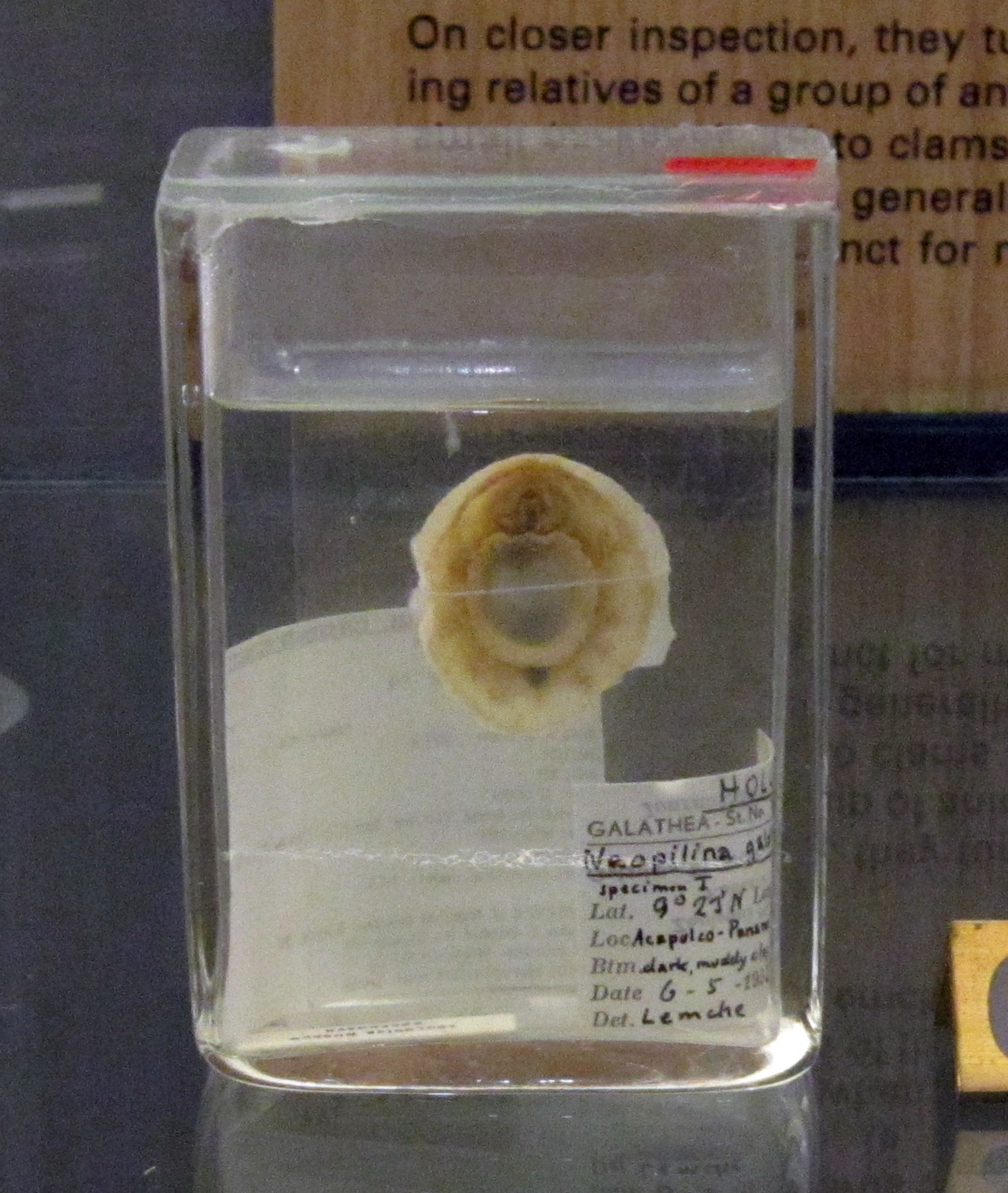
In April 1952, a living specimen was collected from deep depths in the Middle America Trench off Costa Rica's Pacific coast. In 1957 that species was described and named Neopilina galatheae by its discoverer, Danish biologist Henning Mourier Lemche (1904–1977). An expert in the field has called this discovery "one of the greatest sensations in the [twentieth] century." As of 2008, there were 31 living species known, discovered in waters from 200 meters in depth to hadal depths, or more than 6,000 meters in the deepest ocean trenches.
The first specimen photographed alive was Vema hyalina, at a depth of 400 meters off Catalina Island, California, in 1977. Scientists believe that the taxon Monoplacophora is probably polyphyletic and have proposed including all the living members in the order Tryblidiida.
In 1989, fossils in Italy from the middle Pleistocene were described which appear to be identical with the living species Micropilina minuta.
Little is known about monoplacophorans. They have a single, flat, rounded bilateral shell that is often thin and fragile; it ranges in size from 3 to 30 millimetres (in recent species).[citation needed] The apex of the shell is at the anterior end. The fossil shells exhibit a series of muscular attachment scars on the inner side, suggesting metamerism; indeed, with living Monoplacophora to study, it can be seen that their body segments exhibit a serial repetition of kidneys, gills and reproductive structure. This used to be interpreted as a true segmentation, which suggested a "missing link" between mollusks and annelids. More recent studies have shown that the repetition of these organs is secondary.[citation needed]
Monoplacophorans move on a rounded foot. Their reduced head lacks eyes or tentacles.
The mantle cavity forms a horseshoe-shaped groove running around the muscular foot, in a similar fashion to that of the chitons, and contains five or six gills on either side. The mouth opens on the underside between the ends of the groove, while the anus opens into the hindmost part. Like chitons, monoplacophorans possess a sensory subradular organ, as well as a rasping radula. A fold of ciliated tissue surrounds the mouth to the front and sides, while a smaller fold, bearing a number of tentacles, lies just behind it. The stomach contains a style, projecting from a diverticulum, or "style sac".
Tryblidiida
Tryblidiida is a taxon of monoplacophoran molluscans containing the only extant representatives: 37 species are still alive today, inhabiting the ocean at depths of between 175 and 6,400 metres (574 and 21,000 ft).
The first captured living monoplacophoran was Veleropilina zografi in 1896, but at that time it was described as if it were an archaeogastropod, a true limpet, mainly because of its patelliform (limpet-like) shell. This species was finally revealed to be monoplacophoran 87 years later, in 1983.
In April 1952, a living specimen was collected from deep depths in the Middle America Trench off Costa Rica's Pacific coast. In 1957 that species was described and named Neopilina galatheae by its discoverer, Danish biologist Henning Mourier Lemche (1904–1977). An expert in the field has called this discovery "one of the greatest sensations in the [twentieth] century." As of 2008, there were 31 living species known, discovered in waters from 200 meters in depth to hadal depths, or more than 6,000 meters in the deepest ocean trenches.
The first specimen photographed alive was Vema hyalina, at a depth of 400 meters off Catalina Island, California, in 1977. Scientists believe that the taxon Monoplacophora is probably polyphyletic and have proposed including all the living members in the order Tryblidiida.
In 1989, fossils in Italy from the middle Pleistocene were described which appear to be identical with the living species Micropilina minuta.
Little is known about monoplacophorans. They have a single, flat, rounded bilateral shell that is often thin and fragile; it ranges in size from 3 to 30 millimetres (in recent species).[citation needed] The apex of the shell is at the anterior end. The fossil shells exhibit a series of muscular attachment scars on the inner side, suggesting metamerism; indeed, with living Monoplacophora to study, it can be seen that their body segments exhibit a serial repetition of kidneys, gills and reproductive structure. This used to be interpreted as a true segmentation, which suggested a "missing link" between mollusks and annelids. More recent studies have shown that the repetition of these organs is secondary.[citation needed]
Monoplacophorans move on a rounded foot. Their reduced head lacks eyes or tentacles.
The mantle cavity forms a horseshoe-shaped groove running around the muscular foot, in a similar fashion to that of the chitons, and contains five or six gills on either side. The mouth opens on the underside between the ends of the groove, while the anus opens into the hindmost part. Like chitons, monoplacophorans possess a sensory subradular organ, as well as a rasping radula. A fold of ciliated tissue surrounds the mouth to the front and sides, while a smaller fold, bearing a number of tentacles, lies just behind it. The stomach contains a style, projecting from a diverticulum, or "style sac".
Recent media
Recent media