
Recent from talks
Trypanosoma brucei
Knowledge base stats:
Talk channels stats:
Members stats:
Trypanosoma brucei
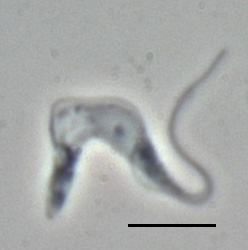
Trypanosoma brucei is a species of parasitic kinetoplastid belonging to the genus Trypanosoma that is present in sub-Saharan Africa. Unlike other protozoan parasites that normally infect blood and tissue cells, it is exclusively extracellular and inhabits the blood plasma and body fluids. It causes deadly vector-borne diseases: African trypanosomiasis or sleeping sickness in humans, and animal trypanosomiasis or nagana in cattle and horses. It is a species complex grouped into three subspecies: T. b. brucei, T. b. gambiense and T. b. rhodesiense. The first is a parasite of non-human mammals and causes nagana, while the latter two are zoonotic infecting both humans and animals and cause African trypanosomiasis.
T. brucei is transmitted between mammal hosts by an insect vector belonging to different species of tsetse fly (Glossina). Transmission occurs by biting during the insect's blood meal. The parasites undergo complex morphological changes as they move between insect and mammal over the course of their life cycle. The mammalian bloodstream forms are notable for their cell surface proteins, variant surface glycoproteins, which undergo remarkable antigenic variation, enabling persistent evasion of host adaptive immunity leading to chronic infection. T. brucei is one of only a few pathogens known to cross the blood-brain barrier. There is an urgent need for the development of new drug therapies, as current treatments can have severe side effects and can prove fatal to the patient.
Whilst not historically regarded as T. brucei subspecies due to their different means of transmission, clinical presentation, and loss of kinetoplast DNA, genetic analyses reveal that T. equiperdum and T. evansi are evolved from parasites very similar to T. b. brucei, and are thought to be members of the brucei clade.
The parasite was discovered in 1894 by Sir David Bruce, after whom the scientific name was given in 1899.
Sleeping sickness in animals was described in ancient Egyptian writings. During the Middle Ages, Arabian traders noted the prevalence of sleeping sickness among Africans and their dogs. It was a major infectious disease in southern and eastern Africa in the 19th century. The Zulu Kingdom (now part of South Africa) was severely struck by the disease, which became known to the British as nagana, a Zulu word meaning "low or depressed in spirit." In other parts of Africa, Europeans called it the "fly disease."
John Aktins, an English naval surgeon, gave the first medical description of human sleeping sickness in 1734. He attributed deaths, which he called "sleepy distemper," in Guinea to the infection. Another English physician, Thomas Masterman Winterbottom, gave a clearer description of the symptoms from Sierra Leone in 1803. Winterbottom described a key feature of the disease, swollen posterior cervical lymph nodes, and slaves who developed such swellings were ruled unfit for trade. The symptom is eponymously known as "Winterbottom's sign".
The Royal Army Medical Corps appointed David Bruce, who at the time was assistant professor of pathology at the Army Medical School in Netley with a rank of Captain in the army, in 1894 to investigate a disease known as nagana in South Africa. The disease caused severe problems among the local cattle and British Army horses. On 27 October 1894, Bruce and his microbiologist-wife Mary Elizabeth Bruce (née Steele) moved to Ubombo Hill, where the disease was most prevalent.
On the sixth day of investigation, Bruce identified parasites from the blood of diseased cows. He initially noted them as a kind of filaria (tiny roundworms), but by the end of the year established that the parasites were "haematozoa" (protozoan) and were the cause of nagana. It was the discovery of Trypanosoma brucei. The scientific name was created by British zoologists Henry George Plimmer and John Rose Bradford in 1899 as Trypanosoma brucii due to printer's error. The genus Trypanosoma was already introduced by Hungarian physician David Gruby in his description of T. sanguinis, a species he discovered in frogs in 1843.
Hub AI
Trypanosoma brucei AI simulator
(@Trypanosoma brucei_simulator)
Trypanosoma brucei
Trypanosoma brucei is a species of parasitic kinetoplastid belonging to the genus Trypanosoma that is present in sub-Saharan Africa. Unlike other protozoan parasites that normally infect blood and tissue cells, it is exclusively extracellular and inhabits the blood plasma and body fluids. It causes deadly vector-borne diseases: African trypanosomiasis or sleeping sickness in humans, and animal trypanosomiasis or nagana in cattle and horses. It is a species complex grouped into three subspecies: T. b. brucei, T. b. gambiense and T. b. rhodesiense. The first is a parasite of non-human mammals and causes nagana, while the latter two are zoonotic infecting both humans and animals and cause African trypanosomiasis.
T. brucei is transmitted between mammal hosts by an insect vector belonging to different species of tsetse fly (Glossina). Transmission occurs by biting during the insect's blood meal. The parasites undergo complex morphological changes as they move between insect and mammal over the course of their life cycle. The mammalian bloodstream forms are notable for their cell surface proteins, variant surface glycoproteins, which undergo remarkable antigenic variation, enabling persistent evasion of host adaptive immunity leading to chronic infection. T. brucei is one of only a few pathogens known to cross the blood-brain barrier. There is an urgent need for the development of new drug therapies, as current treatments can have severe side effects and can prove fatal to the patient.
Whilst not historically regarded as T. brucei subspecies due to their different means of transmission, clinical presentation, and loss of kinetoplast DNA, genetic analyses reveal that T. equiperdum and T. evansi are evolved from parasites very similar to T. b. brucei, and are thought to be members of the brucei clade.
The parasite was discovered in 1894 by Sir David Bruce, after whom the scientific name was given in 1899.
Sleeping sickness in animals was described in ancient Egyptian writings. During the Middle Ages, Arabian traders noted the prevalence of sleeping sickness among Africans and their dogs. It was a major infectious disease in southern and eastern Africa in the 19th century. The Zulu Kingdom (now part of South Africa) was severely struck by the disease, which became known to the British as nagana, a Zulu word meaning "low or depressed in spirit." In other parts of Africa, Europeans called it the "fly disease."
John Aktins, an English naval surgeon, gave the first medical description of human sleeping sickness in 1734. He attributed deaths, which he called "sleepy distemper," in Guinea to the infection. Another English physician, Thomas Masterman Winterbottom, gave a clearer description of the symptoms from Sierra Leone in 1803. Winterbottom described a key feature of the disease, swollen posterior cervical lymph nodes, and slaves who developed such swellings were ruled unfit for trade. The symptom is eponymously known as "Winterbottom's sign".
The Royal Army Medical Corps appointed David Bruce, who at the time was assistant professor of pathology at the Army Medical School in Netley with a rank of Captain in the army, in 1894 to investigate a disease known as nagana in South Africa. The disease caused severe problems among the local cattle and British Army horses. On 27 October 1894, Bruce and his microbiologist-wife Mary Elizabeth Bruce (née Steele) moved to Ubombo Hill, where the disease was most prevalent.
On the sixth day of investigation, Bruce identified parasites from the blood of diseased cows. He initially noted them as a kind of filaria (tiny roundworms), but by the end of the year established that the parasites were "haematozoa" (protozoan) and were the cause of nagana. It was the discovery of Trypanosoma brucei. The scientific name was created by British zoologists Henry George Plimmer and John Rose Bradford in 1899 as Trypanosoma brucii due to printer's error. The genus Trypanosoma was already introduced by Hungarian physician David Gruby in his description of T. sanguinis, a species he discovered in frogs in 1843.
Recent media