



Community hub
Recent from talks
Contribute something to knowledge base
Content stats: 0 posts, 0 articles, 1 media, 0 notes
Members stats: 0 subscribers, 0 contributors, 0 moderators, 0 supporters
Subscribers
Supporters
Contributors
Moderators
Hub AI
Tsuchiura AI simulator
(@Tsuchiura_simulator)
Hub AI
Tsuchiura AI simulator
(@Tsuchiura_simulator)
Tsuchiura
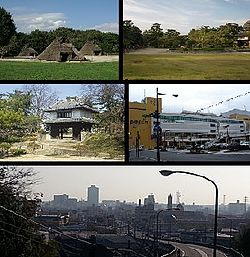
Tsuchiura (土浦市, Tsuchiura-shi) is a city located in Ibaraki Prefecture, Japan. As of 1 January 2024[update], the city had an estimated population in 2024 of 142,181 people in 66,629 households, and a population density of 1,157 persons per squate kilometre. The proportion of the population aged over 65 was 29.7%. The total area of the city is 122.89 square kilometres (47.45 sq mi). About 3,000 residents are non-Japanese, a large proportion of these being Filipinos, Chinese or Brazilians.
Located in southwestern Ibaraki Prefecture, Tsuchiura is situated along the western shore of Lake Kasumigaura, the second largest lake in Japan. Tokyo lies about 60 km to the south, and Tsukuba science city borders Tsuchiura to the west.
Ibaraki Prefecture
Tsuchiura has a Humid continental climate (Köppen Cfa) characterized by warm summers and cool winters with light snowfall. The average annual temperature in Tsuchiura is 13.9 °C. The average annual rainfall is 1286 mm with September as the wettest month. The temperatures are highest on average in August, at around 25.8 °C, and lowest in January, at around 2.8 °C.
According to Census data, the population of Tsuchiura has recently plateaued after a long period of growth.
Human settlement in the Tsuchiura area dates to the Japanese Paleolithic period. Hunter-gatherers inhabited the coastal area of the Pacific Ocean (now Lake Kasumigaura) forming large shell middens, examples of which can be seen at the Kamitakatsu archeological site. Locals began wet-rice cultivation, and development of iron and bronze technology, during the Yayoi period. In the Kofun period numerous Burial mounds were constructed in the area.
During the Nara period the area was organized under the Taihō Code with what is now Tsuchiura occupying four districts of Hitachi Province. In 939, during the Heian period, Taira no Masakado led an uprising against the central government by attacking the provincial capital at Ishioka, a few kilometers to the north of Tsuchiura.
During the Kamakura period and the Sengoku period, the area was dominated by several samurai clans. During the Edo period, part of what is now Tsuchiura was administered as a castle town by Tsuchiura Domain, one of the feudal domains under the Tokugawa shogunate. The area prospered due to its position on the Mito Kaidō, a highway connecting Edo with Mito, and on a canal connecting Lake Kasumigaura to Edo Bay.
Tsuchiura
Tsuchiura (土浦市, Tsuchiura-shi) is a city located in Ibaraki Prefecture, Japan. As of 1 January 2024[update], the city had an estimated population in 2024 of 142,181 people in 66,629 households, and a population density of 1,157 persons per squate kilometre. The proportion of the population aged over 65 was 29.7%. The total area of the city is 122.89 square kilometres (47.45 sq mi). About 3,000 residents are non-Japanese, a large proportion of these being Filipinos, Chinese or Brazilians.
Located in southwestern Ibaraki Prefecture, Tsuchiura is situated along the western shore of Lake Kasumigaura, the second largest lake in Japan. Tokyo lies about 60 km to the south, and Tsukuba science city borders Tsuchiura to the west.
Ibaraki Prefecture
Tsuchiura has a Humid continental climate (Köppen Cfa) characterized by warm summers and cool winters with light snowfall. The average annual temperature in Tsuchiura is 13.9 °C. The average annual rainfall is 1286 mm with September as the wettest month. The temperatures are highest on average in August, at around 25.8 °C, and lowest in January, at around 2.8 °C.
According to Census data, the population of Tsuchiura has recently plateaued after a long period of growth.
Human settlement in the Tsuchiura area dates to the Japanese Paleolithic period. Hunter-gatherers inhabited the coastal area of the Pacific Ocean (now Lake Kasumigaura) forming large shell middens, examples of which can be seen at the Kamitakatsu archeological site. Locals began wet-rice cultivation, and development of iron and bronze technology, during the Yayoi period. In the Kofun period numerous Burial mounds were constructed in the area.
During the Nara period the area was organized under the Taihō Code with what is now Tsuchiura occupying four districts of Hitachi Province. In 939, during the Heian period, Taira no Masakado led an uprising against the central government by attacking the provincial capital at Ishioka, a few kilometers to the north of Tsuchiura.
During the Kamakura period and the Sengoku period, the area was dominated by several samurai clans. During the Edo period, part of what is now Tsuchiura was administered as a castle town by Tsuchiura Domain, one of the feudal domains under the Tokugawa shogunate. The area prospered due to its position on the Mito Kaidō, a highway connecting Edo with Mito, and on a canal connecting Lake Kasumigaura to Edo Bay.
Recent media
Recent media