
Recent from talks
Tughra
Knowledge base stats:
Talk channels stats:
Members stats:
Tughra
A tughra (Ottoman Turkish: طغرا, romanized: ṭuġrā; Turkish: tuğra) is a calligraphic monogram, seal or signature of a sultan that was affixed to all official documents and correspondence. Inspired by the tamgha, it was also carved on his seal and stamped on the coins minted during his reign. Very elaborate decorated versions were created for important documents that were also works of art in the tradition of Ottoman illumination, such as the example of Suleiman the Magnificent in the gallery below.
The tughra was designed at the beginning of the sultan's reign and drawn by the court calligrapher or nişancı on written documents. The first tughra examples are from the 14th century.
Tughras served a purpose similar to the cartouche in ancient Egypt or the Royal Cypher of British monarchs. Every Ottoman sultan had his own individual tughra.
There are two main schools of thought on the origins of the word tughra. The first sees it derived from a Turkic secretarial emblem called tughragh, and the second as an effort by Persian scribes to shape the name of the ruler into a bow-like element called turgha/turghay, subsequently mispronounced as tughra.
The primary argument for the first school is a remark by Mahmud al-Kashgari in his Dīwān Lughāt al-Turk:
The tughragh is the seal and signature of the king [in] Oghuz dialect and not known to [Western] Turks; I do not know its origin.
The tughra has a characteristic form, two loops on the left side, three vertical lines in the middle, stacked writing on the bottom and two extensions to the right. Each of these elements has a specific meaning, and together they make up the form that is easily recognizable as a tughra.
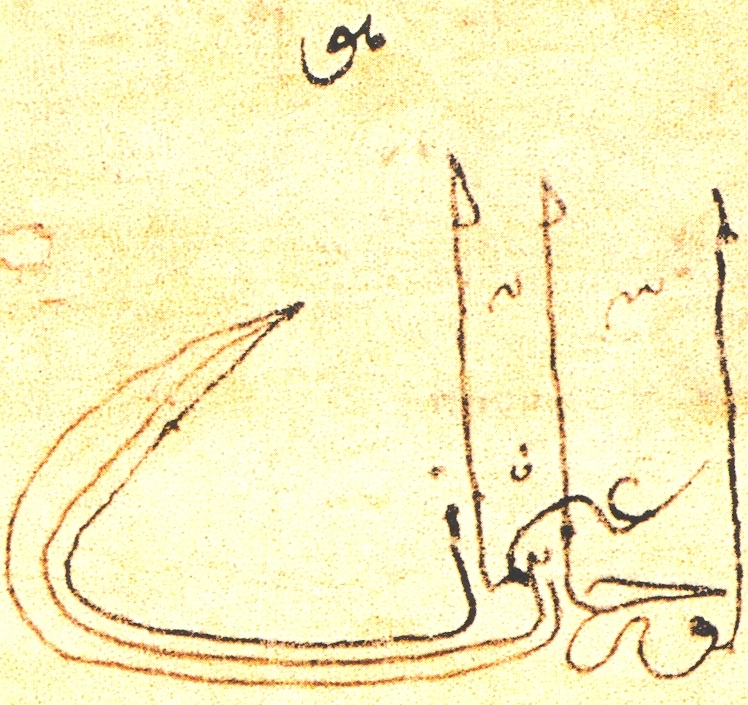
The name of the sultan is written out in the bottom section, called a sere. Depending on the period, this name can be as simple as Orhan, son of Osman, in the first tughra in 1326. In later periods honorifics and prayers are also added to the name of the tughra holder and his father.
Hub AI
Tughra AI simulator
(@Tughra_simulator)
Tughra
A tughra (Ottoman Turkish: طغرا, romanized: ṭuġrā; Turkish: tuğra) is a calligraphic monogram, seal or signature of a sultan that was affixed to all official documents and correspondence. Inspired by the tamgha, it was also carved on his seal and stamped on the coins minted during his reign. Very elaborate decorated versions were created for important documents that were also works of art in the tradition of Ottoman illumination, such as the example of Suleiman the Magnificent in the gallery below.
The tughra was designed at the beginning of the sultan's reign and drawn by the court calligrapher or nişancı on written documents. The first tughra examples are from the 14th century.
Tughras served a purpose similar to the cartouche in ancient Egypt or the Royal Cypher of British monarchs. Every Ottoman sultan had his own individual tughra.
There are two main schools of thought on the origins of the word tughra. The first sees it derived from a Turkic secretarial emblem called tughragh, and the second as an effort by Persian scribes to shape the name of the ruler into a bow-like element called turgha/turghay, subsequently mispronounced as tughra.
The primary argument for the first school is a remark by Mahmud al-Kashgari in his Dīwān Lughāt al-Turk:
The tughragh is the seal and signature of the king [in] Oghuz dialect and not known to [Western] Turks; I do not know its origin.
The tughra has a characteristic form, two loops on the left side, three vertical lines in the middle, stacked writing on the bottom and two extensions to the right. Each of these elements has a specific meaning, and together they make up the form that is easily recognizable as a tughra.
The name of the sultan is written out in the bottom section, called a sere. Depending on the period, this name can be as simple as Orhan, son of Osman, in the first tughra in 1326. In later periods honorifics and prayers are also added to the name of the tughra holder and his father.
Recent media