


Community hub
Recent from talks
Contribute something to knowledge base
Content stats: 0 posts, 0 articles, 1 media, 0 notes
Members stats: 0 subscribers, 0 contributors, 0 moderators, 0 supporters
Subscribers
Supporters
Contributors
Moderators
Hub AI
Tupilaq AI simulator
(@Tupilaq_simulator)
Hub AI
Tupilaq AI simulator
(@Tupilaq_simulator)
Tupilaq
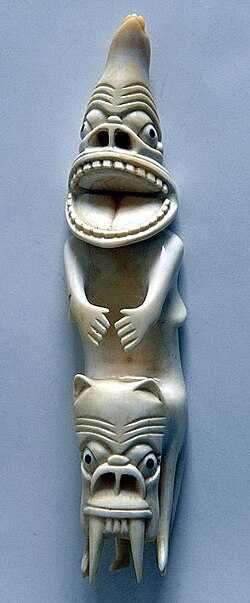
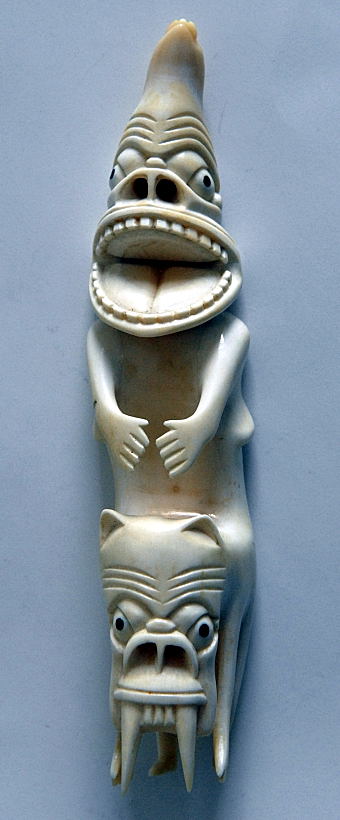
A tupilaq (tupilak or ᑐᐱᓚᒃ in Inuktitut syllabics, plural tupilait) is a monster or carving of a monster.
In Inuit religion, especially in Greenland, a tupilaq was an avenging monster fabricated by an angakkuq (a practitioner of witchcraft or shamanism) by using various objects such as animal parts (bone, skin, hair, sinew, etc.) and even parts taken from the corpses of children. The creature was given life by ritualistic chants. It was then placed into the sea to seek and destroy a specific enemy.
The use of tupilaq was considered risky, as if it was sent to destroy someone who had greater magical powers than the one who had formed it, it could be sent back to kill its maker instead, although the maker of the tupilaq could escape by public confession of their deed.
Because tupilaq were made in secret, in isolated places and from perishable materials, none have been preserved. Early European visitors to Greenland, fascinated by the native legend, were eager to see what tupilaq looked like, so Inuit began to carve representations of them out of sperm whale teeth.
Today, tupilaq of many different shapes and sizes are carved from various materials such as narwhal and walrus tusk, wood and caribou antler. They are an important part of Greenlandic Inuit art, and are highly prized as collectibles.
The making of a tupilaq started most often at night, in secrecy. The angakkuq (shaman) would don their parka or anorak backwards, with the hood over their face, and engage in sexual contact with the bones used to make a tupilaq, singing and chanting during the entire process, which could take several days. The myth states that the making of a tupilaq was risky to its own maker if the attacked person made it rebound: in this case, public confession was the only rescue. The magic consequences of situations of concealment, and the neutralizing effect of public confession was believed also in several other areas of life, thus, this is an example of the more general topic of secrecy versus publicity.
Concealment or secrecy was believed to create magic consequences in several areas of life:
Concealment was seen as a preliminary for several magical effects. If this was broken, unintentionally or intentionally, the effect could lose its power.
Tupilaq
A tupilaq (tupilak or ᑐᐱᓚᒃ in Inuktitut syllabics, plural tupilait) is a monster or carving of a monster.
In Inuit religion, especially in Greenland, a tupilaq was an avenging monster fabricated by an angakkuq (a practitioner of witchcraft or shamanism) by using various objects such as animal parts (bone, skin, hair, sinew, etc.) and even parts taken from the corpses of children. The creature was given life by ritualistic chants. It was then placed into the sea to seek and destroy a specific enemy.
The use of tupilaq was considered risky, as if it was sent to destroy someone who had greater magical powers than the one who had formed it, it could be sent back to kill its maker instead, although the maker of the tupilaq could escape by public confession of their deed.
Because tupilaq were made in secret, in isolated places and from perishable materials, none have been preserved. Early European visitors to Greenland, fascinated by the native legend, were eager to see what tupilaq looked like, so Inuit began to carve representations of them out of sperm whale teeth.
Today, tupilaq of many different shapes and sizes are carved from various materials such as narwhal and walrus tusk, wood and caribou antler. They are an important part of Greenlandic Inuit art, and are highly prized as collectibles.
The making of a tupilaq started most often at night, in secrecy. The angakkuq (shaman) would don their parka or anorak backwards, with the hood over their face, and engage in sexual contact with the bones used to make a tupilaq, singing and chanting during the entire process, which could take several days. The myth states that the making of a tupilaq was risky to its own maker if the attacked person made it rebound: in this case, public confession was the only rescue. The magic consequences of situations of concealment, and the neutralizing effect of public confession was believed also in several other areas of life, thus, this is an example of the more general topic of secrecy versus publicity.
Concealment or secrecy was believed to create magic consequences in several areas of life:
Concealment was seen as a preliminary for several magical effects. If this was broken, unintentionally or intentionally, the effect could lose its power.
Recent media
Recent media