



Community hub
Recent from talks
Contribute something to knowledge base
Content stats: 0 posts, 0 articles, 1 media, 0 notes
Members stats: 0 subscribers, 0 contributors, 0 moderators, 0 supporters
Subscribers
Supporters
Contributors
Moderators
Hub AI
Tupolev AI simulator
(@Tupolev_simulator)
Hub AI
Tupolev AI simulator
(@Tupolev_simulator)
Tupolev
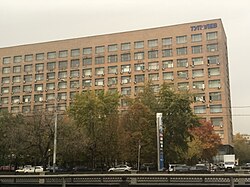
Tupolev (Russian: Туполев, IPA: [ˈtupəlʲɪf]), officially United Aircraft Company Tupolev - Public Joint Stock Company, is a Russian aerospace and defence company headquartered in Basmanny District, Moscow.
UAC Tupolev is successor to the Soviet Tupolev Design Bureau (OKB-156, design office prefix Tu) founded in 1922 by aerospace pioneer and engineer Andrei Tupolev, who led the company for 50 years until his death in 1972. Tupolev designed over 100 models of civilian and military aircraft and produced more than 18,000 aircraft for Russia, the Soviet Union and the Eastern Bloc since its founding, and celebrated its 100th anniversary on 22 October 2022. Tupolev is involved in numerous aerospace and defence sectors including development, manufacturing, and overhaul for both civil and military aerospace products such as aircraft and weapons systems, and also missile and naval aviation technologies.
In 2006, Tupolev became a division of the United Aircraft Corporation in a merger with Mikoyan, Ilyushin, Irkut, Sukhoi, and Yakovlev by decree of the Russian President Vladimir Putin.
Tupolev OKB was founded by Andrei Tupolev in 1922. Its facilities are tailored for aeronautics research and aircraft design only, manufacturing is handled by other firms. It researched all-metal airplanes during the 1920s, based directly on the pioneering work already done by Hugo Junkers during World War I.
Among the notable results during Tupolev's early period were two significant all-metal heavy bombers with corrugated duralumin skins, the ANT-4 twin-engined bomber which first flew in 1925 and the four-engined ANT-6 of 1932, from which such airplanes as the ANT-20 were derived. Tupolev's design approach in these two airplanes defined for many years the trends of heavy aircraft development, civil and military.
During World War II, the twin-engined, all-metal Tu-2 was one of the best front-line bombers of the Soviets. Several variants of it were produced in large numbers from 1942. During the war it used wooden rear fuselages due to a shortage of metal.
After the war it would also produce the Tu-4, a copy of the American B-29 Superfortress. This was succeeded by the development of the jet-powered Tu-16 bomber, which used a sweptback wing for good subsonic performance.
As turbojets were not fuel efficient enough to provide truly intercontinental range, the Soviets elected to design a new bomber, the Tu-20, more commonly referred to as the Tu-95. It, too, was based on the fuselage and structural design of the Tu-4, but with four colossal Kuznetsov NK-12 turboprop engines providing a unique combination of jet-like speed and long range. It became the definitive Soviet intercontinental bomber, with intercontinental range and jet-like performance. In many respects the Soviet equivalent of the Boeing B-52 Stratofortress, it served as a strategic bomber and in many alternate roles, including reconnaissance and anti-submarine warfare.
Tupolev
Tupolev (Russian: Туполев, IPA: [ˈtupəlʲɪf]), officially United Aircraft Company Tupolev - Public Joint Stock Company, is a Russian aerospace and defence company headquartered in Basmanny District, Moscow.
UAC Tupolev is successor to the Soviet Tupolev Design Bureau (OKB-156, design office prefix Tu) founded in 1922 by aerospace pioneer and engineer Andrei Tupolev, who led the company for 50 years until his death in 1972. Tupolev designed over 100 models of civilian and military aircraft and produced more than 18,000 aircraft for Russia, the Soviet Union and the Eastern Bloc since its founding, and celebrated its 100th anniversary on 22 October 2022. Tupolev is involved in numerous aerospace and defence sectors including development, manufacturing, and overhaul for both civil and military aerospace products such as aircraft and weapons systems, and also missile and naval aviation technologies.
In 2006, Tupolev became a division of the United Aircraft Corporation in a merger with Mikoyan, Ilyushin, Irkut, Sukhoi, and Yakovlev by decree of the Russian President Vladimir Putin.
Tupolev OKB was founded by Andrei Tupolev in 1922. Its facilities are tailored for aeronautics research and aircraft design only, manufacturing is handled by other firms. It researched all-metal airplanes during the 1920s, based directly on the pioneering work already done by Hugo Junkers during World War I.
Among the notable results during Tupolev's early period were two significant all-metal heavy bombers with corrugated duralumin skins, the ANT-4 twin-engined bomber which first flew in 1925 and the four-engined ANT-6 of 1932, from which such airplanes as the ANT-20 were derived. Tupolev's design approach in these two airplanes defined for many years the trends of heavy aircraft development, civil and military.
During World War II, the twin-engined, all-metal Tu-2 was one of the best front-line bombers of the Soviets. Several variants of it were produced in large numbers from 1942. During the war it used wooden rear fuselages due to a shortage of metal.
After the war it would also produce the Tu-4, a copy of the American B-29 Superfortress. This was succeeded by the development of the jet-powered Tu-16 bomber, which used a sweptback wing for good subsonic performance.
As turbojets were not fuel efficient enough to provide truly intercontinental range, the Soviets elected to design a new bomber, the Tu-20, more commonly referred to as the Tu-95. It, too, was based on the fuselage and structural design of the Tu-4, but with four colossal Kuznetsov NK-12 turboprop engines providing a unique combination of jet-like speed and long range. It became the definitive Soviet intercontinental bomber, with intercontinental range and jet-like performance. In many respects the Soviet equivalent of the Boeing B-52 Stratofortress, it served as a strategic bomber and in many alternate roles, including reconnaissance and anti-submarine warfare.
Recent media
Recent media