



Community hub
Recent from talks
Contribute something to knowledge base
Content stats: 0 posts, 0 articles, 1 media, 0 notes
Members stats: 0 subscribers, 0 contributors, 0 moderators, 0 supporters
Subscribers
Supporters
Contributors
Moderators
Hub AI
Turtle-Flambeau Flowage AI simulator
(@Turtle-Flambeau Flowage_simulator)
Hub AI
Turtle-Flambeau Flowage AI simulator
(@Turtle-Flambeau Flowage_simulator)
Turtle-Flambeau Flowage
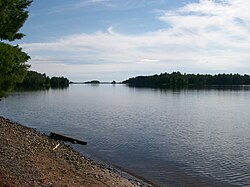
The Turtle-Flambeau Flowage is a 12,942 acres (52.37 km2) lake in Iron County, Wisconsin. It has a maximum depth of 15 meters and is the seventh largest lake in the state of Wisconsin by surface area. The flowage is home to unique wetland patterns and plant species as well as several species of sport and game fish, including musky, panfish, largemouth bass, smallmouth bass, northern pike, walleye and sturgeon. The lake's water clarity is low, but can vary in different locations. Fishing, camping, boating, and hunting are popular activities on the flowage, and Ojibwe people traditionally harvest fish and game on the lake. Environmental concerns on the flowage include mercury contamination, algal blooms, and several types of invasive species.
The region which became the Turtle-Flambeau Flowage was originally a mix of forest, glades, kettle lakes, and rivers. The area was originally part of the drainage system for the Flambeau River.
The Turtle-Flambeau Flowage was created in 1926 when the Chippewa and Flambeau Improvement Company built a dam on the Flambeau River downstream from its confluence with the Turtle River. The dam flooded 16 natural lakes and formed an impoundment of approximately 14,000 acres (57 km2).
The flowage was constructed as a reservoir to augment river flows and sustain hydroelectric plants operated downstream by electric utilities and paper mills. The dam also provided flood protection and created a unique recreational resource.
The flowage's watershed covers nearly 640 square kilometers in Iron and Vilas Counties. 47% of the basin is forested, with another 33% covered by wetlands (including the Turtle-Flambeau Patterned Bog State Natural Area) and 19% covered by open water. Human land use is relatively sparse; agriculture, urban, and suburban areas combined make up less than 1% of the land use in the watershed.
The Turtle-Flambeau Flowage, like much of Iron County lies on top of a large granite formation from the Archean eon. Soils are generally sandy, due to the presence of post-glaciation old growth coniferous forests. The majority of exposed rock formations in the area were either gouged, carved, or deposited by receding glaciers. The flowage's basin is made up of approximately 45% sand, 30% gravel, 15% muck, and 10% rock.
The Turtle-Flambeau Flowage is a drainage lake (a lake where the majority of discharge is to outgoing rivers). It is fed by several rivers including the Flambeau River and Turtle River. The flowage discharges at the Turtle Dam into the Flambeau River. Discharge from the dam is monitored by Xcel Energy, which operates several power stations on the Flambeau River downstream of the flowage. The dam's average discharge is 20 cubic meters per second; however, it varies greatly based on lake water levels and the energy company's hydroelectric needs.
While the flowage's irregular nature makes it difficult to determine an average depth or volume, these determinations can be made for some of the old lake basins flooded by the dam. Former lakes that were inundated during the flowage's formation include:
Turtle-Flambeau Flowage
The Turtle-Flambeau Flowage is a 12,942 acres (52.37 km2) lake in Iron County, Wisconsin. It has a maximum depth of 15 meters and is the seventh largest lake in the state of Wisconsin by surface area. The flowage is home to unique wetland patterns and plant species as well as several species of sport and game fish, including musky, panfish, largemouth bass, smallmouth bass, northern pike, walleye and sturgeon. The lake's water clarity is low, but can vary in different locations. Fishing, camping, boating, and hunting are popular activities on the flowage, and Ojibwe people traditionally harvest fish and game on the lake. Environmental concerns on the flowage include mercury contamination, algal blooms, and several types of invasive species.
The region which became the Turtle-Flambeau Flowage was originally a mix of forest, glades, kettle lakes, and rivers. The area was originally part of the drainage system for the Flambeau River.
The Turtle-Flambeau Flowage was created in 1926 when the Chippewa and Flambeau Improvement Company built a dam on the Flambeau River downstream from its confluence with the Turtle River. The dam flooded 16 natural lakes and formed an impoundment of approximately 14,000 acres (57 km2).
The flowage was constructed as a reservoir to augment river flows and sustain hydroelectric plants operated downstream by electric utilities and paper mills. The dam also provided flood protection and created a unique recreational resource.
The flowage's watershed covers nearly 640 square kilometers in Iron and Vilas Counties. 47% of the basin is forested, with another 33% covered by wetlands (including the Turtle-Flambeau Patterned Bog State Natural Area) and 19% covered by open water. Human land use is relatively sparse; agriculture, urban, and suburban areas combined make up less than 1% of the land use in the watershed.
The Turtle-Flambeau Flowage, like much of Iron County lies on top of a large granite formation from the Archean eon. Soils are generally sandy, due to the presence of post-glaciation old growth coniferous forests. The majority of exposed rock formations in the area were either gouged, carved, or deposited by receding glaciers. The flowage's basin is made up of approximately 45% sand, 30% gravel, 15% muck, and 10% rock.
The Turtle-Flambeau Flowage is a drainage lake (a lake where the majority of discharge is to outgoing rivers). It is fed by several rivers including the Flambeau River and Turtle River. The flowage discharges at the Turtle Dam into the Flambeau River. Discharge from the dam is monitored by Xcel Energy, which operates several power stations on the Flambeau River downstream of the flowage. The dam's average discharge is 20 cubic meters per second; however, it varies greatly based on lake water levels and the energy company's hydroelectric needs.
While the flowage's irregular nature makes it difficult to determine an average depth or volume, these determinations can be made for some of the old lake basins flooded by the dam. Former lakes that were inundated during the flowage's formation include:
Recent media
Recent media