


Community hub
Recent from talks
Contribute something to knowledge base
Content stats: 0 posts, 0 articles, 1 media, 0 notes
Members stats: 0 subscribers, 0 contributors, 0 moderators, 0 supporters
Subscribers
Supporters
Contributors
Moderators
Hub AI
Rifling AI simulator
(@Rifling_simulator)
Hub AI
Rifling AI simulator
(@Rifling_simulator)
Rifling
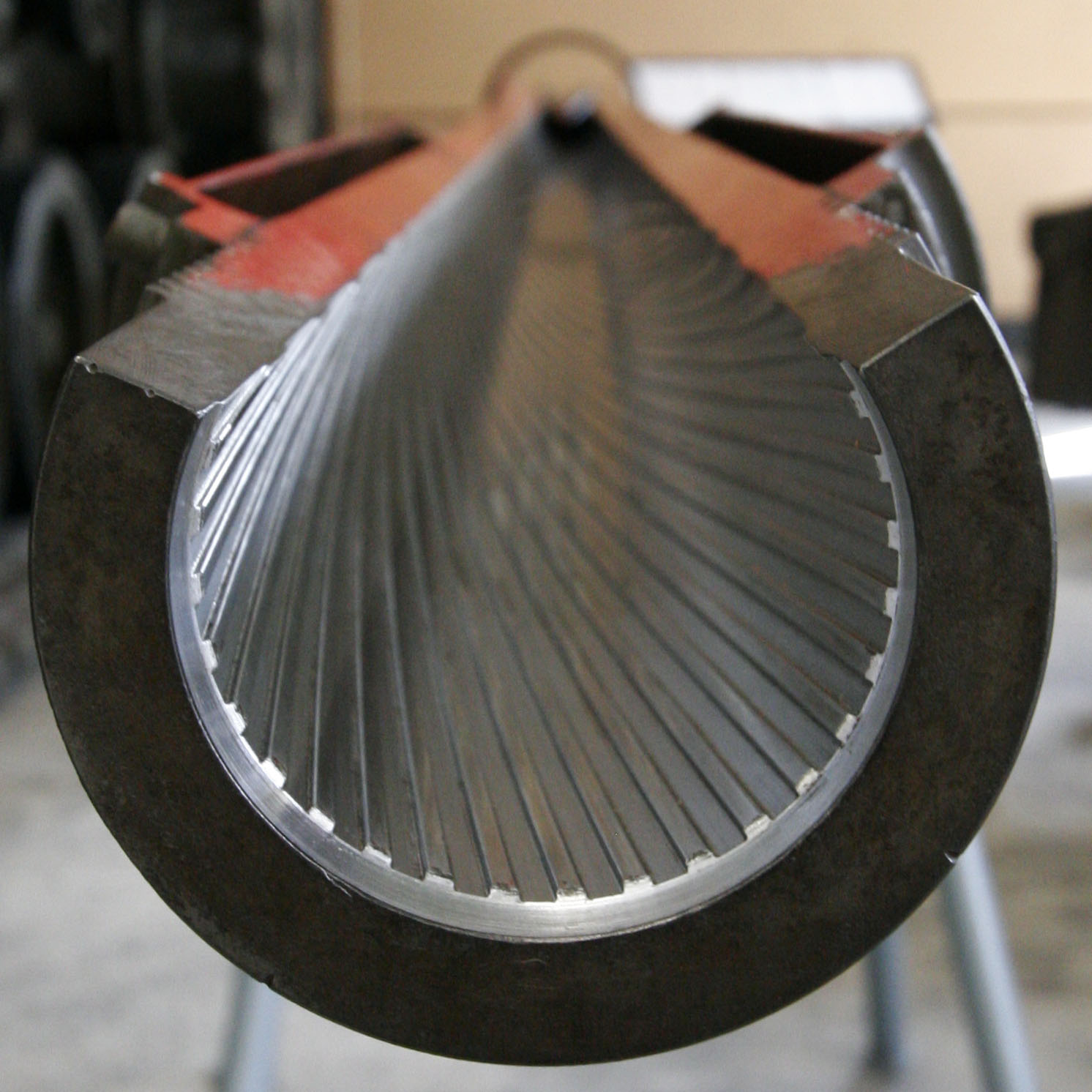
Rifling is the term for helical grooves machined into the internal surface of a firearms's barrel for imparting a spin to a projectile to improve its aerodynamic stability and accuracy. It is also the term (as a verb) for creating such grooves. The opposite of rifling is smoothbore.
Rifling is measured in twist rate, the distance the rifling takes to complete one full revolution, expressed as a ratio with 1 as its base (e.g., 1:10 inches (25.4 cm)). A shorter distance/lower ratio indicates a faster twist, generating a higher spin rate (and greater projectile stability).
The combination of length, weight, and shape of a projectile determines the twist rate needed to gyroscopically stabilize it: barrels intended for short, large-diameter projectiles such as spherical lead balls require a very low twist rate, such as 1 turn in 48 inches (122 cm). Barrels intended for long, small-diameter projectiles, such as the ultra-low-drag 80-grain 0.223 inch bullets (5.2 g, 5.56 mm), use twist rates of 1 turn in 8 inches (20 cm) or faster.
Rifling which increases the twist rate from breech to muzzle is called a gain or progressive twist; a rate which decreases down the length of a barrel is undesirable because it cannot reliably stabilize the projectile as it travels down the bore.
An extremely long projectile, such as a flechette, requires impractically high twist rates to stabilize; it is often stabilized aerodynamically instead. An aerodynamically stabilized projectile can be fired from a smoothbore barrel without a reduction in accuracy.
Muskets are smoothbore, large caliber weapons using ball-shaped ammunition fired at relatively low velocity. Due to the high cost, great difficulty of precision manufacturing, and the need to load readily and speedily from the muzzle, musket balls were generally a loose fit in the barrels. Consequently, on firing the balls would often bounce off the sides of the barrel when fired and the final destination after leaving the muzzle was less predictable. This was countered when accuracy was more important, for example when hunting, by using a tighter-fitting combination of a closer-to-bore-sized ball and a patch. The accuracy was improved, but still not reliable for precision shooting over long distances.
Like the invention of gunpowder itself, the inventor of barrel rifling is not yet definitely known. Straight grooving had been applied to small arms since at least 1480, originally intended as "soot grooves" to collect gunpowder residue.
Some of the earliest recorded European attempts of spiral-grooved musket barrels were of Gaspard Kollner, a gunsmith of Vienna in 1498 and Augustus Kotter of Nuremberg in 1520. Some scholars allege that Kollner's works at the end of the 15th century only used straight grooves, and it was not until he received help from Kotter that a working spiral-grooved firearm was made. There may have been attempts even earlier than this, as the main inspiration of rifled firearms came from archers and crossbowmen who realized that their projectiles flew far faster and more accurately when they imparted rotation through twisted fletchings.
Rifling
Rifling is the term for helical grooves machined into the internal surface of a firearms's barrel for imparting a spin to a projectile to improve its aerodynamic stability and accuracy. It is also the term (as a verb) for creating such grooves. The opposite of rifling is smoothbore.
Rifling is measured in twist rate, the distance the rifling takes to complete one full revolution, expressed as a ratio with 1 as its base (e.g., 1:10 inches (25.4 cm)). A shorter distance/lower ratio indicates a faster twist, generating a higher spin rate (and greater projectile stability).
The combination of length, weight, and shape of a projectile determines the twist rate needed to gyroscopically stabilize it: barrels intended for short, large-diameter projectiles such as spherical lead balls require a very low twist rate, such as 1 turn in 48 inches (122 cm). Barrels intended for long, small-diameter projectiles, such as the ultra-low-drag 80-grain 0.223 inch bullets (5.2 g, 5.56 mm), use twist rates of 1 turn in 8 inches (20 cm) or faster.
Rifling which increases the twist rate from breech to muzzle is called a gain or progressive twist; a rate which decreases down the length of a barrel is undesirable because it cannot reliably stabilize the projectile as it travels down the bore.
An extremely long projectile, such as a flechette, requires impractically high twist rates to stabilize; it is often stabilized aerodynamically instead. An aerodynamically stabilized projectile can be fired from a smoothbore barrel without a reduction in accuracy.
Muskets are smoothbore, large caliber weapons using ball-shaped ammunition fired at relatively low velocity. Due to the high cost, great difficulty of precision manufacturing, and the need to load readily and speedily from the muzzle, musket balls were generally a loose fit in the barrels. Consequently, on firing the balls would often bounce off the sides of the barrel when fired and the final destination after leaving the muzzle was less predictable. This was countered when accuracy was more important, for example when hunting, by using a tighter-fitting combination of a closer-to-bore-sized ball and a patch. The accuracy was improved, but still not reliable for precision shooting over long distances.
Like the invention of gunpowder itself, the inventor of barrel rifling is not yet definitely known. Straight grooving had been applied to small arms since at least 1480, originally intended as "soot grooves" to collect gunpowder residue.
Some of the earliest recorded European attempts of spiral-grooved musket barrels were of Gaspard Kollner, a gunsmith of Vienna in 1498 and Augustus Kotter of Nuremberg in 1520. Some scholars allege that Kollner's works at the end of the 15th century only used straight grooves, and it was not until he received help from Kotter that a working spiral-grooved firearm was made. There may have been attempts even earlier than this, as the main inspiration of rifled firearms came from archers and crossbowmen who realized that their projectiles flew far faster and more accurately when they imparted rotation through twisted fletchings.
Recent media
Recent media