


Community hub
Recent from talks
Contribute something
Nothing was collected or created yet.
Flechette
View on Wikipedia
A flechette or fléchette (/fleɪˈʃɛt/ fle-SHET) is a pointed, fin-stabilized steel projectile. The name comes from French fléchette (from flèche), meaning "little arrow" or "dart". They have been used as ballistic weapons since World War I. Delivery systems and methods of launching flechettes vary, from a single shot to thousands in a single explosive round. The use of flechettes as antipersonnel weapons has been controversial; however, in war, it is not prohibited by the Hague Convention.[1]
Air-dropped
[edit]The weapons were designed to be dropped from an aircraft. They contained no explosive charge but as they fell they developed significant kinetic energy making them lethal and able to easily penetrate soft cover such as jungle canopy, several inches of sand or light armor.[2][3]

During World War I, flechettes were dropped from aircraft to attack infantry and were able to pierce helmets.[4][5]
Also during World War II, a version of the flechette with feathers was dropped, and now resides in the Imperial War Museum.[6]

Later the U.S. used Lazy Dog bombs, which are small, unguided kinetic projectiles typically about 1.75 in (44 mm) in length, 0.5 in (13 mm) in diameter, and weighing about 0.7 oz (20 g).[7] Lazy Dog munitions were simple and cheap; they could be dropped in huge numbers in a pass.[3] Though their effects were often no less indiscriminate than other projectiles,[citation needed] they did not leave unexploded ordnance (UXO) that could be active years after a conflict ended. Lazy Dog projectiles were used primarily during the Korean and Vietnam Wars.[citation needed]
Small-arms ammunition
[edit]


The excellent ballistic performance and armor-piercing potential of flechettes have made the development and integration of this class of munition attractive to small-arms manufacturers. A number of attempts have been made to field flechette-firing small arms.[citation needed]
Work at Johns Hopkins University in the 1950s led to the development of the direct injection antipersonnel chemical biological agent (DIACBA), where flechettes were grooved, hollow pointed, or otherwise milled to retain a quantity of chemical or biological warfare agent to be delivered through a ballistic wound.[8] The initial work was with the nerve agent VX, which had to be thickened to deliver a reliable dose. Eventually this was replaced by a highly toxic carbamate insecticide. The US Biological Program also had a microflechette to deliver either botulinum toxin A or saxitoxin, the M1 biodart, which resembled a 7.62 mm rifle cartridge. The USSR had the AO-27 rifle as well as the APS amphibious rifle, and other countries have their own flechette rounds.[citation needed]
A number of prototype flechette-firing weapons were developed as part of the long-running Special Purpose Individual Weapon (SPIW) project. The Steyr-Mannlicher ACR rifle was a prototype flechette-firing assault rifle built for the US Army's Advanced Combat Rifle program of 1989–90.[citation needed]
A variation of the flechette addressing its difficulties is the SCMITR, developed as part of the Close Assault Weapon System, or CAWS, project. Selective-fire shotguns were used to fire flechettes designed to retain the exterior ballistics and penetration of standard flechettes, but increase wounding capacity through a wider wound path.[citation needed]
Shotguns
[edit]During the Vietnam War the United States employed 12-gauge combat shotguns using flechette loads.[9][10] These plastic-cased shells were issued on a limited trial basis during the Vietnam War. Cartridges manufactured by the Western Cartridge Company contained 20 flechettes, each 18.5 mm (0.73 in) long and weighing 7.3 gr (0.47 g); Federal Cartridge Company rounds contained 25. The flechettes were packed in a plastic cup with granulated white polyethylene to maintain alignment with the bore axis, and supported by a metal disk to prevent penetration of the over-powder wad during acceleration down the bore. The tips of the flechettes were exposed in the Federal cartridges, but concealed by a conventional star crimp in WCC's cartridges.[11] The flechettes demonstrated flatter trajectories over longer ranges than spherical buckshot, but combat effectiveness did not justify continued production.[12]
Rocket and artillery use
[edit]Smaller flechettes were used in special artillery shells called "beehive" rounds (so named after the very distinctive whistling buzz made by thousands of flechettes flying downrange at supersonic speeds) and intended for use against troops in the open – a ballistic shell packed with flechettes was fired and set off by a mechanical time fuse, scattering flechettes in an expanding cone.[citation needed]
During the Vietnam War 105 mm howitzer batteries and tanks (90 mm guns) used flechette rounds to defend themselves against massed infantry attacks. The ubiquitous 105 mm M40 recoilless rifle was primarily used as an anti-tank weapon. However, it could also be used in an anti-personnel role with the use of flechette rounds. The widely used Carl Gustaf 8.4 cm recoilless rifle also uses an Area Defence Munition designed as a close-range anti-personnel round. It fires 1,100 flechettes over a wide area.[13] The US Air Force used 2.75 in (70 mm) rockets with WDU-4/A flechette warheads.[citation needed]
The 70 mm Hydra 70 rocket currently in service with the US Armed forces can be fitted with an anti-personnel (APERS) warhead containing 1,179 flechettes.[14] They are carried by attack helicopters such as the AH-64 Apache and the AH-1 Cobra.[citation needed]
Israel-Palestine conflict
[edit]Israeli authorities have reportedly used flechettes in Gaza since at least 2001.[15][16] That year, Israeli officials stated that "The Israeli military obtained these weapons from the USA after the 1973 war and we have thousands of old shells in warehouses."[17] B'Tselem documented nine Palestinians including four children who were killed by the IDF using flechettes between 2001 and 2003.[18]
Russo-Ukrainian war
[edit].jpg)
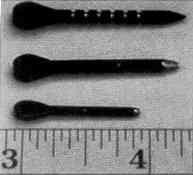
Flechettes have been used during the Russian invasion of Ukraine, where samples of the projectiles were recovered in the mass graves in Bucha, Ukraine.[19] A witness described munitions bursting overhead and littering the area with 3 cm flechettes. A British munitions expert reviewed photographs of the flechettes and concluded that they likely came from a 3Ш1 (flèchette) 122 mm artillery round. A speaker for the Ukrainian Ground Forces stated that Ukraine's military does not use shells with flechettes.[20]
See also
[edit]References
[edit]- ^ "Declaration (IV,3) concerning Expanding Bullets. The Hague, 29 July 1899" (PDF). ihl-databases.icrc.org/en/. 15 April 2025.
- ^ Eades & Powers 1964, passim.
- ^ a b Pursglove 1962.
- ^ "Dropping Darts From An Aeroplane". 12 September 2014. Retrieved 29 May 2015.
- ^ "WWI Flechettes – The troop piercing arrows dropped from planes onto German trenches". 3 March 2018.
- ^ "feathered flechette". Imperial War Museums. Retrieved 2025-02-18.
- ^ Karmes 2014, p. [page needed].
- ^ Bulletin of the Atomic Scientists May 1975 Vol. 31, No. 5 – 48 pages, "... using deliberately contaminated shrapnel or multiple-flechette – 'beehive' – munitions, as in the now defunct DIACBA development program of the US Army ..."
- ^ Margiotta, Franklin D. (1996). Brassey's Encyclopedia of Land Forces and Warfare. Brassey's. ISBN 1-57488-087-X.
- ^ Barnaby, Frank; Huisken, Ronald, eds. (1975). Arms Uncontrolled (2nd ed.). Harvard University Press for Stockholm International Peace Research Institute. p. 109. ISBN 0-674-04655-2.
- ^ Di Maio, Vincent J.M. (1999). Gunshot Wounds (Second ed.). Boca Raton, Florida: CRC Press. p. 320. ISBN 0-8493-8163-0.
- ^ Canfield, Bruce N. "Vietnam-Era Military Shotshells" American Rifleman July 2015 p. 44
- ^ "Peace group slams sale of Swedish 'meat grinder' ammunition". www.thelocal.se. 6 March 2011.
- ^ "Hydra-70 Rocket System - Army Technology". Army Technology. Retrieved 2018-07-03.
- ^ "Dart bombs 'killed four Palestinians'". BBC. Retrieved 12 January 2024.
- ^ "Israel using flechette shells in Gaza". The Guardian. Retrieved 12 January 2024.
- ^ Rodan, Steve (22 May 2001). "Israel's military debates use of flechette round". Jane's Defence Weekly. UK: Janes Information Services.
- ^ "Flechette Shells: an illegal weapon". www.btselem.org. 2011. Archived from the original on 2012-06-09. Retrieved 2025-08-07.
- ^ "Dozens of Bucha civilians were killed by metal darts from Russian artillery". The Guardian. Retrieved 24 April 2022.
- ^ "Lethal darts were fired into a Ukrainian neighborhood by the thousands". Washington Post. Archived from the original on 18 April 2022. Retrieved 18 April 2022.
Bibliography
[edit]- Eades, J. B.; Powers, C. (1964). Static and Dynamic Stability Studies on Several Lazy Dog Configurations. Naval Ordnance Laboratory. DTIC AD0352807. Retrieved 27 November 2022.
- Karmes, David (2014), The Patricia Lynn Project: Vietnam War, the Early Years of Air Intelligence, iUniverse, ISBN 978-1-4917-5227-2
- Pursglove, S. David (February 1962). "Bizarre Weapons for the Little Wars". Popular Mechanics. 117 (2). Hearst Magazines: 107–112. ISSN 0032-4558. Retrieved 17 May 2018.
External links
[edit]
- "How flechettes work"—The Guardian newspaper
- Missiles and Flechettes Archived 2013-07-30 at the Wayback Machine—Pictures of air dropped flechettes, from World War I through the 1970s at big-ordnance.com
- [US7823509B2 - https://patents.google.com/patent/US7823509B2/en Flechette cartridge]
Flechette
View on GrokipediaA flechette is a fin-stabilized steel projectile shaped like a small dart or arrow, designed for aerodynamic stability and penetration in military applications.[1] Unlike spin-stabilized rifle bullets, flechettes rely on vanes or fins for flight control, enabling their use in clustered dispersions from firearms, artillery, or aerial delivery.[1] First employed in World War I as aerial darts dropped from low-flying aircraft to target exposed infantry, flechettes inflicted wounds through high-velocity impacts and tumbling effects upon striking tissue.[2] Their slender form allowed for dense payloads, with thousands dispensed per attack to saturate areas and maximize casualties against unarmored personnel.[2] Subsequent developments integrated flechettes into shotgun shells, rifle sabot rounds, and rocket warheads, such as the 2.75-inch Hydra 70 variants that release up to 2,200 projectiles over an 80-meter by 80-meter zone for suppressive fire. Experimental systems like the Steyr-Mannlicher ACR rifle fired flechette-loaded cartridges to achieve high velocity and reduced ricochet in close-quarters combat.[3] While effective against soft targets due to yaw-induced tissue damage, flechettes' rigidity can limit deformation compared to expanding bullets, influencing their tactical deployment in cluster munitions and anti-personnel ordnance.[1]
Definition and Physical Principles
Design Characteristics
Flechettes are small, dart-like projectiles characterized by a pointed nose for penetration, a slender cylindrical or tapered body, and rear-mounted stabilizing fins to ensure aerodynamic stability during flight. These fins, typically four in number and arranged symmetrically, promote either fin-stabilization or induced spin to minimize tumbling in air and maintain trajectory accuracy, particularly in dispersed munitions. The overall shape mimics an arrow or arrowhead, optimizing for high-velocity projection while minimizing drag.[1][4] Construction materials emphasize durability and density for effective impact; most designs employ hardened steel for the body and fins due to its balance of strength, cost, and ability to be mass-produced. Alternative materials such as tungsten alloys or depleted uranium have been incorporated in the tips or full body for superior armor-piercing performance and kinetic energy retention. Dimensions vary by era and application: World War I aerial variants measured roughly 4 inches (102 mm) in length with a streamlined profile for gravity-drop deployment, whereas small-arms flechettes from mid-20th-century tests were approximately 1 inch (25 mm) long and 0.04 inches (1 mm) in diameter, comparable to large pencil lead.[2][5][6] Advanced designs incorporate a forward-weighted center of gravity to enhance stability post-launch, often with a hollow or quill-like rear section for stacking efficiency in cartridges or warheads. This configuration allows flechettes to yaw or fragment upon target impact, increasing tissue damage beyond simple penetration, though the primary design intent focuses on dispersion lethality over single-point precision. Sabots or plastic carriers are frequently used in rifled barrels to align and accelerate the lightweight darts without excessive spin-induced instability.[4][7][1]Aerodynamic and Material Properties
Flechettes are primarily constructed from hardened steel, which provides high tensile strength, durability under high-velocity impact, and effective penetration capabilities while keeping overall mass low, typically in the range of 6 to 180 grains depending on the variant.[7] [1] Some advanced designs incorporate bimetallic compositions, utilizing dense materials such as tungsten, lead, or depleted uranium for the forward tip to enhance kinetic energy retention, paired with lighter tail sections made from aluminum, magnesium, or polymers like nylon to shift the center of gravity forward relative to the center of pressure.[5] Aerodynamically, flechettes employ a fin-stabilized configuration with a streamlined pointed or conical nose, elongated cylindrical body, and rear-mounted fins or cruciform tail surfaces to minimize drag and ensure directional stability during supersonic flight.[5] [7] The fins, often with a span of 2 to 3 calibers (e.g., 5.33 mm for a 1.78 mm body diameter), generate stabilizing lift forces, while the nose design—ranging from sharp 5° cones to blunter profiles—directly influences drag coefficients, which vary from approximately 0.3 for low-drag spike-nosed variants to 1.86 for 90° blunt cones at Mach numbers between 2 and 4.[7] This forward-biased mass distribution, combined with rear fin placement, positions the center of aerodynamic pressure aft of the center of mass, promoting yaw resistance and straight trajectories without spin stabilization.[5] Static stability margins, quantified by the moment slope coefficient (CMα), remain positive up to Mach 4 but diminish at higher velocities, potentially leading to instability around Mach 5.5–6 due to compressibility effects.[7] In subsonic to supersonic regimes, typical steel flechettes exhibit moderate air resistance, with velocity decay of about 375 feet per second over 100 yards, attributable to their high length-to-diameter ratios and fin-induced drag.[1] Common dimensions for tested military flechettes include a body diameter of 1.78 mm, total length of approximately 28 mm, and fin configurations optimized for low retardation in cluster or sabot-launched applications.[7] These properties enable high terminal velocities and flat trajectories, though yaw tendencies can emerge in non-optimal launches, as observed in free-flight experiments.[7]Mechanisms of Lethality
Flechettes inflict injury primarily through high-velocity penetration, creating narrow but deep laceration channels in soft tissue that sever blood vessels, nerves, and organs, leading to rapid hemorrhage and physiological shock. Their pointed nose and rear fins enable straight-line flight stability, but upon impact with tissue, the asymmetric mass distribution and length-to-diameter ratio (often exceeding 20:1) can induce yaw or tumbling, which expands the wound track beyond the projectile's 1-2 mm diameter, disrupting a volume of tissue comparable to larger caliber bullets in some tests.[8][9] This tumbling effect, observed in animal and gelatin models for flechettes like those in the SPIW system (1.7-grain steel darts at ~1200 m/s muzzle velocity), generates temporary cavitation and permanent crush cavities, amplifying lethality by accelerating incapacitation through blood loss or neural disruption rather than explosive hydrostatic shock, which is limited by their low mass (typically 0.1-0.5 grams per dart).[8][9] In cluster munitions or multi-projectile rounds, lethality arises from probabilistic multiple hits across exposed areas, with empirical data from U.S. Army tests indicating that 3-5 flechette penetrations to the torso can achieve incapacitation probabilities exceeding 50% within 5-10 seconds via cumulative vascular damage, outperforming single large projectiles in dense foliage environments where straight penetration defeats cover without deflection.[8] Unlike expanding bullets, flechettes rarely fragment due to their hardened steel construction, preserving over-penetration (often 30-50 cm in ballistic gelatin), which risks reduced energy dump but ensures hits on vital structures like the heart or spine in probabilistic engagements. Wound profiles in soap or gelatin simulations show initial pencil-like channels widening to 5-10 mm during yaw phases, with fin-induced rotation exacerbating shear forces on muscle and bone.[11] Empirical combat data, such as from Vietnam-era "beehive" artillery rounds dispersing thousands of flechettes, confirm mechanisms centered on shredding soft targets at ranges up to 100 meters, where individual dart kinetic energy (200-400 J at impact) suffices for lethal torso hits via arterial severance, though head or extremity strikes often require multiples for fatality. Ballistic studies caution against assuming consistent tumbling, as shoulder-stabilized designs (e.g., some modern variants) maintain stability in tissue, yielding narrower wounds reliant on volume of fire for effectiveness, with incapacitation criteria tied to projected surface area disruption rather than single-projectile energy transfer.[8] Overall, flechette lethality favors anti-personnel saturation over precision stopping power, with risks of underperformance against armored or distant targets due to velocity decay and minimal deformation.[12]Historical Development
World War I Origins
Flechettes emerged as an improvised antipersonnel weapon during the early stages of World War I, with their modern aerial application first employed by French forces in 1914.[13] These steel darts, typically 3 to 5 inches long with a pointed tip, cylindrical body, and stabilizing barbs or fins, were designed to penetrate helmets and inflict penetrating wounds on exposed infantry below.[14] Lacking synchronized machine guns on aircraft initially, pilots released them from low-altitude flights over enemy trenches and troop concentrations, relying on gravity and volume for lethality.[2] The French pioneered mass deployment, dropping flechettes in containers that scattered upon release to cover wide areas.[15] By March 1915, a single French pilot reportedly dispensed 18,000 flechettes over German positions in one day, demonstrating their tactical use against static defenses.[2] This method proved psychologically effective, instilling fear due to the darts' ability to pierce steel helmets and cause jagged wounds upon impact.[13] Britain and Germany quickly adopted similar designs after observing French success, with British pilots using them against German zeppelins and ground targets by 1915.[13] German variants, collected on the Western Front, featured barbed tails for enhanced penetration and tumbling on impact.[14] While effective in early warfare before advanced bombing, flechettes' inaccuracy limited them to opportunistic strikes, transitioning as aircraft armament evolved.[2]Interwar and World War II Applications
During the interwar period, flechette development stagnated, with minimal documented military experimentation or adoption following their extensive use in World War I aerial anti-personnel roles.[16] No major projects or tests by leading powers such as the United States, Britain, France, or Germany advanced flechette technology for new delivery systems, as focus shifted to bombs, machine guns, and other munitions deemed more reliable for ground attack.[16] In World War II, flechettes found niche applications, primarily through the United States' Office of Strategic Services (OSS) for covert operations. The OSS developed silenced spigot launchers attachable to the M1911A1 pistol, firing large, single flechettes via a self-contained piston cartridge to minimize noise while delivering high kinetic lethality at short ranges, intended for assassinations behind enemy lines.[16] Complementary systems included miniature crossbows loaded with flechettes for stealthy, low-velocity projection.[16] These tools reflected a return to flechettes' piercing design for precision kills but remained experimental and limited to special operations, without widespread field deployment.[17] Aerial applications re-emerged modestly with U.S. development of "Lazy Dog" projectiles—steel, fin-stabilized darts approximately 1.75 inches long and 0.5 inches in diameter—designed as unguided kinetic bomblets dropped from aircraft to exploit terminal velocity for anti-personnel penetration without explosives.[16] Development began during the war, with prototypes tested for cluster dispersal via adaptors like the Mk 44, though operational use was not extensive, overshadowed by conventional bombing campaigns.[16] [17] Axis powers showed no significant flechette innovations, and overall, the weapons' inaccuracy against dispersed or hardened targets limited their tactical impact compared to fragmentation bombs or strafing.[17]Cold War and Post-Vietnam Advancements
During the Cold War, the United States Army's Special Purpose Individual Weapon (SPIW) program, launched in 1962, explored flechette-firing rifles to enhance infantry hit probability through high-velocity, fin-stabilized darts dispersed in bursts.[18] Prototypes from contractors like AAI Corporation featured caseless ammunition propelling lightweight flechettes at speeds exceeding 1,200 m/s, with designs incorporating 60-round magazines and integrated grenade launchers, though early trials revealed reliability issues with the liquid propellant and flechette dispersion.[19] The program persisted into the early 1970s, testing second-generation variants that improved flechette accuracy but ultimately failed to meet durability and logistical requirements, leading to cancellation around 1972.[20] Post-Vietnam, interest in flechette small arms revived during the Advanced Combat Rifle (ACR) program initiated in 1984 to succeed the M16.[21] Steyr-Mannlicher's ACR prototype, evaluated in 1989-1990 trials, fired 5.56x45mm synthetic-case flechette (SCF) rounds consisting of a 9.85-grain tungsten dart encased in a four-piece polymer sabot, achieving muzzle velocities of approximately 1,400 m/s from a smoothbore barrel with minimal rifling twist.[22] The design emphasized reduced recoil, higher ammunition capacity via lightweight projectiles—allowing up to three times more rounds per weight—and improved penetration against soft targets, but concerns over barrier performance and manufacturing complexity contributed to the program's termination in 1990 without adoption.[23] Concurrent Cold War efforts included Soviet developments, such as the APS underwater assault rifle introduced in the 1970s, which utilized 5.66x39mm flechette cartridges optimized for both aquatic and terrestrial environments, with steel darts featuring barbed tips for enhanced wounding. These advancements reflected broader pursuits of hypervelocity projectiles for individual weapons, prioritizing volume of fire and terminal ballistics over traditional bullet designs, though practical fielding remained limited due to technological hurdles.[24]Delivery Systems and Technical Implementations
Air-Dropped and Cluster Munitions
Air-dropped flechettes originated during World War I as simple steel darts released from aircraft to target infantry positions.[2] These unguided projectiles, typically dropped in bundles, relied on gravitational acceleration to achieve penetrating velocity, capable of piercing helmets and causing severe wounds upon impact.[13] Their use marked an early adaptation of aerial platforms for antipersonnel ordnance, dispersing over wide areas to maximize psychological and physical effects on exposed troops.[24] The concept evolved into the "Lazy Dog" munitions during World War II, consisting of small, fin-stabilized steel projectiles—often teardrop-shaped and about 1-2 inches long—designed for kinetic energy lethality without explosives.[25] These were deployed by U.S. forces in the Korean War and extensively in Vietnam, released from low-flying aircraft or containers to attain terminal velocities of approximately 700 feet per second (210 m/s), enabling penetration of soft cover and personnel.[26] Unlike fused bombs, Lazy Dogs required no detonation mechanism, simplifying production and reducing dud rates while emphasizing area denial against unarmored targets.[27] Cluster munitions incorporating flechettes, such as the U.S. Mk 44 bomb used in Vietnam, functioned as aerial dispensers that opened mid-flight to scatter thousands of projectiles—up to 10,000 per unit—over designated zones.[27] This delivery method enhanced coverage compared to free-fall drops, with the bomblet's dispersal pattern optimized for antipersonnel effects in troop concentrations or jungle environments.[16] Post-Vietnam developments integrated flechettes into modern cluster systems like rocket pods, though air-dropped variants persisted in inventories for their low-cost, high-volume suppression capabilities.[28] Empirical assessments from conflicts indicate effectiveness against dismounted infantry but limited utility against hardened or mobile forces due to predictable trajectories and vulnerability to cover.[25]Small-Arms Ammunition Including Shotguns
Flechettes have been adapted for small-arms use primarily in experimental rifle programs and limited shotgun applications, seeking advantages in penetration, velocity retention, and multi-projectile dispersion over conventional bullets or shot. These implementations typically involve saboted or bundled steel darts fired from modified firearms, with designs prioritizing aerodynamic stability for extended range or specialized environments like underwater operations.[22][29] In shotguns, 12-gauge flechette loads emerged during the Vietnam War, where U.S. forces utilized plastic-cased shells containing multiple 25 mm steel flechettes salvaged or designed for anti-personnel roles.[30] These rounds aimed to extend the shotgun's effective range against elevated targets, such as snipers in dense foliage, by reducing drag compared to spherical shot. However, empirical testing showed they underperformed in terminal effects, with darts tumbling post-impact and failing to match the wound channels of buckshot, resulting in restricted issuance and eventual phase-out.[31] Commercial variants persist for civilian use, offering armor penetration superior to birdshot but inferior to rifle cartridges in overall lethality.[31] Rifle-based systems represent more ambitious integrations, exemplified by the Steyr ACR prototype developed for the U.S. Army's 1980s Advanced Combat Rifle trials. This bullpup fired 5.56 mm saboted carbon steel flechettes—each weighing 9.85 grains—encased in translucent telescoped plastic rounds with propellant molded around the projectile for compact storage and rapid ejection.[22] The design achieved a cyclic rate exceeding 700 rounds per minute from 24-round magazines, dispersing multiple darts per burst to boost hit probability at 300 meters, though barrel wear and environmental sensitivity limited reliability.[22] The program concluded without adoption in 1990, citing insufficient advantages over existing 5.56 mm service rounds.[22] Specialized underwater firearms further demonstrate flechette principles in small arms. The Soviet APS assault rifle, adopted by the Russian Navy in 1975, employs smoothbore barrels to launch 5.66 mm steel darts (120 mm long, fin-stabilized) from 26-round magazines, optimized for hydrodynamic stability rather than air ballistics.[29] Effective underwater range reaches 30 meters at 5 meters depth, dropping sharply in air to 50-100 meters due to yaw instability, with the darts' needle-like form minimizing cavitation drag.[29][32] Similar concepts appeared in the experimental U.S. Close Assault Weapon System (CAWS), a 12-gauge automatic shotgun firing stacked flechettes in saboted loads for enhanced penetration against body armor.[33] Despite these innovations, flechette small-arms ammunition has seen no widespread operational success, constrained by manufacturing complexity, inconsistent wounding, and competition from improved conventional projectiles.[31][22]Artillery, Rocket, and Large-Caliber Projectile Uses
Flechettes were employed in United States artillery during the Vietnam War through the M546 105 mm anti-personnel tracer (APERS-T) projectile, commonly known as the Beehive round, which dispersed approximately 8,000 fin-stabilized steel flechettes upon activation of a mechanical time fuze.[34] This round was designed for direct fire against infantry at short to medium ranges, providing a shotgun-like effect over a wide area.[35] Similar flechette-loaded munitions were adapted for large-caliber systems, including the 106 mm M40 recoilless rifle's antipersonnel-tracer round, which released flechettes in a conical dispersion pattern for close-range suppression of enemy personnel.[36] In rocket applications, flechettes featured prominently in the 2.75-inch (70 mm) family of unguided rockets, such as the M255 and M255A1 warheads, which ejected between 585 heavier 120-grain flechettes or up to 1,200 lighter 60-grain variants at motor burnout to engage soft targets and light armor through kinetic impact.[37] These warheads, integrated into systems like the Hydra 70, were primarily launched from helicopters for antipersonnel roles, dispersing the projectiles without explosive filler to maximize area coverage.[38] The design emphasized high-velocity penetration and tumbling upon impact for enhanced wounding effects against exposed troops.[39] More recently, Russian forces have utilized flechette-filled artillery shells in the 2022 invasion of Ukraine, with documented instances in Sumy Oblast on May 30, 2022, where border areas were targeted with rounds dispersing thousands of metal darts.[40] In Bucha, April 2022 attacks involved artillery munitions that embedded flechettes in civilian bodies and structures, confirmed by independent weapons experts as small, arrow-like projectiles from Russian ordnance.[41] These applications highlight the continued tactical role of flechettes in modern artillery for saturating areas with lethal, fin-stabilized darts, though their use has drawn scrutiny for indiscriminate effects.[42]Combat Applications and Empirical Effectiveness
Performance in Conventional Warfare
In World War I, flechettes dropped from low-flying aircraft demonstrated limited physical effectiveness against infantry due to erratic descent patterns and air resistance, often failing to inflict widespread casualties despite penetrating steel helmets upon direct hits. Their deployment, such as a French pilot releasing 18,000 flechettes over German trenches on March 1915, prioritized psychological terror over decisive lethality, as the silent, arrow-like projectiles evoked dread but were soon supplanted by more reliable bombing tactics after 1915.[2][43][44] During the Vietnam War, flechette-equipped "beehive" rounds in 105 mm howitzers and 90 mm tank guns excelled in static defense against massed North Vietnamese Army assaults, dispersing up to 8,000 steel darts per shell over a 50-meter radius to shred advancing infantry formations effectively. Similarly, AH-1 Cobra helicopters employed 2.75-inch rockets packed with thousands of flechettes for close air support, providing suppressive fire that halted human-wave attacks on firebases. Shotgun flechette loads extended lethal ranges to 100 yards, registering multiple one-shot stops in field tests, underscoring their utility in dense jungle engagements.[16][45][46] Military evaluations of flechette projectiles highlight their hydrodynamic stability in flight, minimizing velocity loss to approximately 375 feet per second per 100 meters, which sustains kinetic energy for soft-tissue penetration and tumbling-induced wound cavities comparable to larger calibers upon impact. However, in conventional settings, their performance hinges on delivery systems; air-dropped variants suffer accuracy degradation, while artillery dispersions optimize area-denial against unarmored troops but falter against dispersed or fortified foes. Renewed U.S. Army interest post-Vietnam focused on antipersonnel modeling, confirming high lethality metrics yet noting challenges in scaling for rifle-caliber adoption beyond experimental systems like the SPIW.[1][47]Use in Asymmetric Conflicts
Flechette munitions have seen deployment in asymmetric conflicts, particularly where state militaries confront non-state actors employing guerrilla tactics, urban concealment, and human shields, leveraging the projectiles' ability to penetrate light cover and achieve wide-area suppression against dispersed personnel targets. The Israel Defense Forces (IDF) employed 120mm flechette tank shells, dispersing up to 5,000 darts each over a 300 by 100 meter kill zone, during operations in the Gaza Strip against Hamas militants from the early 2000s onward, including in the 2008-2009 Gaza War, to counter fighters hiding in dense vegetation or built-up areas.[48] Similar applications occurred in southern Lebanon against Hezbollah during the 2006 Lebanon War, where the shells' kinetic energy rods were intended to neutralize infantry threats without relying on explosive fragmentation.[49] Despite their tactical rationale for engaging elusive insurgents, flechette shells' broad dispersion pattern has frequently resulted in civilian injuries and fatalities when fired in populated zones, as documented in Gaza incidents where darts embedded in non-combatants, including a 2003 case killing two women and injuring others in a residential area.[50] Amnesty International reported their periodic use against Gaza civilians over several years prior to 2009, often yielding indiscriminate effects due to the inability to precisely target militants amid civilian density.[51] In response to such outcomes and legal challenges, including a 2002 Israeli Supreme Court petition questioning their proportionality, the IDF phased out flechette tank shells by 2010, citing excessive collateral risks in congested environments typical of asymmetric urban warfare.[52][48] Russian forces incorporated flechettes into artillery shells during the 2022 invasion of Ukraine, firing thousands in areas like Bucha and Irpin, where the darts struck civilians and embedded in structures, exacerbating casualties in hybrid warfare scenarios involving urban resistance and irregular defenses against a superior conventional adversary.[42] Forensic examinations confirmed flechettes in mass grave victims from Bucha strikes on April 2022, highlighting their rare modern use for area saturation against personnel in contested settlements.[41] While effective for short-range denial against infantry clusters, their employment in these contexts underscores challenges in distinguishing combatants from non-combatants, contributing to debates over tactical necessity versus humanitarian costs in protracted, low-intensity engagements.[53]Quantitative Assessments and Comparative Analysis
Flechettes demonstrate superior aerodynamic stability compared to spherical or blunt projectiles, with ballistic coefficients potentially exceeding 1.0 G1 form factor, enabling minimal velocity decay—approximately 375 feet per second over typical engagement distances—and flatter trajectories for extended effective ranges.[1][54] In advanced small-arms applications, such as the Steyr ACR prototype, 9.85-grain flechettes achieved muzzle velocities of 4,600 feet per second, outperforming standard 5.56mm NATO ball ammunition in penetration depth and armor defeat against light barriers due to high sectional density.[23] Terminal ballistic performance, however, reveals limitations in soft-tissue incapacitation; flechettes often produce narrow "ice pick" wound channels by passing through targets with delayed or insufficient yawing, particularly if exceeding 13 grains in mass, resulting in lower energy transfer than expanding bullets or fragments.[1][55] Military wound ballistics models estimate conditional incapacitation probabilities (P_k) for single random hits at 50-80% across velocities of 1,000-3,000 feet per second, contingent on vital organ intersection, but consistently lower than chunky fragments for peripheral strikes due to reduced cavitation.[55][9] Comparatively, flechettes surpass equal-mass ball ammunition in penetration—enabling multi-layer barrier traversal—but underperform in unarmored lethality, where over-penetration minimizes hydrostatic shock and fragmenting effects observed in jacketed hollow points.[56] In Vietnam War shotgun evaluations, flechette loads yielded one-shot stops up to 100 yards with high hit probabilities in dense foliage, yet veterans reported inferior close-range decisiveness versus 00 buckshot, attributing this to narrower individual impact wounds despite greater pellet count and halved load weight for increased carry capacity.[46][16][57] For area-denial munitions like artillery beehive rounds, quantitative tests indicate constrained dispersion—spreads under 1.5 meters at 150 meters—limiting coverage against maneuvering infantry compared to high-explosive fragmentation, though individual flechette velocities ensure deep tissue penetration exceeding 12 inches in gelatin simulants.[58]| Metric | Flechette Advantage | Comparative Limitation vs. Ball/Fragment |
|---|---|---|
| Velocity Retention | Low drag; ~375 fps loss | Higher decay in blunt projectiles |
| Penetration Depth | Superior vs. light armor/soft tissue | Over-penetration reduces stopping power |
| Incapacitation (P_k) | 50-80% on vital hits | Lower for non-vital; narrow channels |
| Ammunition Weight | ~50% less than buckshot equivalent | N/A |
| Effective Range (Shotgun) | Up to 100 yards lethality | Buckshot dominant <30 yards |
Controversies, Criticisms, and Defenses
Humanitarian and Medical Impact Claims
Claims that flechette munitions cause disproportionate humanitarian harm center on their area-effect deployment, which disperses thousands of small darts over wide radii, increasing risks to non-combatants in populated zones. In the 2022 Russian invasion of Ukraine, forensic examinations in Bucha revealed flechettes embedded in civilian heads and chests from artillery shells, with pathologists attributing dozens of deaths to these projectiles amid mass graves. Similarly, Russian flechette use in Irpin residential areas drew condemnation for indiscriminate strikes on homes, violating prohibitions on weapons causing excessive civilian casualties under international humanitarian law when used in such contexts. Critics, including human rights groups, argue this dispersion pattern exacerbates collateral damage compared to precision-guided munitions, though empirical data on comparative civilian casualty rates remains limited to conflict-specific reports.[41][59] Medically, flechette wounds typically feature small entry points with minimal external hemorrhage, often delaying diagnosis and treatment due to subtle initial symptoms like cardiac tamponade rather than overt bleeding. A 1971 surgical study of flechette-induced heart injuries noted that the projectiles' narrow profiles produce confined myocardial penetrations, leading to pressure buildup in the pericardium that can cause rapid circulatory collapse without exsanguination. Ukrainian clinical analyses from 2023 reported similar patterns in conflict casualties, with low pain response, insignificant skin disruption, and absent heavy bleeding complicating field triage, as darts may lodge deep without surface indicators. Wound ballistics research indicates multiple flechettes enhance incapacitation through synergistic effects, probabilistically striking vital structures more readily than single projectiles, though individual channels exhibit less cavitation than expanding bullets.[60][61][8] Assertions of superfluous injury or unnecessary suffering invoke Article 35(2) of Additional Protocol I to the Geneva Conventions, prohibiting weapons causing harm beyond military necessity, with flechettes cited for inflicting numerous penetrations that overwhelm medical resources. Proponents of restrictions, such as in petitions against Israeli flechette shells in Gaza (2001–2009), contend the darts' design yields untreatable fragments and prolonged agony from undetected internal damage, contrasting with cleaner bullet wounds. However, legal analyses emphasize that superfluous harm is assessed comparatively against alternatives; flechettes' effects mirror those of fragments or shotgun loads, lacking evidence of inherently greater suffering per empirical ballistic models. No peer-reviewed consensus establishes flechettes as uniquely exacerbating pain or disability beyond incapacitative intent, with military studies prioritizing their efficacy in fragment-like wounding over humanitarian excess claims.[62][17][8]Specific Conflict-Related Debates
In the Gaza Strip, Israeli Defense Forces (IDF) employed flechette artillery shells during military operations, including in 2001, 2003, and 2014, prompting debates over their proportionality and compliance with international humanitarian law in densely populated areas. Human Rights Watch documented instances where these shells, dispersing thousands of steel darts over a wide radius, killed civilians such as four Palestinian women in Khan Yunis on May 18, 2001, arguing the weapons' inherent inaccuracy rendered them indiscriminate against non-combatants.[63] B'Tselem, an Israeli human rights organization, similarly condemned a 2008 incident in Gaza where a flechette shell killed a Reuters cameraman, asserting that the munitions' 300-meter dispersal pattern violated distinction principles amid ongoing hostilities involving militants embedded in civilian zones.[64] IDF spokespersons countered that flechettes targeted personnel in open areas, not structures, and were being phased out for tank variants by 2010 to address ethical concerns over collateral damage, though artillery use persisted in some cases.[49] Critics, including Palestinian groups, highlighted patterns of civilian injuries from dart penetration, while defenders emphasized the weapons' role against human-wave tactics by Hamas fighters.[65] During the 2006 Lebanon War, Israel's use of flechette rounds from tanks and artillery against Hezbollah positions elicited comparable scrutiny, with reports of darts embedding in civilian structures and causing injuries in southern Lebanese villages. The Christian Science Monitor noted their deployment alongside other antipersonnel munitions, fueling arguments from humanitarian observers that the broad kill zone—up to 300 by 100 meters—exacerbated civilian risks in mixed combat environments.[66] Israeli military reviews post-conflict acknowledged tactical efficacy against infantry but led to restrictions on urban firing, reflecting internal debates on balancing lethality with minimizing unintended harm.[48] In the Russia-Ukraine war, Russian artillery shells loaded with flechettes struck Ukrainian civilian areas, including Bucha in March 2022 and Sumy Oblast on May 30, 2022, igniting accusations of war crimes due to the projectiles' penetration of soft cover and high civilian toll. Forensic examinations in Bucha revealed dozens of flechettes in mass grave victims, primarily non-combatants, with The Guardian reporting their rarity in modern conflicts yet effectiveness in causing deep wounds over wide areas.[41] CNN documented impacts in Irpin, where darts riddled homes, arguing under humanitarian law that such use in populated zones contravenes prohibitions on indiscriminate attacks, though Russian forces claimed targeting military assets amid urban fighting.[59] Ukrainian officials and analysts, citing finds in Kharkiv and Donetsk regions, debated the munitions' obsolescence and intent, viewing them as escalatory terror tactics rather than precise countermeasures, with no verified Russian admission of deployment.[40] U.S. employment of "Lazy Dog" flechette bombs during the Vietnam War (1962–1975), which dispersed up to 17,000 unguided steel darts from aircraft at high speeds for kinetic impact, generated retrospective debates on their area-denial effects in jungle terrain versus risks to villagers. These munitions, lacking explosives but achieving terminal velocities over 200 m/s, proved lethal against Viet Cong infantry but drew criticism for uncontrollable scatter patterns, contributing to civilian casualties in contested rural zones, though quantitative assessments of distinct military versus collateral impacts remain limited by wartime documentation gaps.[25] Post-war analyses, including from military historians, weighed their psychological deterrence value against ethical concerns over non-discriminatory dispersal, influencing later U.S. doctrines favoring precision-guided alternatives.[27]Military Utility and Tactical Justifications
Flechettes enhance anti-personnel effectiveness in small-arms ammunition by delivering multiple high-velocity darts that maintain lethality beyond typical shotgun ranges, with 12-gauge loads achieving kills at 100 yards during the Vietnam War.[16] Their fin-stabilized design permits superior aerodynamics, enabling penetration through dense foliage and light barriers like car doors, which proved tactically advantageous in jungle ambushes and tunnel clearance operations.[16] Each dart, often weighing around 8 grains, imparts energy comparable to a 9 mm round while yawing on impact to produce wound channels up to 800% larger than the projectile's diameter, frequently shattering bones and ensuring rapid incapacitation.[16] In artillery and rocket systems, flechettes justify employment through area saturation capabilities, as in U.S. beehive rounds fired from 105 mm howitzers, which dispersed thousands of darts to repel massed infantry charges, providing immediate defensive firepower against human wave tactics without requiring precise aiming.[67] Military evaluations highlighted their high lethality across ranges, with one-shot stops documented to 100 yards in shotgun applications, outweighing drawbacks like potential accuracy dispersion for scenarios demanding volume of fire over single-target precision.[46] Tactically, flechettes address mixed-threat environments by combining penetration against softer cover with multi-hit probability, reducing the need for separate rounds for armored and unarmored targets; this versatility supported adoption in systems from grenade launchers to tank guns during Vietnam, where they neutralized concealed or clustered enemies effectively.[16] Experimental rifles like the Steyr-Mannlicher ACR further pursued these traits at rifle velocities to defeat body armor, underscoring ongoing military interest in their low-mass, high-speed profile for enhanced terminal ballistics in close assault roles.[1]Legal and Ethical Status
International Humanitarian Law Framework
The international humanitarian law (IHL) framework governing flechette weapons derives primarily from customary international law, the 1907 Hague Regulations, the 1949 Geneva Conventions and their 1977 Additional Protocols, and subsequent treaty interpretations, but imposes no categorical prohibition on their use.[68] Flechettes, as fragmenting munitions, fall under scrutiny for compliance with core IHL principles, including the prohibition on weapons causing superfluous injury or unnecessary suffering (Additional Protocol I, Article 35(2)) and the bans on inherently indiscriminate weapons or those employing poison or bacteriological agents (Additional Protocol I, Articles 35(3) and 51(4)).[69] However, legal analyses consistently affirm that flechettes do not violate these provisions per se, as their design—small steel darts intended for area denial or anti-personnel effects—does not inherently expand, poison, or cause injury beyond that expected from comparable fragmenting ordnance like high-explosive shells.[70] Historical precedents, such as the 1868 St. Petersburg Declaration and 1899 Hague Declaration IV,3 prohibiting bullets that expand or flatten easily, do not extend to flechettes, which maintain aerodynamic stability rather than deforming on impact.[68] Efforts to explicitly restrict flechettes emerged in the late 1960s amid U.S. testing during the Vietnam War, but failed to gain traction in treaty negotiations, including those leading to the 1980 Convention on Certain Conventional Weapons (CCW).[68] The CCW's Protocol I bans non-detectable fragments, yet flechettes, being metallic, evade this restriction, while the 2008 Convention on Cluster Munitions prohibits submunitions but exempts dedicated flechette shells as non-cluster delivery systems.[71] Customary IHL, as codified by the International Committee of the Red Cross, similarly treats flechettes as permissible absent specific treaty bans, emphasizing instead contextual application: their deployment must adhere to the principles of distinction (Additional Protocol I, Article 48) and proportionality (Additional Protocol I, Article 51(5)(b)), ensuring attacks differentiate between combatants and civilians while avoiding excessive civilian harm relative to anticipated military advantage. Scholarly reappraisals, such as those following Israel's use of flechette artillery in Gaza operations from 2001–2009, conclude that legality hinges on operational circumstances rather than the weapon type itself, with no evidence of inherent unlawfulness under IHL.[17] Judicial precedents reinforce this framework's permissive stance. In 2002, Israel's Supreme Court rejected a petition by Physicians for Human Rights challenging flechette use in Gaza, holding that such munitions are not prohibited by international law and align with lawful anti-personnel ordnance when employed against legitimate military targets.[52] This ruling aligns with broader interpretations by bodies like the UN Goldstone Commission, which noted in 2009 that while flechettes pose risks of fragmentation and penetration injuries, international law does not explicitly bar them, shifting focus to use-specific violations of distinction or proportionality.[62] Absent explicit treaty prohibition, flechettes thus remain subject to IHL's general rules, with accountability arising from individual applications rather than blanket illegality.[72]National and Judicial Rulings
In Israel, the Supreme Court ruled on April 27, 2003, that the use of flechette shells by the Israel Defense Forces does not violate international law, rejecting a petition by human rights groups claiming indiscriminate effects on civilians.[73] The court determined that flechettes, as non-explosive darts, comply with prohibitions on inherently indiscriminate weapons under the Geneva Conventions, though it emphasized the need for proportionate use in populated areas.[73] This decision upheld prior military policy, with the IDF continuing deployment in operations such as those in Gaza, where flechettes were fired from 105mm artillery.[65] Several U.S. states impose restrictions on civilian possession of flechette ammunition, treating it as a prohibited projectile type due to penetration and fragmentation risks. Florida Statute § 790.31 explicitly bans flechette shells, alongside armor-piercing and exploding ammunition, classifying their possession, sale, or use as a third-degree felony punishable by up to five years imprisonment.[74] California's Penal Code § 30210 prohibits flechette darts and bullets containing explosive agents, categorizing them as destructive devices under state firearms regulations enforced since the 1980s.[75] Federal law does not restrict flechette rounds for civilian use, provided they comply with interstate commerce rules, though military exports remain subject to International Traffic in Arms Regulations.[76] No major national judicial rulings have deemed flechette use a war crime in international tribunals, despite allegations in conflicts like Ukraine's Bucha incident in 2022, where Russian forces allegedly employed flechette-laden artillery, prompting forensic investigations but no convictions to date.[77] In the United Kingdom, flechettes face no blanket national ban, with military stocks permissible under domestic arms control, though export to non-NATO allies requires licensing under the Export Control Order 2008.[17]Ongoing Debates and Non-Proliferation Perspectives
Debates persist regarding whether flechette munitions inherently cause superfluous injury or unnecessary suffering, prohibited under Article 35(2) of Additional Protocol I to the Geneva Conventions, due to their aerodynamic design that induces tumbling upon impact, leading to extensive tissue damage disproportionate to the military advantage gained.[78] Proponents of restrictions argue that the small size and high velocity of flechettes (typically 20-30 mm in length, fired at speeds exceeding 1,000 m/s) result in injuries akin to those from expanding bullets, violating customary international humanitarian law (IHL) principles, as evidenced by medical analyses of wound ballistics showing cavitation effects far beyond simple penetration.[79] However, defenders counter that such effects are comparable to standard fragmenting high-explosive munitions, which are universally accepted, and that flechettes enhance precision against personnel clusters without excessive blast radius, aligning with military necessity under IHL; empirical comparisons from U.S. Army studies on animal models confirm tumbling but attribute it to kinetic energy transfer inherent in all small-arms projectiles, not unique cruelty.[17][70] In asymmetric conflicts, such as Israel's deployments in Gaza from 2001 to 2009, critics including human rights organizations have highlighted risks of indiscriminate effects in densely populated areas, where scatter patterns (up to 300-600 flechettes per round) challenge the IHL principle of distinction between combatants and civilians, prompting calls for contextual prohibitions despite no outright ban.[80] These arguments are contested by legal scholars who emphasize that legality hinges on targeting decisions rather than the weapon itself, noting that proportional use against verified threats—e.g., in open terrain—avoids violations, as affirmed in national reviews like Israel's internal military debates.[81] Recent instances, including Russian flechette employment in Ukraine since 2022, have reignited discussions on urban warfare ethics, but without altering the consensus that such munitions comply with IHL when employed discriminately.[71] Non-proliferation efforts targeting flechettes have historically faltered, with no dedicated treaty emerging despite deliberations during the 1970s-1980s United Nations Conference on Prohibitions or Restrictions of Use of Certain Conventional Weapons (CCW). Proposals to classify flechettes alongside non-detectable fragments (addressed in CCW Protocol I) or incendiaries failed due to insufficient state consensus, as major powers like the U.S. and Soviet Union viewed them as essential for anti-personnel efficacy without the indiscriminate traits of banned alternatives like chemical agents.[68] The CCW's review conferences (e.g., 1995, 2001, 2011) revisited fragmenting weapons but prioritized landmines and cluster munitions, sidelining flechettes owing to their detectability via X-ray and lack of evidence for inherently excessive harm beyond comparable artillery shrapnel.[71] Absent a proliferation control regime akin to the Wassenaar Arrangement for dual-use goods, flechettes continue widespread production and export by states including the U.S., Israel, and Russia, with no multilateral push for restrictions post-2010, reflecting a pragmatic acceptance of their tactical role in conventional arsenals.[17]References
- https://www.[researchgate](/page/ResearchGate).net/publication/235206177_Criteria_For_Incapacitating_Soldiers_With_Fragments_And_Flechettes