
Recent from talks
Torsion (mechanics)
Knowledge base stats:
Talk channels stats:
Members stats:
Torsion (mechanics)
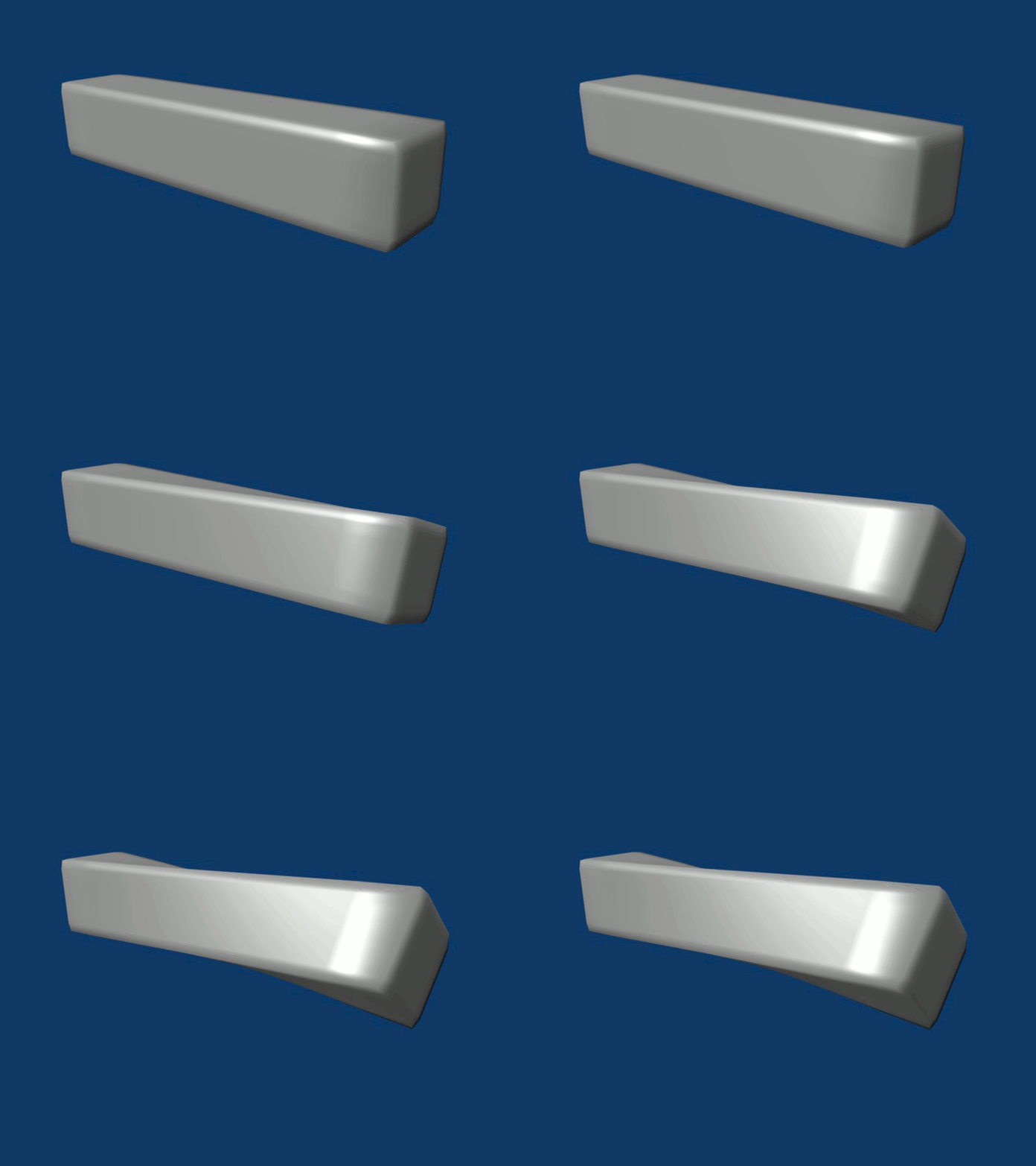
In the field of solid mechanics, torsion is the twisting of an object due to an applied torque. Torsion could be defined as strain or angular deformation, and is measured by the angle a chosen section is rotated from its equilibrium position. The resulting stress (torsional shear stress) is expressed in either the pascal (Pa), an SI unit for newtons per square metre, or in pounds per square inch (psi) while torque is expressed in newton metres (N·m) or foot-pound force (ft·lbf). In sections perpendicular to the torque axis, the resultant shear stress in this section is perpendicular to the radius.
In non-circular cross-sections, twisting is accompanied by a distortion called warping, in which transverse sections do not remain plane. For shafts of uniform cross-section unrestrained against warping, the torsion-related physical properties are expressed as:
where:
The shear stress at a point within a circular shaft is:
Note that the highest shear stress occurs on the surface of the shaft, where the radius is maximum. High stresses at the surface may be compounded by stress concentrations such as rough spots. Thus, shafts for use in high torsion are polished to a fine surface finish to reduce the maximum stress in the shaft and increase their service life.
The angle of twist can be found by using:
Calculation of the steam turbine shaft radius for a turboset:
Assumptions:
Hub AI
Torsion (mechanics) AI simulator
(@Torsion (mechanics)_simulator)
Torsion (mechanics)
In the field of solid mechanics, torsion is the twisting of an object due to an applied torque. Torsion could be defined as strain or angular deformation, and is measured by the angle a chosen section is rotated from its equilibrium position. The resulting stress (torsional shear stress) is expressed in either the pascal (Pa), an SI unit for newtons per square metre, or in pounds per square inch (psi) while torque is expressed in newton metres (N·m) or foot-pound force (ft·lbf). In sections perpendicular to the torque axis, the resultant shear stress in this section is perpendicular to the radius.
In non-circular cross-sections, twisting is accompanied by a distortion called warping, in which transverse sections do not remain plane. For shafts of uniform cross-section unrestrained against warping, the torsion-related physical properties are expressed as:
where:
The shear stress at a point within a circular shaft is:
Note that the highest shear stress occurs on the surface of the shaft, where the radius is maximum. High stresses at the surface may be compounded by stress concentrations such as rough spots. Thus, shafts for use in high torsion are polished to a fine surface finish to reduce the maximum stress in the shaft and increase their service life.
The angle of twist can be found by using:
Calculation of the steam turbine shaft radius for a turboset:
Assumptions:
Recent media