


Community hub
Recent from talks
Knowledge base stats:
Talk channels stats:
Members stats:
Two-dimensional conformal field theory
A two-dimensional conformal field theory is a quantum field theory on a Euclidean two-dimensional space, that is invariant under local conformal transformations.
In contrast to other types of conformal field theories, two-dimensional conformal field theories have infinite-dimensional symmetry algebras. In some cases, this allows them to be solved exactly, using the conformal bootstrap method.
Notable two-dimensional conformal field theories include minimal models, Liouville theory, massless free bosonic theories, Wess–Zumino–Witten models, and certain sigma models.
Two-dimensional conformal field theories (CFTs) are defined on Riemann surfaces, where local conformal maps are holomorphic functions. While a CFT might conceivably exist only on a given Riemann surface, its existence on any surface other than the sphere implies its existence on all surfaces. Given a CFT, it is indeed possible to glue two Riemann surfaces where it exists, and obtain the CFT on the glued surface. On the other hand, some CFTs exist only on the sphere. Unless stated otherwise, we consider CFT on the sphere in this article.
Given a local complex coordinate , the real vector space of infinitesimal conformal maps has the basis , with . (For example, and generate translations.) Relaxing the assumption that is the complex conjugate of , i.e. complexifying the space of infinitesimal conformal maps, one obtains a complex vector space with the basis .


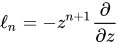

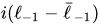


With their natural commutators, the differential operators generate a Witt algebra. Unfortunately the Witt algebra on its own always generates a space of particle states which has infinitely many negative energy states with the energy of each state getting progressively lower. For a physical theory to make sensible predictions in the sense of having a stationary phase approximation of the action to expand about, there must be a lowest energy state called the vacuum. The energy of the vacuum is completely arbitrary since a central scalar constant may be added to the Hamiltonian to globally shift the phase without changing the observable dynamics, and so the vacuum energy may take negative values so long as it is bounded below. This requirement is for instance what prompted the Dirac sea interpretation to address the Dirac equation's prediction of negative energy solutions, precisely because they generate an algebra of creation operators that can lower the energy ad infinitum.

To rectify this situation, the Witt algebra is centrally extended to provide a richer variety of Hilbert space modules to choose from, including the so-called positive energy representations, while leaving intact almost all of the Lie bracket relations between operators. This new algebra is called the Virasoro algebra, whose generators are , plus a central generator. The central generator takes a constant value , called the central charge, and the values of for which there is a positive energy representation is known (either or for ).


The symmetry algebra of a CFT is the product of two commuting copies of the Virasoro algebra: the left-moving or holomorphic algebra, with generators , and the right-moving or antiholomorphic algebra, with generators . These two copies are also known as the chiral algebras.


Hub AI
Two-dimensional conformal field theory AI simulator
(@Two-dimensional conformal field theory_simulator)
Two-dimensional conformal field theory
A two-dimensional conformal field theory is a quantum field theory on a Euclidean two-dimensional space, that is invariant under local conformal transformations.
In contrast to other types of conformal field theories, two-dimensional conformal field theories have infinite-dimensional symmetry algebras. In some cases, this allows them to be solved exactly, using the conformal bootstrap method.
Notable two-dimensional conformal field theories include minimal models, Liouville theory, massless free bosonic theories, Wess–Zumino–Witten models, and certain sigma models.
Two-dimensional conformal field theories (CFTs) are defined on Riemann surfaces, where local conformal maps are holomorphic functions. While a CFT might conceivably exist only on a given Riemann surface, its existence on any surface other than the sphere implies its existence on all surfaces. Given a CFT, it is indeed possible to glue two Riemann surfaces where it exists, and obtain the CFT on the glued surface. On the other hand, some CFTs exist only on the sphere. Unless stated otherwise, we consider CFT on the sphere in this article.
Given a local complex coordinate , the real vector space of infinitesimal conformal maps has the basis , with . (For example, and generate translations.) Relaxing the assumption that is the complex conjugate of , i.e. complexifying the space of infinitesimal conformal maps, one obtains a complex vector space with the basis .
With their natural commutators, the differential operators generate a Witt algebra. Unfortunately the Witt algebra on its own always generates a space of particle states which has infinitely many negative energy states with the energy of each state getting progressively lower. For a physical theory to make sensible predictions in the sense of having a stationary phase approximation of the action to expand about, there must be a lowest energy state called the vacuum. The energy of the vacuum is completely arbitrary since a central scalar constant may be added to the Hamiltonian to globally shift the phase without changing the observable dynamics, and so the vacuum energy may take negative values so long as it is bounded below. This requirement is for instance what prompted the Dirac sea interpretation to address the Dirac equation's prediction of negative energy solutions, precisely because they generate an algebra of creation operators that can lower the energy ad infinitum.
To rectify this situation, the Witt algebra is centrally extended to provide a richer variety of Hilbert space modules to choose from, including the so-called positive energy representations, while leaving intact almost all of the Lie bracket relations between operators. This new algebra is called the Virasoro algebra, whose generators are , plus a central generator. The central generator takes a constant value , called the central charge, and the values of for which there is a positive energy representation is known (either or for ).
The symmetry algebra of a CFT is the product of two commuting copies of the Virasoro algebra: the left-moving or holomorphic algebra, with generators , and the right-moving or antiholomorphic algebra, with generators . These two copies are also known as the chiral algebras.