
Recent from talks
Two Treatises of Government
Knowledge base stats:
Talk channels stats:
Members stats:
Two Treatises of Government
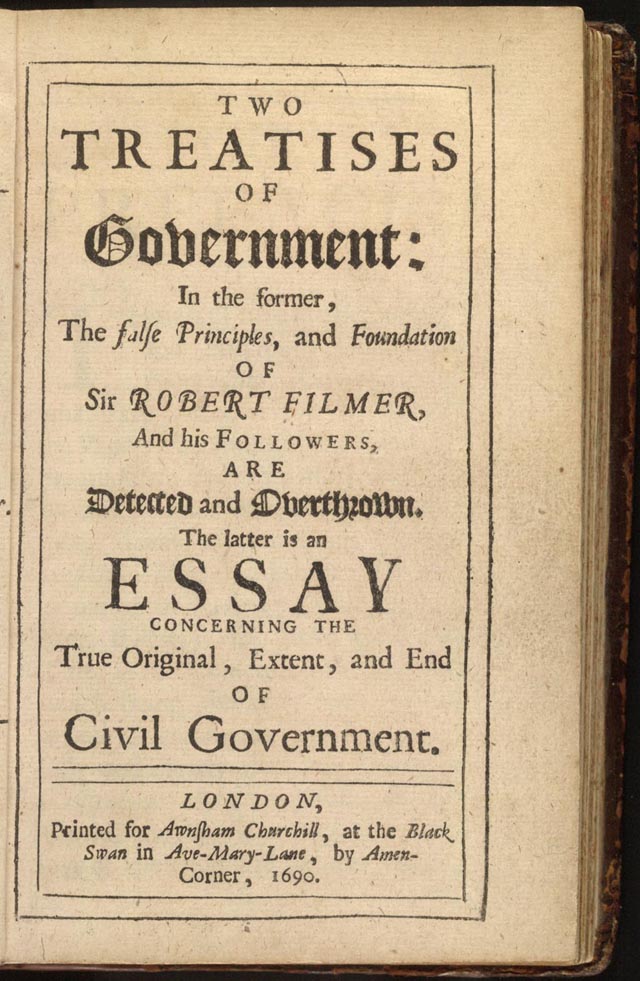
Two Treatises of Government (full title: Two Treatises of Government: In the Former, The False Principles, and Foundation of Sir Robert Filmer, and His Followers, Are Detected and Overthrown. The Latter Is an Essay Concerning The True Original, Extent, and End of Civil Government) is a work of political philosophy published anonymously in 1689 by John Locke. The First Treatise attacks patriarchalism in the form of sentence-by-sentence refutation of Robert Filmer's Patriarcha, while the Second Treatise outlines Locke's ideas for a more civilized society based on natural rights and contract theory. The book is a key foundational text in the theory of liberalism.
This publication contrasts with former political works by Locke himself. In Two Tracts on Government, written in 1660, Locke defends a very conservative position; however, Locke never published it. In 1669, Locke co-authored the Fundamental Constitutions of Carolina, which endorses aristocracy, slavery and serfdom. Some dispute the extent to which the Fundamental Constitutions of Carolina portray Locke's own philosophy as opposed to that of the Lord proprietors of the colony—it was a legal document written for and signed and sealed by the eight Lord proprietors to whom Charles II of England had granted the colony. In this context, Locke was a paid secretary.
King James II of England (VII of Scotland) was overthrown in 1688 by a union of Parliamentarians and the stadtholder of the Dutch Republic William III of Oranje-Nassau (William of Orange), who as a result ascended the English throne as William III of England. He ruled jointly with Mary II, as Protestants. Mary was the daughter of James II, and had a strong claim to the English Throne.
This is now known as the Glorious Revolution, also called the Revolution of 1688. Locke claims in the "Preface" to the Two Treatises that its purpose is to justify William III's ascension to the throne, though Peter Laslett suggests that the bulk of the writing was instead completed between 1679–1680 (and subsequently revised until Locke was driven into exile in 1683). According to Laslett, Locke was writing his Two Treatises during the Exclusion Crisis, which attempted to prevent James II from ever taking the throne in the first place. Anthony Ashley-Cooper, 1st Earl of Shaftesbury, Locke's mentor, patron and friend, introduced the bill, but it was ultimately unsuccessful. Richard Ashcraft, following in Laslett's suggestion that the Two Treatises were written before the Revolution, objected that Shaftesbury's party did not advocate revolution during the Exclusion Crisis. He suggests that they are instead better associated with the revolutionary conspiracies that swirled around what would come to be known as the Rye House Plot. Locke, Shaftesbury and many others were forced into exile; some, such as Sidney, were even executed for treason. Locke knew his work was dangerous—he never acknowledged his authorship within his lifetime.
Two Treatises was first published anonymously in December 1689 (following printing conventions of the time, its title page was marked 1690). Locke was dissatisfied with the numerous errors and complained to the publisher. For the rest of his life, he was intent on republishing the Two Treatises in a form that better reflected its intended meaning. Peter Laslett, one of the foremost Locke scholars, has suggested that Locke held the printers to a higher "standard of perfection" than the technology of the time would permit. Be that as it may, the first edition was indeed replete with errors. The second edition was even worse, in addition to being printed on cheap paper and sold to the poor. The third edition was much improved, but still deemed unsatisfactory by Locke. He manually corrected the third edition by hand and entrusted the publication of the fourth to his friends, as he died before it could be brought out.
Two Treatises is prefaced with Locke announcing what he aims to achieve, also mentioning that more than half of his original draft, occupying a space between the First and Second Treatises, has been irretrievably lost. Peter Laslett maintains that, while Locke may have added or altered some portions in 1689, he did not make any revisions to accommodate for the missing section; he argues, for example, that the end of the First Treatise breaks off in mid-sentence.
In 1691 Two Treatises was translated into French by David Mazzel, a French Huguenot living in the Netherlands. This translation left out Locke's "Preface," all of the First Treatise, and the first chapter of the Second Treatise (which summarised Locke's conclusions in the First Treatise). It was in this form that Locke's work was reprinted during the 18th century in France and in this form that Montesquieu, Voltaire and Rousseau were exposed to it. The only American edition from the 18th century was printed in 1773 in Boston; it, too, left out all of these sections. There were no other American editions until the 20th century.
Two Treatises is divided into the First Treatise and the Second Treatise. typically shortened to "Book I" and "Book II" respectively. Before publication, however, Locke gave it greater prominence by (hastily) inserting a separate title page: "An Essay Concerning the True Original, Extent and End of Civil Government". The First Treatise is focused on the refutation of Sir Robert Filmer, in particular his Patriarcha, which argued that civil society was founded on divinely sanctioned patriarchalism. Locke proceeds through Filmer's arguments, contesting his proofs from Scripture and ridiculing them as senseless, until concluding that no government can be justified by an appeal to the divine right of kings.
Hub AI
Two Treatises of Government AI simulator
(@Two Treatises of Government_simulator)
Two Treatises of Government
Two Treatises of Government (full title: Two Treatises of Government: In the Former, The False Principles, and Foundation of Sir Robert Filmer, and His Followers, Are Detected and Overthrown. The Latter Is an Essay Concerning The True Original, Extent, and End of Civil Government) is a work of political philosophy published anonymously in 1689 by John Locke. The First Treatise attacks patriarchalism in the form of sentence-by-sentence refutation of Robert Filmer's Patriarcha, while the Second Treatise outlines Locke's ideas for a more civilized society based on natural rights and contract theory. The book is a key foundational text in the theory of liberalism.
This publication contrasts with former political works by Locke himself. In Two Tracts on Government, written in 1660, Locke defends a very conservative position; however, Locke never published it. In 1669, Locke co-authored the Fundamental Constitutions of Carolina, which endorses aristocracy, slavery and serfdom. Some dispute the extent to which the Fundamental Constitutions of Carolina portray Locke's own philosophy as opposed to that of the Lord proprietors of the colony—it was a legal document written for and signed and sealed by the eight Lord proprietors to whom Charles II of England had granted the colony. In this context, Locke was a paid secretary.
King James II of England (VII of Scotland) was overthrown in 1688 by a union of Parliamentarians and the stadtholder of the Dutch Republic William III of Oranje-Nassau (William of Orange), who as a result ascended the English throne as William III of England. He ruled jointly with Mary II, as Protestants. Mary was the daughter of James II, and had a strong claim to the English Throne.
This is now known as the Glorious Revolution, also called the Revolution of 1688. Locke claims in the "Preface" to the Two Treatises that its purpose is to justify William III's ascension to the throne, though Peter Laslett suggests that the bulk of the writing was instead completed between 1679–1680 (and subsequently revised until Locke was driven into exile in 1683). According to Laslett, Locke was writing his Two Treatises during the Exclusion Crisis, which attempted to prevent James II from ever taking the throne in the first place. Anthony Ashley-Cooper, 1st Earl of Shaftesbury, Locke's mentor, patron and friend, introduced the bill, but it was ultimately unsuccessful. Richard Ashcraft, following in Laslett's suggestion that the Two Treatises were written before the Revolution, objected that Shaftesbury's party did not advocate revolution during the Exclusion Crisis. He suggests that they are instead better associated with the revolutionary conspiracies that swirled around what would come to be known as the Rye House Plot. Locke, Shaftesbury and many others were forced into exile; some, such as Sidney, were even executed for treason. Locke knew his work was dangerous—he never acknowledged his authorship within his lifetime.
Two Treatises was first published anonymously in December 1689 (following printing conventions of the time, its title page was marked 1690). Locke was dissatisfied with the numerous errors and complained to the publisher. For the rest of his life, he was intent on republishing the Two Treatises in a form that better reflected its intended meaning. Peter Laslett, one of the foremost Locke scholars, has suggested that Locke held the printers to a higher "standard of perfection" than the technology of the time would permit. Be that as it may, the first edition was indeed replete with errors. The second edition was even worse, in addition to being printed on cheap paper and sold to the poor. The third edition was much improved, but still deemed unsatisfactory by Locke. He manually corrected the third edition by hand and entrusted the publication of the fourth to his friends, as he died before it could be brought out.
Two Treatises is prefaced with Locke announcing what he aims to achieve, also mentioning that more than half of his original draft, occupying a space between the First and Second Treatises, has been irretrievably lost. Peter Laslett maintains that, while Locke may have added or altered some portions in 1689, he did not make any revisions to accommodate for the missing section; he argues, for example, that the end of the First Treatise breaks off in mid-sentence.
In 1691 Two Treatises was translated into French by David Mazzel, a French Huguenot living in the Netherlands. This translation left out Locke's "Preface," all of the First Treatise, and the first chapter of the Second Treatise (which summarised Locke's conclusions in the First Treatise). It was in this form that Locke's work was reprinted during the 18th century in France and in this form that Montesquieu, Voltaire and Rousseau were exposed to it. The only American edition from the 18th century was printed in 1773 in Boston; it, too, left out all of these sections. There were no other American editions until the 20th century.
Two Treatises is divided into the First Treatise and the Second Treatise. typically shortened to "Book I" and "Book II" respectively. Before publication, however, Locke gave it greater prominence by (hastily) inserting a separate title page: "An Essay Concerning the True Original, Extent and End of Civil Government". The First Treatise is focused on the refutation of Sir Robert Filmer, in particular his Patriarcha, which argued that civil society was founded on divinely sanctioned patriarchalism. Locke proceeds through Filmer's arguments, contesting his proofs from Scripture and ridiculing them as senseless, until concluding that no government can be justified by an appeal to the divine right of kings.
Recent media